

By: Mark Barnes // Last Updated:
The City of London is more than the sum of its financial parts. Visit temples shrouded in mystery, hidden churches, architectural masterpieces and the Sky Garden on our free self-guided walking tour of historic London.
The City of London, known as the square mile, is the historic heart of the capital. It’s where the city first came to life before its rapid expansion in the 17th century.
There is more history packed into this tiny area than in many other cities in the world. Within its boundaries are one of the greatest Norman Castles, Wren’s masterpiece St. Paul’s Cathedral, and the church of the Knights Templar.
But what makes it unique is the contrast between the settings.
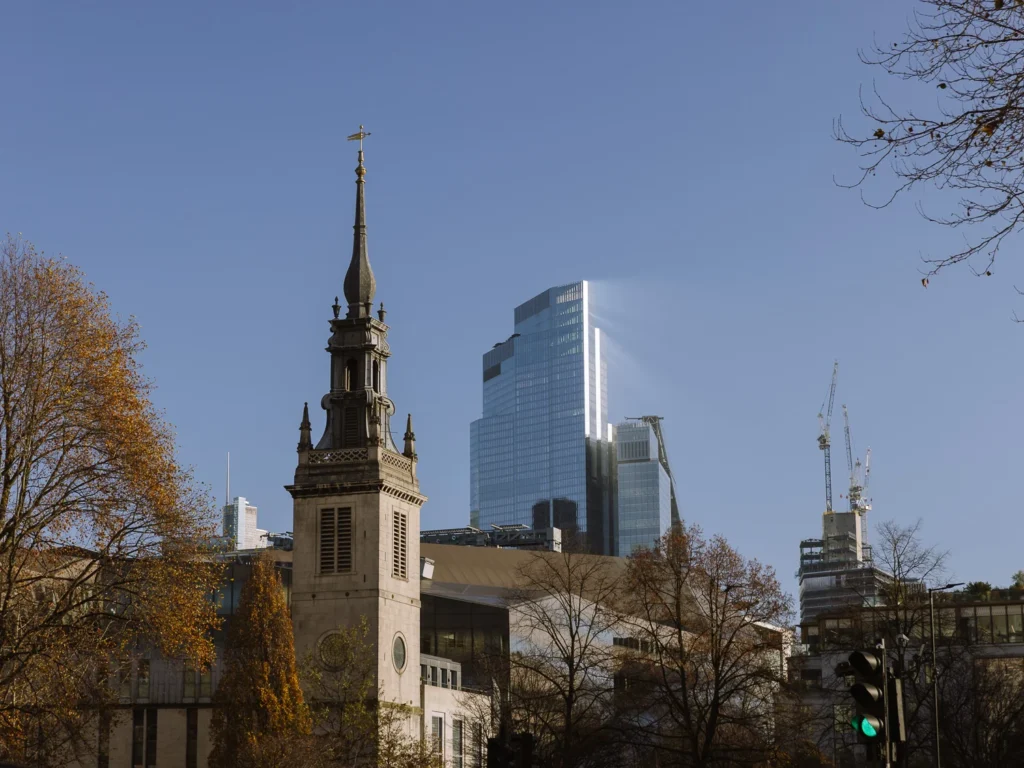
Ancient street patterns that haven’t changed since the medieval period wind between glass skyscrapers. A medieval city wall stands next to a trading exchange opened by Queen Victoria. A third-century Roman temple sits in the basement of a 21st-century corporate headquarters.
Paul and I have lived and worked in the city at various points in our lives. We have designed a walk to see the best of the city’s historic corners.
The walk is 4.5 miles and runs from Holborn to Tower Bridge, taking just over two hours. The post includes a map and tips for what to book ahead. The walk is free, but some sights require a fee to enter.
In our opinion, it’s one of the most fascinating walks in London and one of our favourites in our London self-guided walks series.


Brief History of the City of London
The City of London is not just a neighbourhood — it is a city in its own right, with its own Lord Mayor, its own police force, and its own local government entirely separate from the rest of London.
Its boundaries follow almost exactly the walls of the original Roman settlement of Londinium, founded around 47 CE, making it one of the oldest continuously occupied urban sites in Britain.
The Romans built their forum and temple to Mithras within these boundaries. The Saxons traded here. The Normans built their castle — the Tower of London — at its eastern edge.
Medieval London grew wealthy on wool and cloth, and the great institutions that funded Britain’s expansion — the Bank of England, the Royal Exchange, the insurance markets of Lloyd’s — were all born within the square mile.
In 1666, the Great Fire of London destroyed much of the city, requiring a lot to be rebuilt. We have plotted this route to cover the most significant buildings that were left behind and the best of those built afterwards.
City of London Walking Tour Overview
- Start: Holborn Tube Station
- End: Tower Bridge Tube Station
- Distance – 4.5 miles (7.25 kilometres).
- Walking Time – 2 hours, 15 minutes (full day with stops)
- Best For: Exploring the hidden history of London
This self-guided walk starts at Holborn tube station and finishes at Tower Bridge tube station. It takes you past the Royal Inns of Court, Temple Church and then along Fleet Street to St.Paul’s Cathedral.
It then delves into the financial heart of London, heads up to the Sky Garden for great views and finally, ends at the Tower of London.
The walk is 4.5 miles (7.25 kilometres) and, if you walk without stopping, it would take just over 2 hours. But there’s plenty to see along the way, so allow at least half or even a full day.
The walk is free to complete, but there are several sights you need to pay to enter that we think are worth considering:
- Temple Church
- Doctor Johnson’s House
- St. Paul’s Cathedral
- London Mithraeum
- Tower of London (Book in advance)
St. Paul’s and Tower of London are two of the iconic sights of London, but personally, we would not miss going into Temple Church.

Map: City of London Walking Tour
Below is a map of the walk. The main attractions are marked so you don’t miss any of the sights.
If you have the map open on your phone as you walk, you can track your progress.
Click on the top right corner to open our map in your Google Maps app. Click the star next to the title to save it to your Google account.
When to Do the Walk
The biggest decision to make when choosing when to do the walk is whether to do it on a weekend or a weekday. On weekdays, almost half a million commuters flood into the city, making it lively and bustling.
In contrast, at weekends it can be extremely quiet with many restaurants closed. Both have their attractions, depending on the experience you want.
Heading to the top of the Sky Garden for great views over London is free, but you need to book in advance, and slots can fill up a few weeks in advance.
If you plan to visit the Tower of London, we also suggest booking in advance.
Try to avoid Mondays, when the London Museum, Dr Johnson’s House and Sir John Soane’s Museum (also Tuesdays) are all closed.


Our Self-Guided London City Walking Tour
Lincoln’s Inn
Make your way to Holborn Tube Station and go through Gate Street to enter Lincoln Inn Fields (You can follow your route on the map above).
If you fancy a caffeine fix to fuel the walk, drop in at Redemption Coffee Roasters.
Lincoln’s Inn Fields was first laid out in the 1630s. Surrounded by attractive townhouses, it’s the largest public square in London.
At the eastern edge of the field is Lincoln’s Inn, one of only four Inns of Court in London that are entitled to call their members barristers. Set in beautiful historic grounds surrounding New Square, it is a hidden gem in London.
Dominating the scene is the Old Hall, built in 1492. Its Tudor architecture of red brick, original roof timbers, and stained-glass windows, is accentuated with soaring turrets and sculptures.
The chapel, (free to enter) tucked into the corner of the square was rebuilt in 1623. Don’t miss the vaulted ceiling beneath its foundations.
On its northern side is Sir John Soane’s Museum, the former home of neo-classical architect John Soane. Inside (free to enter, closed Monday and Tuesday), there’s a large collection of his paintings, sculptures, and drawings. The house is in the same condition as it was when he died in 1837.


Royal Courts of Justice
Exit New Square and turn left on Carey Street. The glorious white building at the end is the Grade II-listed Maughan Library. It was built in 1851 and its dodecagonal reading room (closed to the public) was inspired by the British Museum.
Turn right onto Bell Yard and then right again on the Strand to stand in front of the Royal Courts of Justice. Looking more like a towering cathedral than a law court, soaring arches complement stained-glass windows decorated with the coats of arms of Lord Chancellors.
In the middle of the road outside the court is a dragon on a plinth. These cast iron dragons mark the boundary of the City of London, which you are about to enter.


Temple Church
Head east back up the Strand, turning right down Middle Temple Lane. This tiny alleyway takes you into the heart of ‘Temple,’ the headquarters of the Knights Templar until they were dissolved in 1312. Today it’s home to Temple Inn, another of the four Inns of Court.
Make a short detour to Middle Temple Hall. Completed in the 1570’s its hammerbeam roof is the best in London but usually closed to the public.


Next up is Temple Church, one of the most significant historic buildings in London.
The oldest section of the church is The Round. Built by the Knights Templar and consecrated in 1185, it was designed to reflect the round church of the Holy Sepulchre in Jerusalem.
We recommend paying the £5 to go inside for the chance to stand among the 13th-century effigies of medieval knights. These carved stone figures in full armour, lying in a circle on the floor, are among the finest examples of medieval funerary sculpture in England.
Turn left up Old Mitre Court, then turn right onto Fleet Street.


Fleet Street
In the 16th and 17th centuries it was London’s centre of printing and publishing — William Caxton’s apprentice set up the first printing press here in 1500, and the street remained synonymous with the written word for nearly 500 years.
By the 20th century it had become the home of Britain’s national newspapers, with the Daily Telegraph, The Times, Daily Express, and Daily Mirror
Looking for cheaper premises to house new printing technology, the papers gradually left, draining the area’s energy and leaving only their buildings behind.
Make sure you check out the Art Deco facade of the old Daily Express at number 120.
Literary enthusiasts should take the short detour off Fleet Street to Doctor Johnson’s House (see map above).
This 300-year-old townhouse was home to Samuel Johnson, who compiled his great Dictionary of the English Language here between 1746 and 1755. The house is largely unchanged and contains a collection relating to his work (admission £10).
Just around the corner on Wine Office Court, Ye Olde Cheshire Cheese is one of the oldest and most atmospheric pubs in London.
Rebuilt in 1667 immediately after the Great Fire, it retains its original layout of low-ceilinged sawdust-floored rooms and was a favourite of Johnson, Dickens, Twain, and Conan Doyle.
If it’s not too early, it’s a great stop for a traditional English Pint and we have had a few too many here over the years.


St Paul’s Cathedral
At the end of Fleet Street, cross over Farringdon Road and onto Ludgate Hill. Continuing east, St Paul’s Cathedral rises in front you. One of the most recognisable buildings in London, it dates to a church founded here in 604 CE.
The present building was completed in 1710 by Sir Christopher Wren and has dominated the skyline ever since. It’s worth walking anti-clockwise around the entire church and peering up at the remarkable dome and sculpture-covered facades.
Inside (cheaper if you book in advance), admire the towering nave and glorious stained glass windows. The tombs in the crypt include Nelson, Duke of Wellington, Joseph Turner, and Sir Alexander Fleming.
You can also climb the 257 steps to the Whispering Gallery. This circular balcony underneath the dome has a remarkable acoustic phenomenon, enabling you to hear whispers made from the opposite side of the dome 34 metres away.
Head up more steps, and you come to the Stone Gallery and finally the Golden Gallery (528 steps in total). Perched 85 metres above the cathedral floor, it has excellent panoramic views of London.
The final section is particularly steep and enclosed — not recommended for anyone with mobility issues, a fear of heights, or claustrophobia. Children must be accompanied.


Paternoster Square
Paternoster Square is on the northern side of St Paul’s Cathedral. The entrance is marked by Temple Bar Gate, the only surviving gateway to the city of London dating to the late 17th century.
The gate was at the junction of Strand and Fleet Street before it was moved here in 2004.
The square has a host of cafes and bars, and makes a good spot for a break.
Pass under the gate, turn right through Paternoster Square, cross over the busy junction, and head up Cheapside towards the skyscrapers of the city.


St Mary-Le-Bow Church
The Great Fire of 1666 destroyed 87 of the City’s parish churches in four days.
Sir Christopher Wren was commissioned to rebuild 51 of them — an extraordinary architectural undertaking that he completed over the following decades alongside St Paul’s Cathedral.
Many of those churches still stand, scattered across the Square Mile, and the walk passes several of them.
The most significant on this route is St Mary-le-Bow (free to enter) on Cheapside, one of Wren’s finest and most historically important churches. According to tradition, a true Cockney is someone born within earshot of its bells.
In the crypt below, The Place Below café serves good coffee and lunch on weekdays — one of the best-kept secrets on the walk and an excellent mid-route stop.
After the church, turn right down Bow Lane, then left down Watling Street. Cross over Victoria Street and head down Bloomberg Arcade, where there is an excellent choice of restaurants (though many are closed at weekends). Turn left on Walbrook.


London Mithraeum
During the construction of Bucklersbury House in 1954, ruins were found beneath Walbrook Street. It turned out to be the remains of a third-century Roman temple dedicated to the god Mithras.
After a failed attempt to move the temple, Bloomberg bought the property and restored it. Today, the Temple of Mithras (or London Mithraeum) sits underneath Bloomberg’s European Headquarters.
London Mithraeum (free to enter) has a small museum before stairs descend to the temple. Entry is every 20 minutes and begins with an immersive light and sound show, after which you are free to walk around the temple walls.


St Stephen Walbrook
Almost directly opposite is St Stephen Walbrook (Free to enter 10 am to 3:30 pm, but sadly closed Saturday and Sunday).
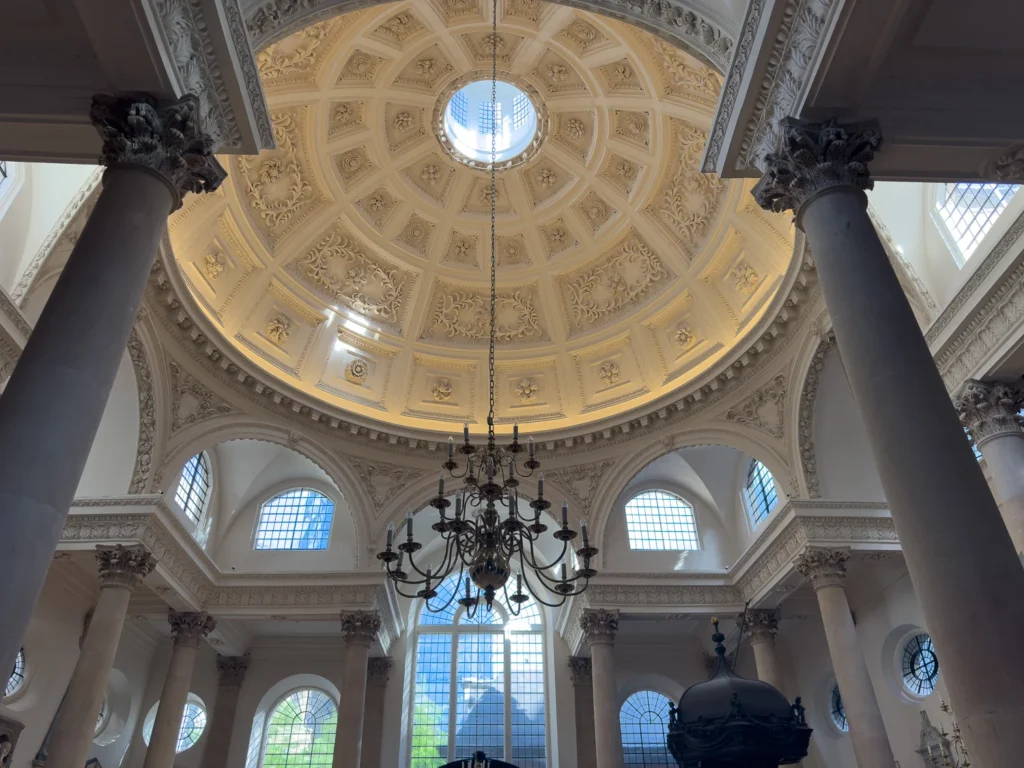
Wren considered it his finest church, and many architectural historians agree — the interior is a masterpiece of light and proportion, with a central 63-foot dome centred over 12 Corinthian columns that served as a direct prototype for St Paul’s.
A telephone in a glass box inside marks another piece of history: it was here that rector Dr Chad Varah founded the Samaritans in 1953, beginning with a single phone line for people in emotional need.
Dr Chad’s story is fascinating, and the guy on the door will be only too willing to tell it to you.
My friend Sven, with whom I’ve done this walk a couple of times, proudly proclaims this his favourite church in London.
Bank of England
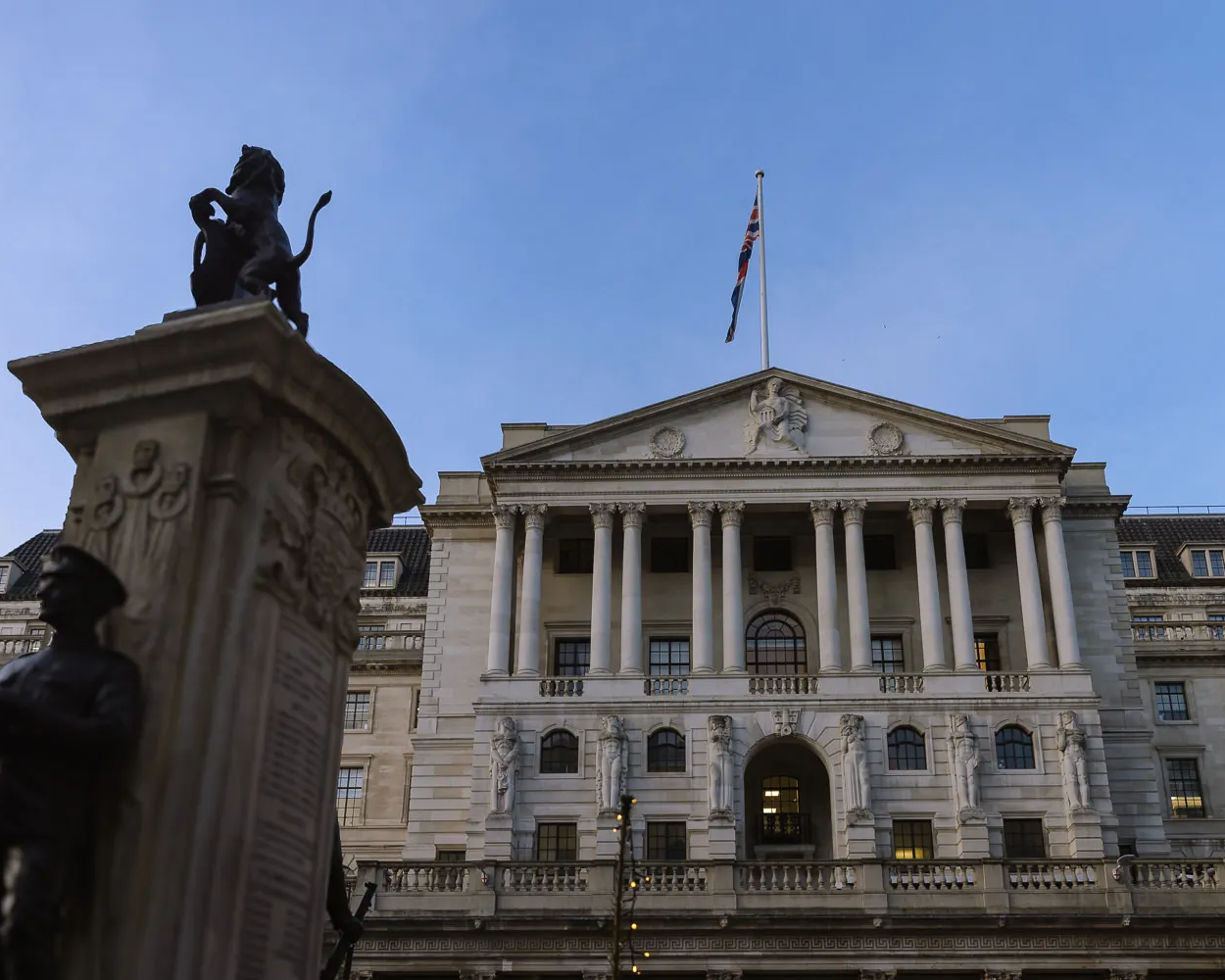
Exit London Mithraeum, turn left up Walbrook, and then right onto Queen Victoria Street. In front of you stands The Bank of England and Royal Exchange.
The Bank of England is the central bank of the United Kingdom and the model upon which most other central banks are built. Established in 1694, it’s the eighth oldest bank in the world and a cornerstone of Britain’s success in the 18th and 19th centuries. Today, it’s responsible for one of the largest gold vaults anywhere in the world, around 400,000 bars.
Tucked around the corner of its imposing façade is the small Bank of England Museum (free to enter) detailing the history of the bank and displaying old banknotes. You can even get your hands on one of the two gold bars the Bank of England owns.


Royal Exchange
The Royal Exchange is even more imposing than the Bank of England. Opened in 1571 it was to be the centre of commerce in the City of London. Only the exchange of goods was allowed here, so the unruly behaviour of stockbrokers was banished to nearby coffee houses.
The Royal Exchange has been destroyed twice by fire. The version you see today was opened by Queen Victoria in 1844.
Its portico of eight Corinthian columns is topped by a pediment covered in 17 figures representing merchants and traders. Enter through the columns, and you’ll find a grand covered courtyard lined with arcades and luxury boutiques.
There are few more refined places to sit and have a coffee or cocktail than at the Fortnum and Mason Bar. Take a seat and pretend you blend in.
Exit out the back, turn right, and then left onto Cornhill. At the A10 main road turn right and almost immediately on your left is Leadenhall Market.


Leadenhall Market
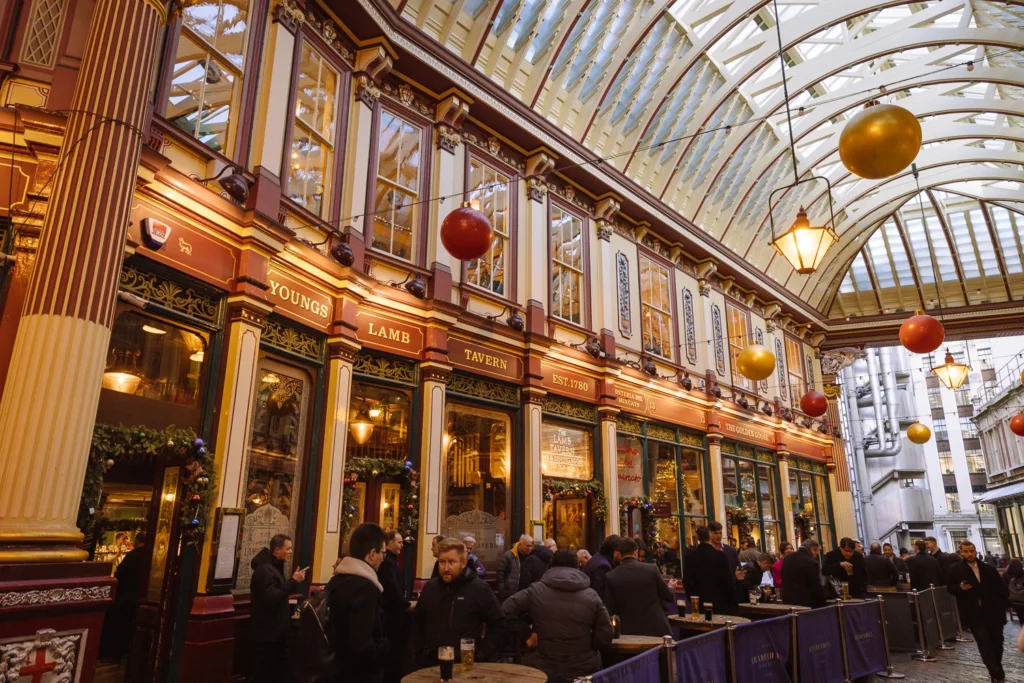
Dating back to the 14th century, Leadenhall Market is one of London’s oldest markets. Originally a meat, game, and poultry market, the ornate Victorian roof was added in 1881.
A dramatic restoration in 1991 made this Grade II listed building one of the most attractive in London. Its beautifully lit arches appeared in Harry Potter and the Philosopher’s Stone.
Head through the market, then pass the back of the tubular Lloyds Building. Turn right on Lime Street and cross over Fenchurch Street onto Philpot Street to reach the Sky Garden.


Sky Garden
Sky Garden is on top of 20 Fenchurch Street, better known as the Walkie-Talkie. It’s the highest public garden in London with magical panoramic views across the city.
It’s one of the best free things to do in London, but you need to book a free timed entry slot in advance.
Slots are released three weeks ahead, and the most popular times — weekend mornings and weekday lunchtimes — go quickly. If you can’t get a slot, walk-up spaces are sometimes available at quieter times, but these are not guaranteed.
Next, wind your way down to Monument following the route on the map above.


Monument
The Great Fire of London started on 2 September 1666 in Thomas Farriner’s bakery in Pudding Lane. It swept through the City of London for 4 days destroying most of the buildings.
It burned for four days, destroying 13,200 houses, 87 churches, and most of the medieval city within the walls. Remarkably, the official death toll was just six, though historians suspect the true number was considerably higher.
The fire is commemorated by the large, fluted Doric column simply called Monument designed by Wren and completed in 1677.
At 62 metres high, it is the tallest isolated stone column in the world, and it was placed precisely 62 metres from the bakery where the fire started.
You can climb the 311 steps to the viewing platform at the top (£6), but (in our opinion) the views from the Sky Garden are considerably better.
Before leaving, find the small blue plaque on Pudding Lane marking the site of Farriner’s bakery — one of the most consequential addresses in London’s history.
Take an optional detour onto London Bridge for views along the Thames and up to Tower Bridge, before heading to St Dunstan in the East


St Dunstan in the East
St Dunstan in the East is one of the best hidden gems in London and one of the most atmospheric stops on the entire walk.
The church dates back to the 12th century but was largely destroyed in the Great Fire of 1666. Wren rebuilt it, but the Blitz of 1940 gutted the interior once again, leaving only the tower, the steeple, and the outer walls standing.
Rather than rebuild it a second time, the City of London Corporation made the inspired decision to leave the ruins as they were and open them as a public garden in 1967.
Nature has done the rest. Climbing plants have threaded themselves through the empty window arches and up the old stone walls, and the interior — open to the sky. It is free to enter and has become one of the most beautiful spaces in the city.
Now follow the map, crossing over Lower Thames Street and loop anti-clockwise around the Tower of London.


Tower of London
The Tower of London was founded in 1066, but the white tower that gives the castle its name was built by William the Conqueror in 1078.
Stunningly situated by the river Thames it was expanded in the 12th and 13th centuries, and its general layout has remained ever since.
The walk approaches the Tower of London from the north — the city side — which gives you a strong sense of its original purpose: to intimidate the citizens of London and to defend the city from invaders.
The best views are from the other side, and it’s free to walk around the outer walls. But to see the Crown Jewels, explore the White Tower, and Medieval Palace, you’ll have to head inside – book a time slot in advance – as queues can be long.

Tower Bridge
London’s most ornate bridge was built between 1886 and 1894. The two bridge towers are connected at the upper level by two horizontal walkways and at the lower level by a pair of bascules that open to allow boats to pass underneath.
It’s free to walk across the pedestrian footpath on the lower levels. You’ll need to buy a ticket to head up the towers, visit the Victorian bascule engine rooms, and look through the glass floors of the upper-level walkways.
This City of London Walking Tour finishes at Tower Hill tube station, which is on the Circle, District, and DLR lines.
Extending the Walk
We have curated lots of walks like this. To explore the others, read our best Walks in London.
There are two others that begin or end at the Tower of London, so if you have finished early and want to extend the walk, then consider continuing on the South Bank Walk or the Greenwich to Tower of London Walk.
If you fancy a day hike in the countryside surrounding London, pick one of our Country Walks near London.

More London Self-Guided Walking Guides
- Our favourite 15 walks in London with maps.
- See the best Shoreditch Street Art on our self-guided walking route.
- Enjoy the picturesque stroll along the Regent’s Canal Walk.
- Explore one of London’s best green spaces on our Hampstead Heath Walk.
- Take the iconic walk through Regent’s Park and Camden Town.
- See the grandeur of London on our Royal Parks & Palaces Walk.
- See the best Instagram spots on our Notting Hill Walk.
- Explore the heart of historic London on our City of London Walking Tour.
- Take a historic stroll along the Queen’s Walk in London.
- Our Southbank London Walk covers several iconic landmarks.
- See the best of the lights on our Christmas Lights Walking Route.
- Explore old and new London in our Greenwich to Tower of London Walk.

reader-supported
When you buy through links on our site, we may earn a small affiliate commission at no extra cost to you.
Thanks for your support // Paul & Mark