

This 3-mile walk explores the iconic London neighbourhood of Notting Hill. It visits colourful houses, Portobello market, and landmarks from the film with a map and instructions to help you navigate this vibrant community.
By: Mark Barnes | Last Updated:
Notting Hill is one of those rare places that lives up to its reputation.
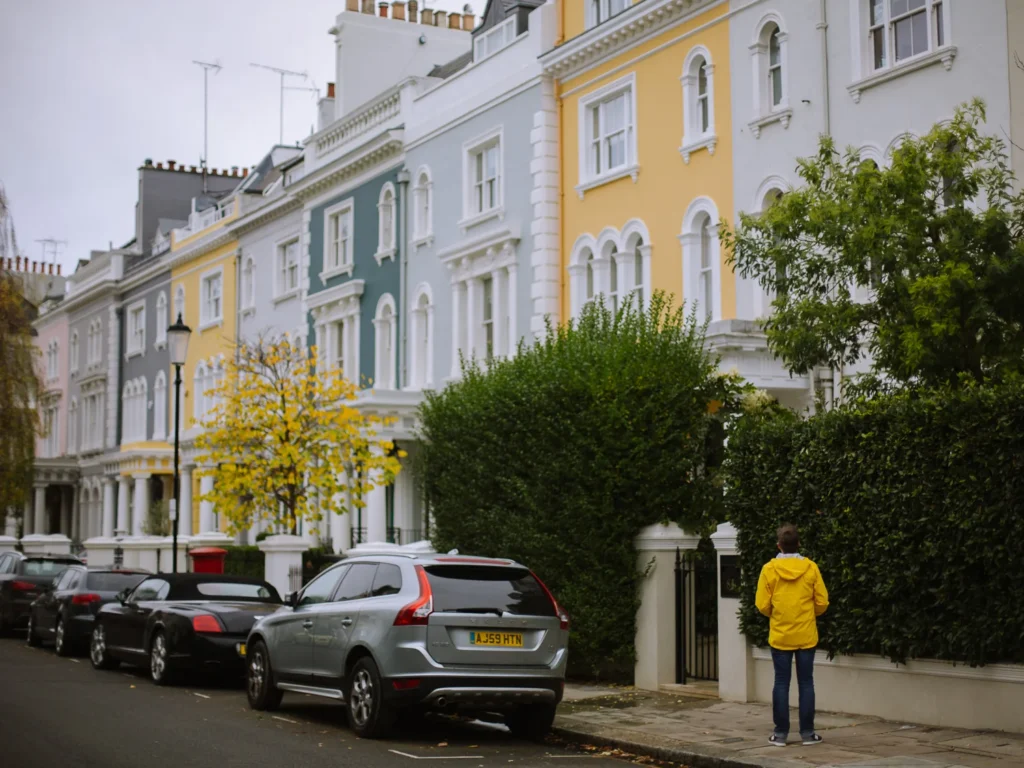
The colourful painted terraces, the sprawling antiques market and the Notting Hill film locations all deliver exactly what the postcards promise.
Yet underlying the sights, this is a genuinely multicultural neighbourhood. Portuguese delis and Moroccan food stalls sit alongside Jamaican reggae stores and Spanish Tapas restaurants.
It’s also a great place for a half-day out. The brunch options are excellent, and Golborne Road’s bric-a-brac market and delis are a hidden gem that few visit.
Paul and I have lived in Notting Hill for over 20 years, and we still find new things to love about it.
We’ve designed this 3-mile self-guided walk to cover the best of the area. Walk it briskly, and you’ll be done in under two hours, but it’s worth slowing down, grabbing brunch and spending half a day.


Notting Hill Walking Tour Overview
- Start: Notting Hill Tube Station
- End: Ladbroke Grove Tube Station
- Distance: 3 miles (4.7 kilometres)
- Walking Time: 2 to 3 hours
- Best for: Colourful houses and famous film locations
This Notting Hill Walking Tour begins at Notting Hill Tube Station (Central, District and Circle Lines) and ends at Ladbroke Grove Tube Station (Hammersmith & City and Circle Lines.
It is not easy to park around Notting Hill, so it’s best to come by public transport or get a taxi.
We have planned the route to visit the most colourful houses in the area, the most famous film locations, the best market stalls, and many great places to have brunch or lunch.
It is 3 miles long, all along paved paths or roads and takes about 2 hours, but you could easily spend half a day wandering around the area.
Map: Notting Hill Walking Tour
Below is a map of the walk. The main attractions are marked so you don’t miss any of the sights. If you have the map open on your phone as you walk around, you can follow your progress.
We have also included our favourite spots for brunch, lunch and coffee, in case you fancy a break.
Click on the top right corner to open our map in your Google Maps app. Click the star next to the title to save it to your Google account.
When to Do the Walk
Portobello Market opens from 8.30 am to 6 pm, except in winter, when it opens from 9.30 am to 5 pm. Thursday is a half-day, operating from 9 am to 1 pm.
Different parts of the market are open on different days.
- Vintage & Bric-a-brac Market: Friday, Saturday & Sunday
- Fashion Market: Monday, Tuesday, Wednesday, Friday, Saturday
- Fruit & Veg Market: Monday, Tuesday, Wednesday, Friday, Saturday
- Antiques market: Friday, Saturday
The best time to visit is on Friday and Saturday, when all stall types are open. Try to arrive about 9 am to avoid the worse of the crowds and see the stall holders setting up for the day.
If you are less interested in the market and more keen to see the colourful houses and film locations, then come on Sunday to Thursday, when the area is much quieter.
For keen photographers, overcast days are better for photographing the colourful houses, and early morning usually has the best light.
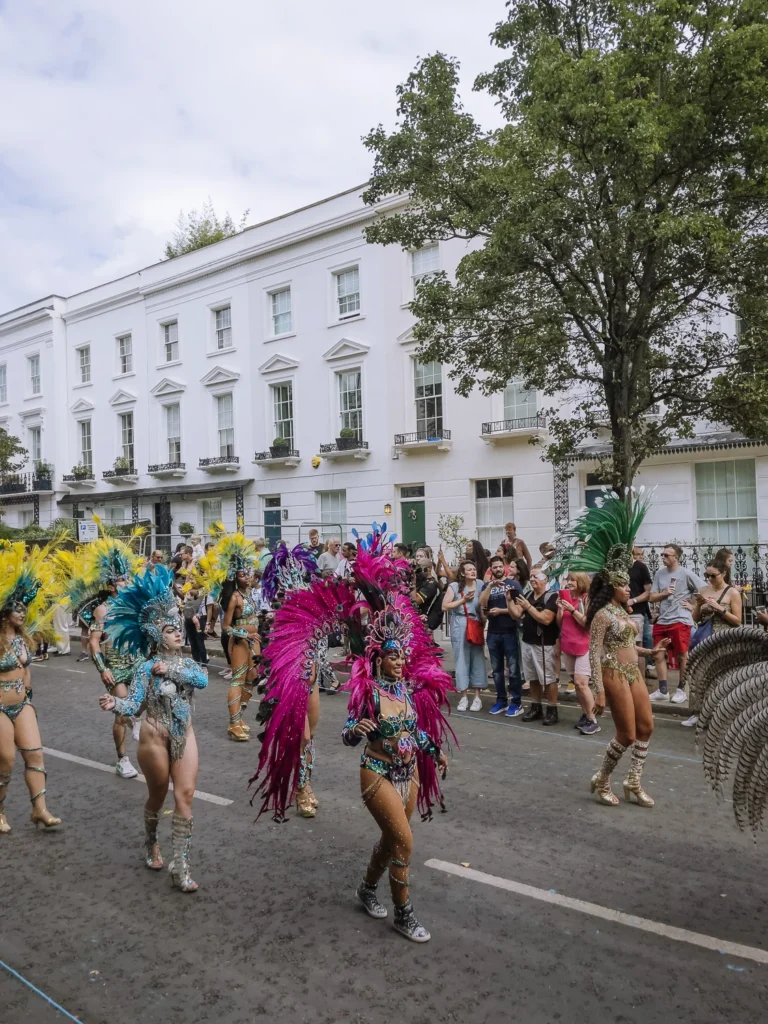
Finally, on the bank holiday weekend in August, the entire area is taken over by the Notting Hill Carnival. It is Europe’s biggest street party and either enormous amounts of fun or utter chaos, depending on your preference.
If you intend to visit that weekend, don’t expect to be able to do any sightseeing, just savour the energetic, but incredibly crowded atmosphere.

Key Sights Along the Route
As well as Portobello Market, Notting Hill is known for its colourful houses and film locations. We have designed the walking route below to pass the best of them, but here’s a bit of background.
Colourful Houses
During the Second World War, many of the houses in Notting Hill were divided into flats, and the once reputable neighbourhood fell into disrepair.
In the late 1950s and 60s, artists, writers and counter-culture types began moving in because the rents were low.
They started painting their houses in bold colours, partly as a form of self-expression and partly to reclaim and brighten a neglected neighbourhood.
It was a very Notting Hill thing to do: anti-establishment, individualistic, and a bit bohemian.
Today, the best streets for seeing these colourful houses are Elgin Crescent, Lancaster Road, St’ Luke’s Mews and the Hillgate Area. We have planned the route to visit each of them.
Please note: The colourful houses of Notting Hill are private homes, not a film set. Residents have increasingly found the volume of visitors disruptive — some on Lancaster Road have even painted their houses black in response. Please be considerate.


Notting Hill Film Locations
Released in 1999, Notting Hill, starring Julia Roberts (Anna Scott) and Hugh Grant (William Thacker), became one of the highest-grossing British romantic comedies ever made.
Writer Richard Curtis lived in the area when he wrote the script, and the neighbourhood’s colourful streets and independent shops gave the film much of its distinctive charm.
More than 25 years later, fans still make the pilgrimage to find the film locations. We have planned the route to pass all the main sights:
- The front door of William Thacker’s flat
- The actual building used for filming the exterior of William’s travel bookshop
- A book shop recreated to look like the one in the film
- The private communal garden where William and Anna take their moonlit walk
- The cinema where William and Spike watch a film together.


Notting Hill Walking Tour Route
Hillgate Area
Start by making your way to Notting Hill Gate Tube Station (Central, Circle and District Lines). Exit the station and follow the map above head west along Bayswater Road.
After a couple of hundred meters, look up, and you’ll see the Coronet Theatre. This arts venue used to be a cinema and was the film location where William and Spike (wearing a snorkelling mask) went to the cinema in the film Notting Hill.
Just in front of the theatre, turn left on Hillgate Street.
Hillgate is a charming little neighbourhood of narrow streets and pastel-coloured houses. Missed by many visitors, it’s well worth making a loop of the quiet roads (see map above). Every house is a different colour, and it’s a good spot for photography without crowds.
In recent years, it has also become an excellent destination for food and coffee and it’s a great spot for brunch or a caffeine fix before you start the walk.
Kuro has three locations: a bakery, a bagel cafe and a coffee shop. Eggbreak does all-day brunch in a pretty Notting Hill House, and Akub does modern Palestinian cuisine using locally sourced ingredients.
Living locally, we regularly head here for breakfast. You can find all our favourite spot in our best brunch in Notting Hill
Head back towards the tube station, but just before reaching it, turn left up Pembridge Road. Follow the road to the yellow-painted Sun Inn, and turn left onto Portobello Road.


Portobello Road & Antiques Market
The walk now follows Portobello Road, home to Portobello Market, which stretches along it.
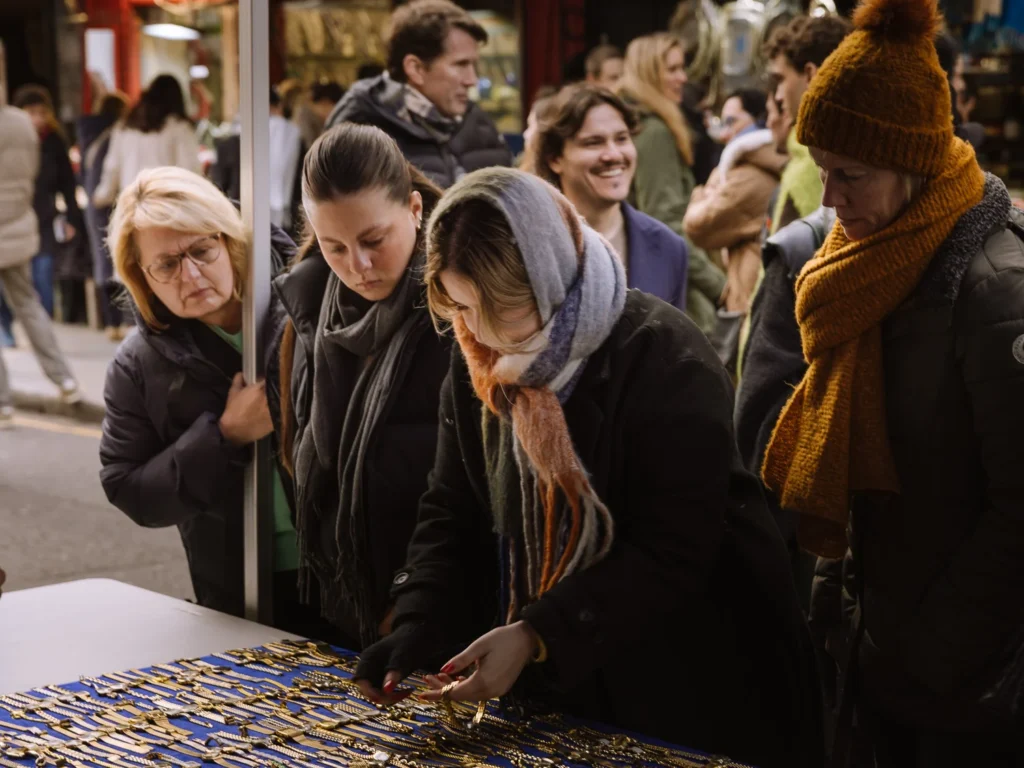
The market is split into different sections. The first section you reach is the Antique Market (Friday & Saturday). Here you’ll find silver plates and teapots, old matchbox cards, collectables, telescopes, binoculars and much more.
Wander through the arcades that line the street where you’ll find furniture, paintings, and sculptures in a series of mazes.
Lining the road are an eclectic mix of map shops and Scottish clothing stores. Don’t miss Alice’s – a nostalgic and colourful antiques store.
Just before reaching the junction with Elgin Crescent, keep an eye out for 142 Portobello Road. This is the location of the actual shop used to film the bookstore scenes in the film Notting Hill.
During filming, it was an antique shop; it’s now a souvenir store with a sign saying “The Travel Book Store” as opposed to “The Travel Book Co”, which is what appears in the film.
Turn left down Elgin Crescent.


Elgin Crescent & Lansdowne Road
We think Elgin Crescent is the most photogenic street in Notting Hill. A gentle curve of pastel coloured houses, it is less gaudy, less bold and less crowded than Lancaster Road.
Head down the street and turn left on Rosemead Road.
On your left is a small black gate. This is the entrance to Rosmead Gardens, where William (Hugh Grant) and Anna (Julia Roberts) climbed over the fence. The gardens are private, so you can’t enter, but you can sneak a peek through the fence.
Now turn left onto Lansdowne Road. One of the most expensive streets in London, its grand houses with beautiful facades cost an average of close to £5 million.
At the end of the street, turn left on Kensington Park Road, right on Elgin Crescent, then left to continue up Portobello Road.


Blenheim Crescent & Talbot Road
The market on Portobello Road morphs from antiques to fruit and veg, before reaching the junction of Blenheim Road and Talbot Road. It’s worth taking a short detour down each.
On your right, Talbot Street has Rough Trade West, the oldest and smallest of the Rough Trade stores, selling a collector’s array of vinyl. Next door, Buns from Home, often has a queue for their popular baked goods.
The recently opened Permit Room is part of the Dishoom franchise, and its Indian food is frankly excellent. They have a great brunch menu if you only want a light bite.
On your left, Blenheim Street has several great shops. The Spice Shop is worth entering for the smell alone. Books for Cooks has a huge selection for all types of chefs. Cable Co Coffee (renamed Notting Hill Bookshop Cafe) is on our list of the best cafes in Notting Hill.
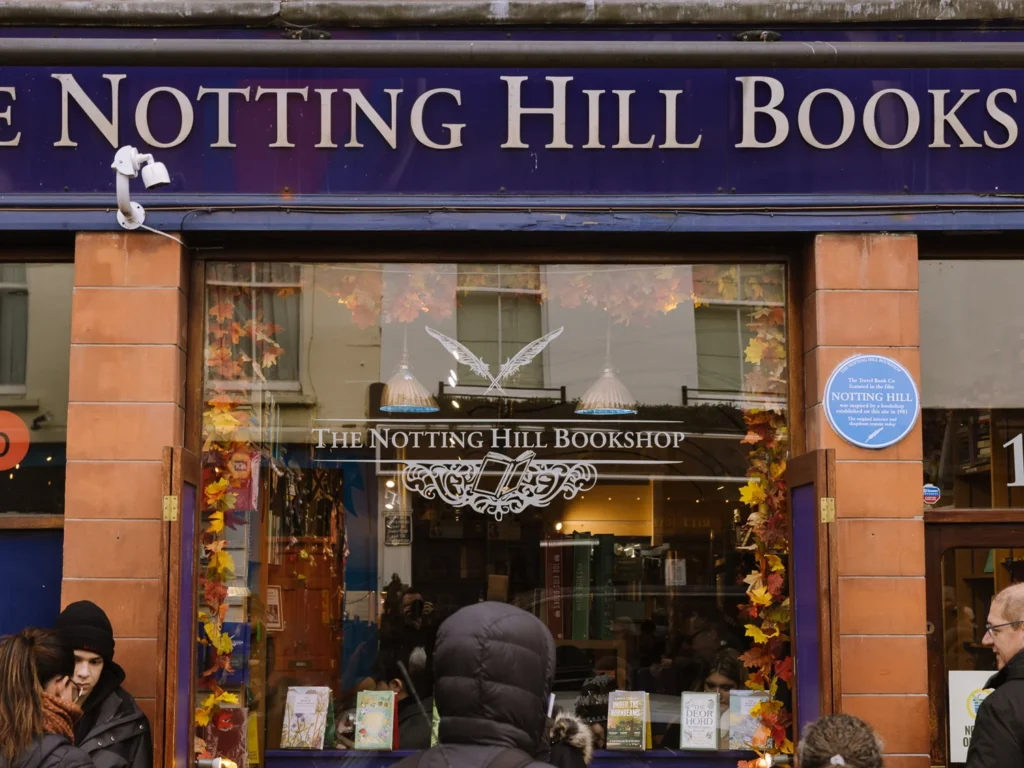
Most importantly, pop your head into the Notting Hill Bookshop. Located at 13 Blenheim Crescent, it was not used in the film, but has been designed as a recreation of William Thackeray’s bookshop from the movie.
After exploring both streets, continue north on Portobello Road.


St. Lukes Mews & Lancaster Road
Turn right down Westbourne Park Road, but before you do, look left. The blue door at 280 Westbourne Park Road is the front door to William Thacker’s (Hugh Grant’s) flat from the film Notting Hill.
Head down Westbourne Park Road (in the opposite direction to the blue door), take the first left onto Basing Street and then right onto St. Luke’s Mews. This cute cobbled mews street has a famous pink house that featured in Love Actually.
Turn left on All Saints Road and you’ll find two great music shops.
Portobello Music sells all sorts of electric and acoustic guitars. Next door, People’s Sound Records is a treasure trove of Jamaican colours, vinyl covers, and revival reggae music and a nod to Notting Hill’s Caribbean roots.
Next, turn left on Lancaster Road. The most visited and most photographed, primarily because of its proximity to the market, its houses are bold, loud colours rather than pastels. Don’t miss the house with the monkeys climbing up the facade.
Try to be considerate of residents; some have painted their houses black to try to discourage tourists.
When you get back to Portobello Road, turn right and continue heading north.


Portobello Fashion & Vintage Market
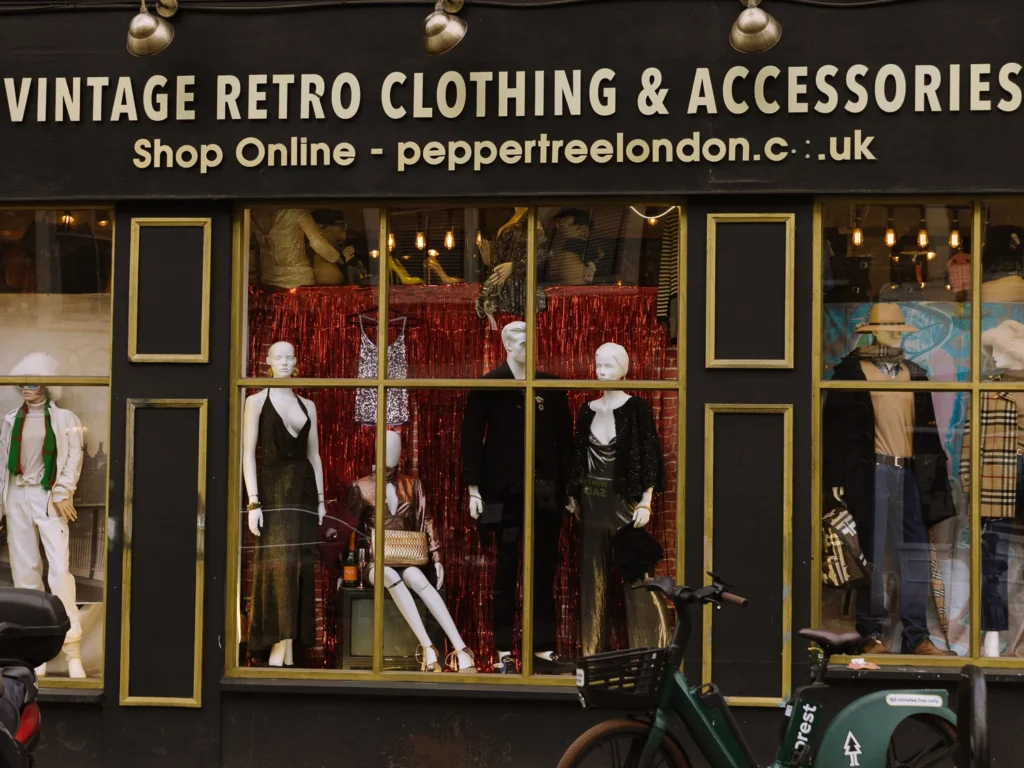
Portobello Market now changes again, from fruit and veg to fashion.
Pop into the Pepper Tree Vintage Clothes Store and the Fashion Market, selling everything from quirky hats to scarves, bags and designer items.
There’s also a Spanish community here with a couple of tapas bars and a Spanish supermarket.
Heading under the bridge, the market becomes more vintage. The stalls, atmospherically set under the arches of the Westway Flyover, sell vintage clothes, old second-hand books, handmade jewellery, and old vinyl records.

Acklam Road Food Market
Just across from the market is Acklam Road. From Friday to Sunday, stalls sell an eclectic mix of street food from around the world.
Don’t miss the Banksy mural “The Painter” on the wall of The Grand Hotel on the corner of Portobello Road and Acklam Road. It’s one of the oldest intact Banksy’s in London, but it can only be seen when the street food market is not running, as the stalls block it.
To see more Banksy’s in London, read our Shoreditch street art guide.


Golborne Road
Continue up Portobello Road and turn right onto Golborne Road.
Golborne Road is one of the best-kept secrets in Notting Hill. Only a short walk from the tourist bustle of Portobello Road, Golborne Road has retained a genuinely multicultural neighbourhood.
The street has been at the heart of London’s Portuguese community since the 1960s, and the evidence is everywhere — pastel de nata in the café windows, salt cod in the deli fridges, and the sound of Portuguese conversation spilling out of the grocery stores.
The Moroccan community is equally well represented, with fabric stores, spice sellers and food stalls that make the street feel closer to Marrakech than Kensington.
On Friday and Saturday mornings, the street comes alive with a small but excellent market. Stalls sell bric-a-brac, antique furniture, flowers and secondhand finds at prices considerably lower than the antiques arcades down the road.
The food stalls are the real draw — try the Moroccan fish if it’s on offer, and don’t leave without visiting the Golborne Deli. Nearby Flying Horse serves a good coffee, and Lowry & Baker is a very cute bohemian brunch spot.


Museum of Brands
When you’ve seen enough ot Golborne Road, tunr around and make your way (following the map above) to Ladbroke Grove, where this walking tour ends.
But before you rush off, we highly recommend visiting the Museum of Brands, just around the corner from Ladbroke Grove Station.
This nostalgic journey through 200 years of consumer culture is one of our favourite things to do in Notting Hill.
Packed with memorabilia from Victorian times through to the modern day, the museum is stuffed with cultural markers. Find vintage prints, household products, old magazines, toys and everything in between.
Displays are separated by subject and then by decade. We loved sifting through the 1980’s memorabilia from our childhood.
The building was once the world’s largest centre for people living with HIV. Princess Diana regularly visited patients in the memorial garden, which is now part of the cafe.
If you enjoyed this walk, be sure to check out our other favourite walks in London. For longer walks in the green spaces on the edge of the city, read our best country walks near London.


More Guides to Plan Your London Trip
- To get an idea of what you might like to do, read our guide to the best things to do in London.
- Our London Itinerary helps you plan 3 or 4 amazing days in the city.
- Find your perfect accommodation with our Where To Stay in London guide, which includes a review of the best areas.
- A great neighbourhood to explore is Notting Hill – this guide covers the highlights.
- For a completely different area, take our Shoreditch Street Art walk.
- Read our Hackney neighbourhood guide for all the best things to do in this East London area.
- Our guide to accommodation in Soho includes our hotel recommendations and things to do.
- Get out and about with our top walks in London – each with a detailed map.

reader-supported
When you buy through links on our site, we may earn a small affiliate commission at no extra cost to you.
Thanks for your support // Paul & Mark