

With remarkable wildlife, trendy food and quality wines, South Africa is a diverse destination with memorable experiences. Here are our favourite South Africa destinations.
By: Paul Healy | Last Updated:
South Africa does something to you.
We’ve been several times now, and we still struggle to describe it to people who haven’t been.
It’s one of those countries where the scale of what’s on offer — the wildlife, the landscapes, the history, the food and wine — keeps surprising you even when you think you know what to expect.
In the course of a single two-week trip, you can stand at the top of Table Mountain watching the Atlantic stretch to the horizon, sit in silence at the Apartheid Museum, spot lions in Kruger, and eat world-class food in Franschhoek.
This guide covers the places we think are unmissable, spread across the country’s most rewarding regions.


Map: Where to Go in South Africa
To make it easier to plan your South Africa itinerary, we’ve organised the must-see attractions into the five different provinces they belong to.
- Cape Town & Around – for the combination of African & European cultures.
- Western Cape – for the Garden Route, Winelands and the arty, semi-arid Karoo.
- KwaZulu-Natal – for remote South Africa, mountain hikes and excursions into Lesotho.
- Johannesburg – for the story of South Africa’s past.
- Mpumalanga – for some of the best safari experiences in South Africa.
Each of the amazing attractions that made it onto our list is included on the map below, colour-coded for each area.
Click on the top right corner to open our map in your Google Maps app. Click the star next to the title to save it to your Google account.
Places to Visit Around Cape Town
Squeezed between the mountains and the ocean, Cape Town is full of tantalising travel experiences that combine African and European cultures in a stunning natural setting. When visiting South Africa, this is a great place to start.
1. Cape Town
Set in a dramatic location between mountains and the ocean, and with an intoxicating cultural blend, Cape Town is an unmissable destination in South Africa.
There’s no better way to get a feel for the stunning setting than by taking a trip up the top of the Table Mountain National Park. The views are remarkable at 1,000 metres above the city centre, with the Atlantic Ocean in the background.
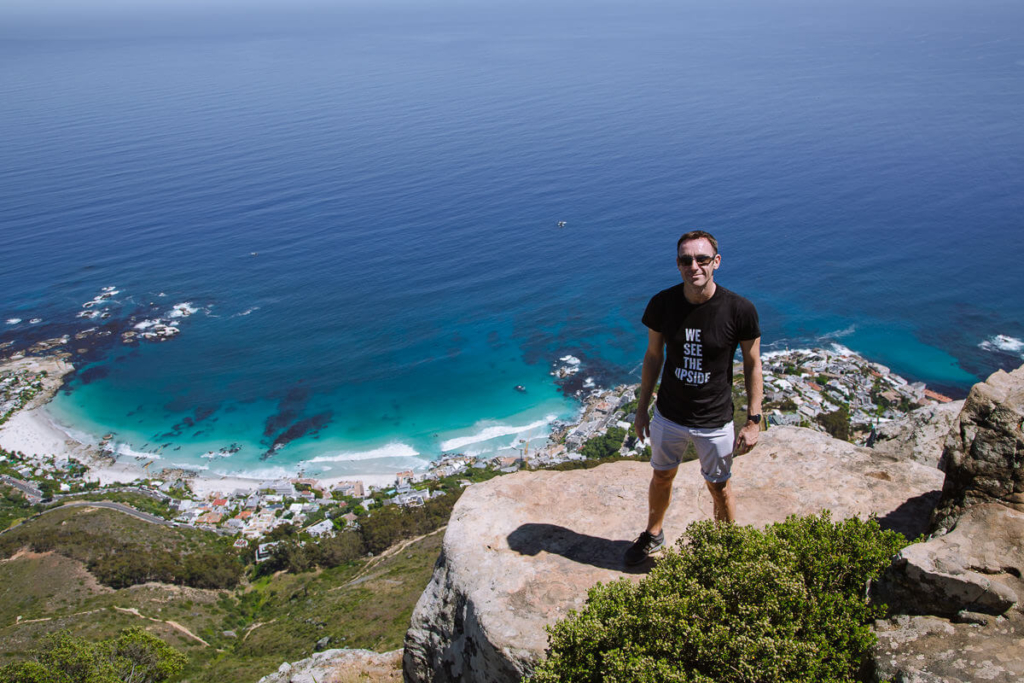
Even better views can be found up Lion’s Head. It’s a one-hour walk along a rocky path punctuated with yellow and white flowers, cutting a swathe through the granite covered in fynbos. But it’s worth every step.
The views back to Table Mountain, across to the Twelve Apostles and along the sweeping sandy arc of Camps Bay beach are the finest in the city.
Full Guide // Best things to do in Cape Town


2. Cape Town Beaches
We’re not often impressed with the beach scene in cities, but Cape Town is a notable exception.
The vast stretches of Bloubergstrand are excellent for kitesurfing, while the beaches of the affluent Clifton area are a cool spot to unwind behind the protection of large boulders.
The most celebrated stretch of beach, however, is the arc of white sand that is Camps Bay. The water is as cool as the trendy cocktails served from the parade of bars backing onto the beach.
It’s one of the best sunset locations in the city and one of the best tourist attractions in South Africa.
Itinerary // Our 5-day Cape Town itinerary


3. Cape Peninsula
The Cape Peninsula Nature Reserve holds a trifecta of winning beaches. Watch penguins play in shallow waters at Boulders Beach; explore a traditional harbour and fish market at Hout Bay, and enjoy the bohemian slice of life at Kalk Bay.
Driving towards the peninsula, make a pitstop at the Constantia Wine Route. Groot Constantia and Buitenverwachting are both great places to enjoy lunch with wine tasting.
But it’s the scenery that steals the show on a road trip along the stunning Cape Peninsula. One of the most impressive road trip routes anywhere in the world is Chapman’s Peak Drive – a windy road that clings to red rock boulders above the sea as it makes its way to Cape Point.
Here, a rugged walk to the lighthouse offers tantalising views across the Cape of Good Hope – an excellent addition to your South Africa itinerary.
Full Itinerary // 3-weeks in South Africa


4. The Townships
To see how most people live in Cape Town, a township tour is one of the most important South African experiences.
Most of the workers who built and now operate the trendy hangouts that have made the beautiful city such a drawcard reside in townships still living with the ongoing legacy of apartheid.
Join a township tour to learn how these communities are developing and talk to locals about how life has changed in just a few decades.
It’s a humbling experience to understand their fight for the basic freedoms we take for granted, and to hear their enthusiasm for a better future.
Read // Visiting a township in Cape Town

Places to Visit on the Western Cape
The Western Cape is one of the iconic South African must-see destinations. Find rugged coastal paths, desert towns and hilly Winelands from the dramatic coastline at Cape Peninsula up to the semi-arid interior via the Garden Route National Park.
5. Garden Route Coastline
The 200-kilometre stretch of coastline that makes up the Garden Route National Park is a road trip with a staggering array of scenery and activities.
Coastal cliffs dotted with hiking paths drop down to sweeping virgin beaches and crashing waves.
The 4-hour walk around the Robberg Peninsula is a spectacular way to spot seals, dolphins and a variety of wildlife in a beautiful coastal setting.
While driving the Garden Route, tackle a small section of the Otter trail – a five-day 42-kilometre hike that visits exotic seaside waterfalls and refreshing rock pools.
Alternatively, jump in a kayak and paddle up the Storms River for an exciting gorge adventure in the beautiful Tsitsikamma National Park.
Read Next // Putting together your South Africa Itinerary


6. Hermanus
Hermanus is a lovely small town perched on the cliffs overlooking the sea in the south of the country.
If you time your South Africa trip for whale-watching (June-November), Hermanus is considered one of the best places for spotting a number of different species.
Join a boat or kayak tour to increase your chances of spotting these mighty mammals and learn about the challenges they face in an environment under threat.
An afternoon walking along the 10-kilometre coastal path from New Harbour to Grotto Beach is ideal for spotting dolphins and seals playing close to the shore.
It’s also a great way to take in sunset after a lazy day on one of the many beautiful beaches in Hermanus.

7. The Karoo
The Great and Little Karoo National Park are semi-arid deserts, an hour or so drive inland from the crashing surf.
The drive transports you to a different world where the temperature soars and the lush forested regions of the Garden Route are replaced by patches of succulents in barren desert landscapes.
It’s a beautiful part of South Africa and a lovely way to experience a different side of the country.
Connecting the Great and Little Karoo is the Swartberg Pass, a dramatic red-rock canyon cut by a seemingly insignificant river that ends at Prince Albert.
Deep in a desert wilderness, Prince Albert is one of the best things to do in South Africa. It’s a surprising cultural oasis and a creative hub full of quirky art galleries and top-quality South African cooking.
Read Next // Best time to visit South Africa

8. Winelands & Route 62
South Africa has some of the finest value food and wine in the world. On-trend signature dishes, whipped up from local ingredients with a creative flair, adorn the menu of stylish eating establishments.
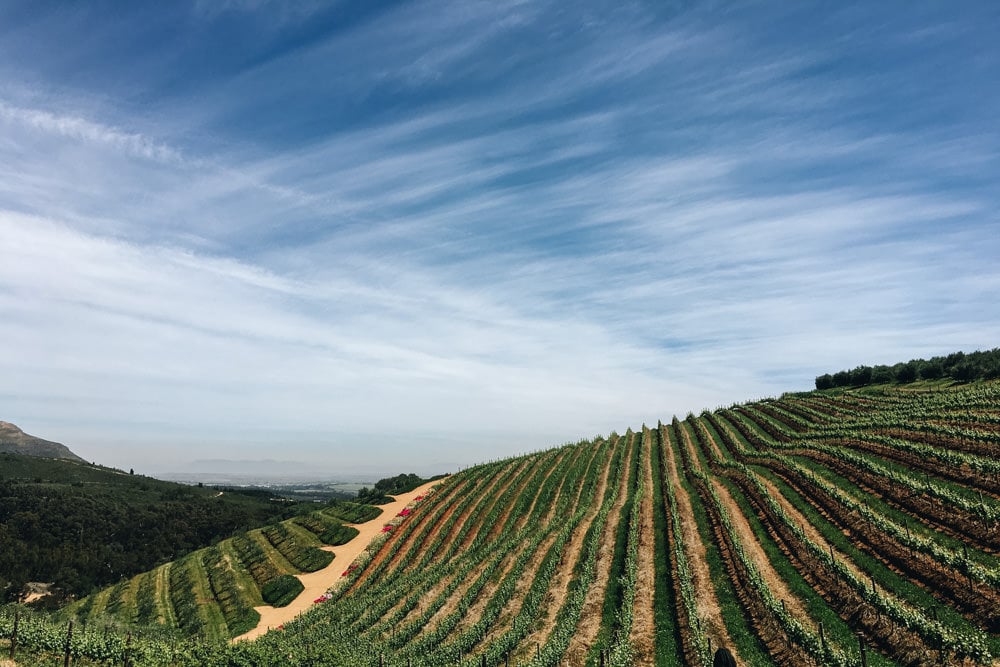
Paired with wines from one of the hundreds of little wineries in South Africa, the culinary quality of the region reaches its zenith around the Winelands, just an hour east of Cape Town.
Franschhoek is one of the smartest and most popular destinations for a wine tasting on a South African vacation.
But head east along the R62 and into the Robertson Valley to get further off the beaten track and discover some less-visited wineries.
The Excelsior Wine Estate has a relaxed lakeside setting, while Springfield Estate produces excellent wines using traditional methods.


Places to Visit in Kwazulu-Natal
KwaZulu-Natal stretches along the southeast coast of South Africa up to the Mozambique border.
As a genuinely African adventure in a remote setting, KwaZulu-Natal offers the best outdoor adventures, breathtakingly diverse scenery, and people fiercely proud of their Zulu culture. This is South Africa’s must-see at its most remote.
9. St Lucia Wetlands
Surrounded by the warm tropical waters of the Indian Ocean and the UNESCO World Heritage Site of iSimangaliso Wetland Park, St Lucia is a world-class wilderness area.
A sprawling wetland park separates grassy savannahs from sand dunes teeming with life in an area bursting with a multitude of ecosystems.
Boat rides up the estuary bring you to hippos wallowing in the mud, crocodiles looking for their next meal and a wide variety of birds going about their daily life.
But the highlight of a visit to St Lucia is a night safari along the beach to witness the massive Leatherback and Loggerhead turtles laying eggs in the moonlight.
Full Guide // What to do in St. Lucia, South Africa


10. Sani Pass & Lesotho
There are not many road trips like this in the world. The Sani Pass rises 1300 metres in less than 9 kilometres as it climbs from the plains of South Africa to the mountain kingdom of Lesotho.
The authorities won’t let you up without a 4×4, and for good reason. This narrow rocky road with loose boulders and tight hairpins is one of the most adventurous drives we have ever done.
It takes around 1 hour and 15 minutes of nerve-jangling ascent to drive the Sani Pass up to the Kingdom of Lesotho.
Here, Basotho (Lesotho’s citizens) roam the high mountain grasslands looking after their goats, sheep and horses.
Dressed like Jedi in sweeping robes and hoods – eyes obscured from the harsh Lesotho sun – they keep a keen eye on all visitors to their rugged realm.
Read More // Visiting Lesotho via the Sani Pass

11. Hluhluwe-Imfolozi Game Reserve
Hluhluwe-iMfolozi is one of the most underrated safari parks in South Africa, and we think it deserves far more attention than it gets because it offers truly great wildlife viewing year-round.
The Big Five are all here; in addition, driving around the beautiful scenery of this forested safari park will provide countless opportunities to spot rhino and buffalo.
Mountains carpeted in green forest conceal bull elephants looking for a mate; grasslands and open savannah form a patchwork providing cover for lions, and jungle vines form an artery for baboons to scurry home.
The accommodation at the one camp inside the park – Hilltop – is pretty good value for money for a safari park, and it’s something we highly recommend adding to your South Africa vacation.
More // Where to see African Safari animals


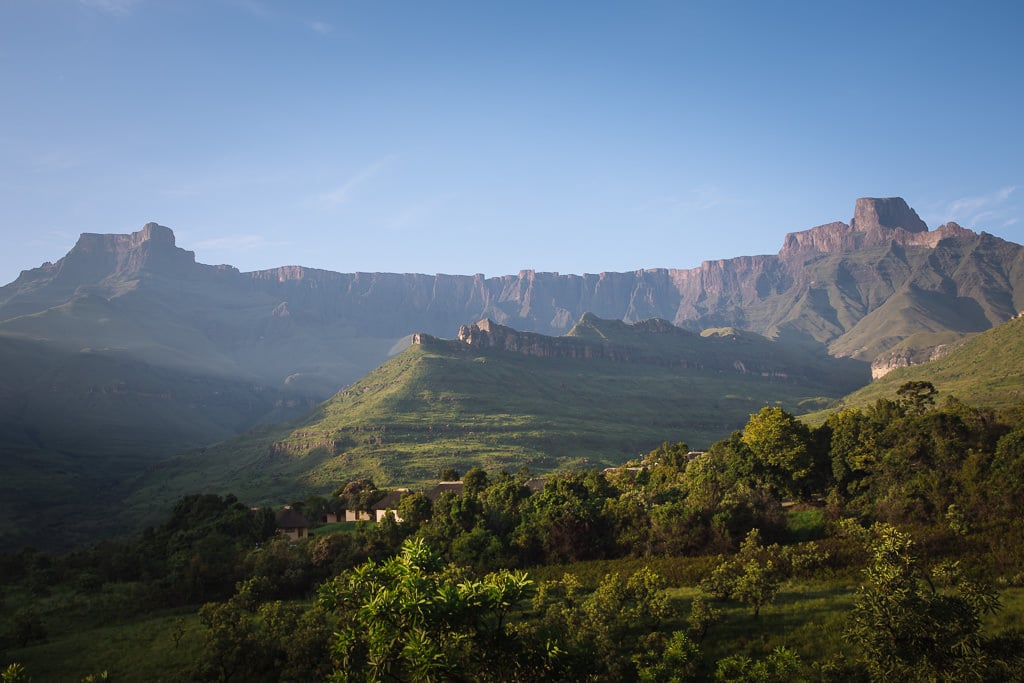
12. Drakensberg Amphitheatre
Nestled in the Royal Natal National Park, the Drakensberg Amphitheatre is 5 kilometres long with a vertical drop of just over 1,200 metres, giving it a cliff face more than 10 times the size of El Capitan in Yosemite.
Listed as a UNESCO World Heritage Site, this mighty cliff face contains the second-highest waterfall in the world, several excellent hiking trails and a wonderful opportunity to encounter the many cultures.
Drakensberg is a gem and one of the most beautiful places in the world.
Strap on your boots and discover one of the many excellent hikes in the Drakensberg. Push your way through thick, beautiful jungle, boulder hop up gorges and ascend over rickety chain ladders to be rewarded with truly awe-inspiring scenery.
Full Guide // Visiting the Drakensberg Mountains


Places to Visit in Johannesburg
The capital of South Africa is often overlooked in favour of other parts of the country with more obvious tourist appeal.
But Johannesburg is the best place to uncover the story of racial segregation and how the legacy of the past is still being felt today.
13. Apartheid Museum
Opened in 2001, the Apartheid Museum in Johannesburg houses a harrowing but moving story of apartheid in South Africa.
Charting the policy of racial segregation and its social implications, it uses a variety of audio-visual media to tell the story. Most chilling and inspiring are the first-hand accounts provided by the victims of apartheid and their struggle towards democracy.
Apart from the important message, the museum is also an achievement in architectural design, using both internal and external space in a uniquely South African experience.
14. Soweto
Soweto (short for Southwest Township) was for many years the heart of resistance to the policy of apartheid. It’s incredible that this place of uprising just thirty years ago is today a friendly neighbourhood in suburban Johannesburg that welcomes visitors to hear its story.
If the Apartheid Museum tells the story through exhibits, then Soweto tells it in real life.
Join a bike tour and visit the homes of Nelson Mandela and Desmond Tutu; visit the Hector Pieterson Museum, which explains the 1976 uprising; and pass through neighbourhoods still clearly struggling to shake the legacy of apartheid.
As the place in South Africa where change began, it’s a privilege to witness it today.

Places to Visit in Mpumalanga
Mpumalanga is one of the smallest provinces in South Africa, but it packs one of the biggest punches.
Located to the east of Johannesburg with a strong Zulu and eSwatini heritage, it’s blessed with diverse mountain scenery, deep canyons and a subtropical climate.
Despite the impressive scenery, it’s rightly most famous for Kruger National Park.
15. Kruger National Park
Covering almost 20,000 square kilometres, Kruger National Park is the largest safari park in the world. It has more species of large mammals than anywhere else, and it’s a top destination for spotting the elusive Big Five.
The good news, however, is that they’re not that elusive in Kruger – we collected all 5 twice in one day.
Along the edges of the government-run Kruger Park are a number of smaller private reserves that offer great game viewing in the lap of luxury.
With trained private drivers, this can be a great way to see more wildlife, including leopards and the elusive African wild dogs.
A self-drive in Kruger is a very cost-effective way to visit Kruger National Park. For a private reserve, we recommend Sabi Sands.
How To // Self-drive safari in Kruger National Park


16. Blyde River Canyon
Wedged between Johannesburg and Kruger National Park, Blyde River Canyon is one of the largest canyons in the world.
It’s an average of 750 metres deep but rises to as high as 1,400 metres. It’s best seen from some excellent viewpoints:
The Three Rondavels, God’s Window and Bourke’s Luck Potholes, all spread along the R532.
A great way to experience the Blyde River Canyon is to pick up a hiking map from the Forever Resort.
They have various hiking trails that explore the valley floors, collect hidden waterfall-filled lagoons for wild swimming, and pass through jungle-covered rocky walls.

Planning & Logistics
How to Get to South Africa
Most international flights arrive at OR Tambo International Airport in Johannesburg, which has direct connections from London (British Airways and South African Airways from Heathrow), Amsterdam, Frankfurt, Dubai and several other hubs.
Cape Town International also has some direct flights from London (British Airways and Virgin Atlantic) and several European cities. This is a good option if your trip is more focused on the Western Cape.
Flying into one city and out of the other is often a good way to see South Africa.
Getting Around
South Africa is a big country — the distances between regions are significant, and public transport between destinations is limited.
Self-driving is the most practical way to get around, particularly for the Garden Route, Cape Peninsula, Winelands and Drakensberg.
Roads are generally good and well-signposted, and driving is on the left. Car hire is affordable by European standards and available at all major airports.
For Kruger, a self-drive is an excellent and cost-effective option — the park’s internal roads are well-maintained, and you don’t need a 4×4 for the main routes.
We generally use Discover Cars, which provides price estimates from all the major car rental companies.
Domestic flights are the most practical way to cover long distances — between Cape Town and Johannesburg or Durban.

Best Time to Visit
South Africa’s climate varies significantly by region, which makes timing complex.
- Cape Town and the Western Cape are best visited from October to April (the Southern Hemisphere spring and summer). The winter months (June–August) bring rain and cold, particularly on the Cape Peninsula.
- Kruger and safari regions are best in the dry season (May–September), when vegetation is thinner, and animals congregate around water sources, making them far easier to spot. The wet summer months (November–February) can make game viewing more difficult.
- KwaZulu-Natal is warm year-round, but the best conditions are generally April–September, avoiding the humid summer heat.
The main practical challenge is that the best times for Cape Town and Kruger are opposite. We suggest you prioritise based on your primary focus and accept a compromise on the other.
We generally recommend prioritising the dry season for Kruger.
We have more information about this in our guide about when to visit South Africa.
How Long Do You Need?
We suggest 3 weeks is the ideal minimum to cover Cape Town, the Garden Route, the Winelands, KwaZulu-Natal and Kruger without feeling rushed. Our 3-week South Africa itinerary has a practical route for doing this.
Two weeks is doable if you focus on two or three regions rather than trying to cover everything.
Visas
Most European, North American and Australian passport holders do not require a visa to enter South Africa for stays of up to 90 days.
Check the current list of exempt countries on the South African Department of Home Affairs website before travel, as it changes periodically.
Health & Safety
Malaria is present in Kruger, the Limpopo and Mpumalanga lowveld, and in parts of KwaZulu-Natal near the Mozambique border.
Consult your GP or a travel health clinic before travel to discuss whether anti-malarial medication is recommended for your itinerary.
South Africa has a significant crime rate, particularly in Johannesburg. This doesn’t need to stop you visiting — millions of tourists travel safely every year — but it does mean exercising consistent vigilance: don’t display valuables, avoid walking alone in unfamiliar areas at night, use reputable taxi services rather than flagging cars on the street, and follow local advice.
Cape Town, the Garden Route and safari areas are considerably lower risk.
Money
The currency is the South African Rand (ZAR).
South Africa is excellent value for most European and North American visitors — food, wine, accommodation and safari experiences are all significantly cheaper than equivalent experiences in Europe.
Cards are widely accepted in cities and tourist areas; carry some cash for more remote regions and markets.
Booking in Advance
Accommodation in Kruger National Park (particularly the SANParks camps) and private reserves like Sabi Sands books up far in advance, especially during peak dry-season months.
We’d recommend booking these components as soon as your dates are confirmed. Table Mountain Cableway, the Robben Island Ferry and popular township tours are also worth pre-booking.

More South Africa Guides
- Plan your trip with our detailed Cape Town itinerary.
- Here are all our favourite places to visit in South Africa.
- Planning a trip? Read our 3-week South Africa Itinerary.
- Read our tips for planning your South Africa trip.
- These are the best things to do in Cape Town – food, attractions, hikes & more.
- How to do a self-drive Kruger Safari.
- Here’s why you should add the Drakensberg to your South Africa Trip.
- When to go? Read our guide on the best time to visit South Africa.

reader-supported
When you buy through links on our site, we may earn a small affiliate commission at no extra cost to you.
Thanks for your support // Paul & Mark
From mind blowing food and delectable wines to its dazzling array of beaches, the list of things to love about this country is seemingly endless. Up until a few years ago, South Africa’s tourism slogan was “The world in one country” that in our opinion beautifully summarises the astonishing diversity of cultures and landscapes that the country offers.
Totally agreed it’s such a diverse destination, we always find something new to do. Can’t wait to go back.
Planning a road trip starting from Cape Town. Will have a couple of nights in Hermanus and then the goal is to get to Maseru and across Lesotho to come back into SA via Sani Pass. Any advice on places to stay along the way?
The intention is to spend a few days hiking around the drakensburg area. chain Ladders, etc. Where would you recommend staying that’s “central” to everything there?
Appreciate the help!
What a fantastic post! I was absolutely entranced by your vivid descriptions of the breathtaking beauty of South Africa. The charm of the sweeping landscapes, the vibrant culture, the rich history, and the spectacular wildlife, it’s all just too mesmerizing. It felt as though I was on a virtual tour through this stunning country.
I completely agree with you – there’s something uniquely captivating about South Africa that sets it apart from every other destination in the world. The blend of diverse cultures, the unparalleled natural beauty, and the warmth of its people truly make it a must-visit place for everyone.
I’m pleased to say that my company, Deeprift Ventours, shares your enthusiasm for South Africa and all the wonders it has to offer. We specialize in organizing meticulously planned tours to ensure our customers have the most memorable experiences. From day tours around Johannesburg to embarking on thrilling safari adventures in Kruger National Park, we cover it all.
We would be thrilled to help anyone inspired by your post to turn their South African dream into a reality. Please feel free to visit our website at https://www.tourandsafari.com to look through the various tours we offer. We take immense pride in our attention to detail and commitment to ensuring each traveler has a unique and unforgettable experience.
Thank you again for this inspiring post. It’s always a pleasure to see others spreading the word about the beauty of South Africa. Let’s continue to inspire more people to explore this incredible country.