

Morocco’s ancient imperial capital is unlike anywhere else on earth. Here’s our guide to the very best things to do in Fez.
By: Paul Healy | Last Updated:
There are cities that impress, and then there are cities that genuinely disorient you. Fez is firmly in the second camp.
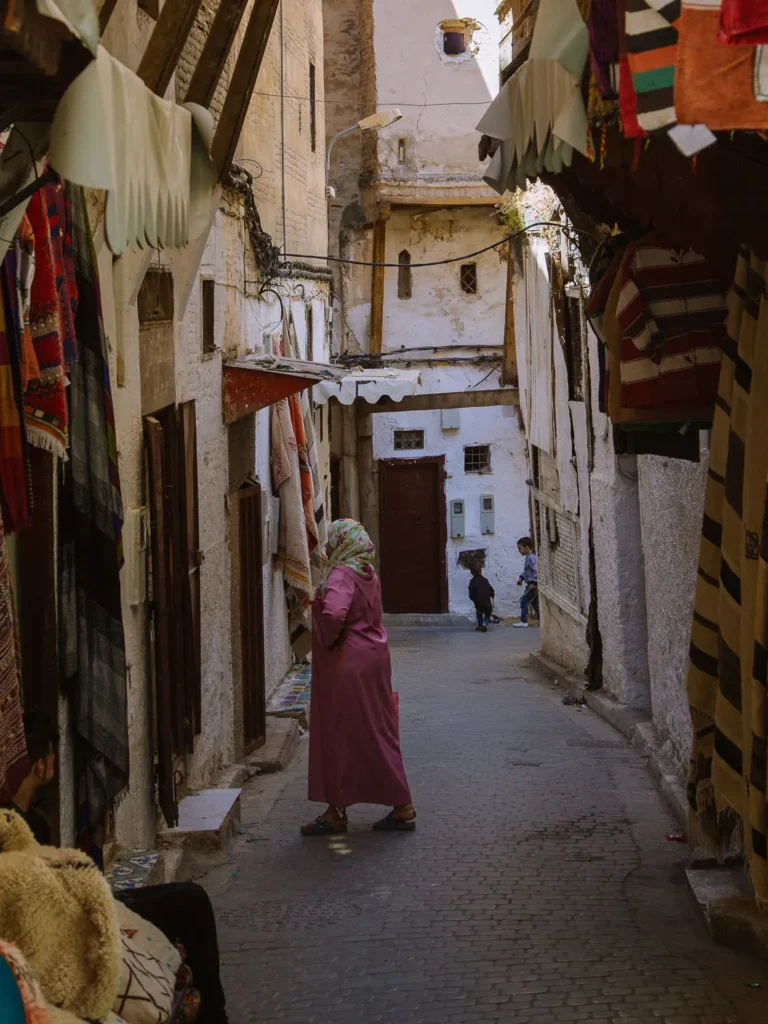
The medina of Fes el-Bali is one of the largest car-free urban areas in the world.
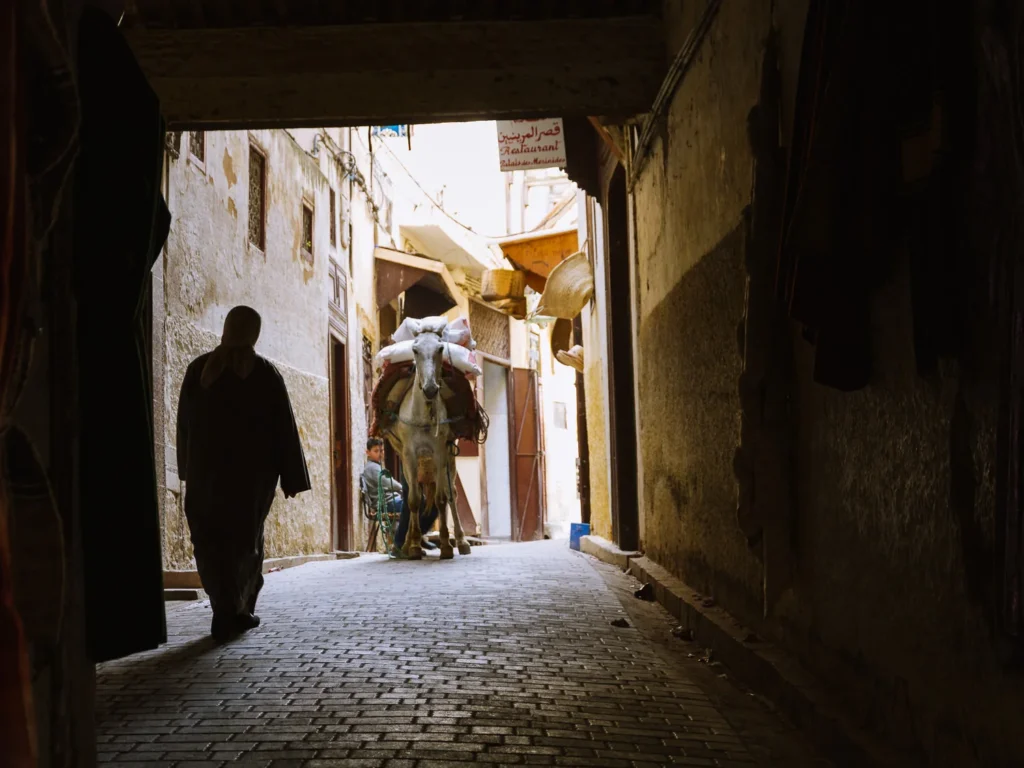
You won’t find a single motor vehicle inside its labyrinthine walls.
What you will find is over 9,000 alleyways, centuries-old mosques, tanneries still operating as they did in the 11th century, and the smell of spices, leather, and fresh bread baking in communal ovens.
Fez can be overwhelming at first. The medina has no obvious grid, no clear logic, and an uncanny ability to swallow you whole.
But if you’re willing to surrender to it, follow your nose instead of your phone and accept that getting a little lost is part of the experience, you’re in for a treat.
We’ve been to Fez 3 times now, and this guide covers all the main attractions you really shouldn’t miss.
Map: Fez
To help you navigate, we have put together the map below, which includes all the attractions we have listed in this guide.
Click on the top right corner to open our map in your Google Maps app. Click the star next to the title to save it to your Google account.
What to Do in Fez
1. Fès El-Bali — the Ancient Medina
Most of what you do in Fez will be centred around Fes el-Bali, the ancient medina.
A UNESCO World Heritage Site since 1981, it is the best-preserved medieval Islamic city in the world. Walking its streets feels like stepping back in time.
The main artery, Talaa Kebira, runs through the heart of the medina and is a good spine for navigation.
We have put together a self-guided walking tour of the Fez Medina, which includes some of the main attractions, plus a few local markets.
2. Chouara Tannery
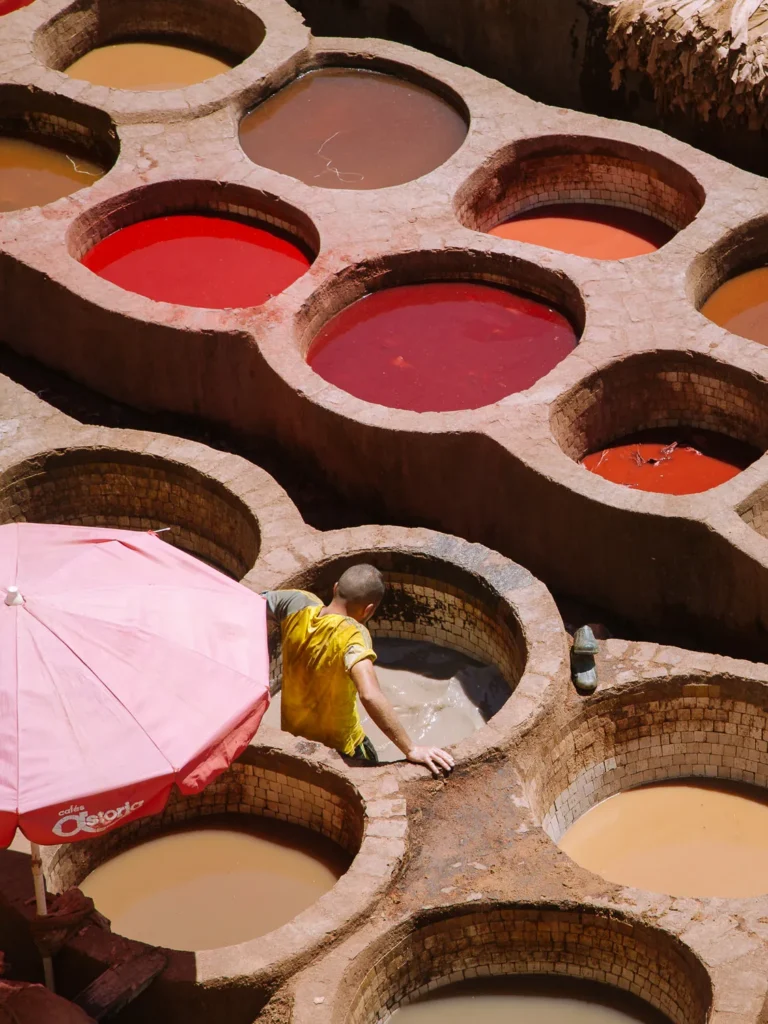
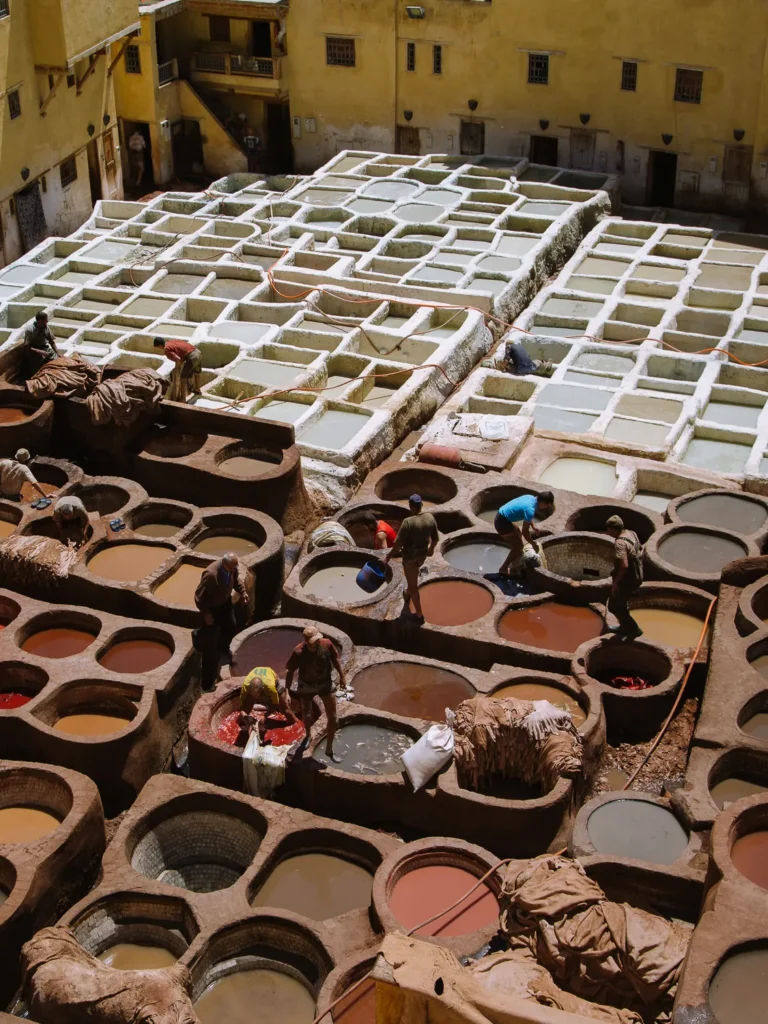
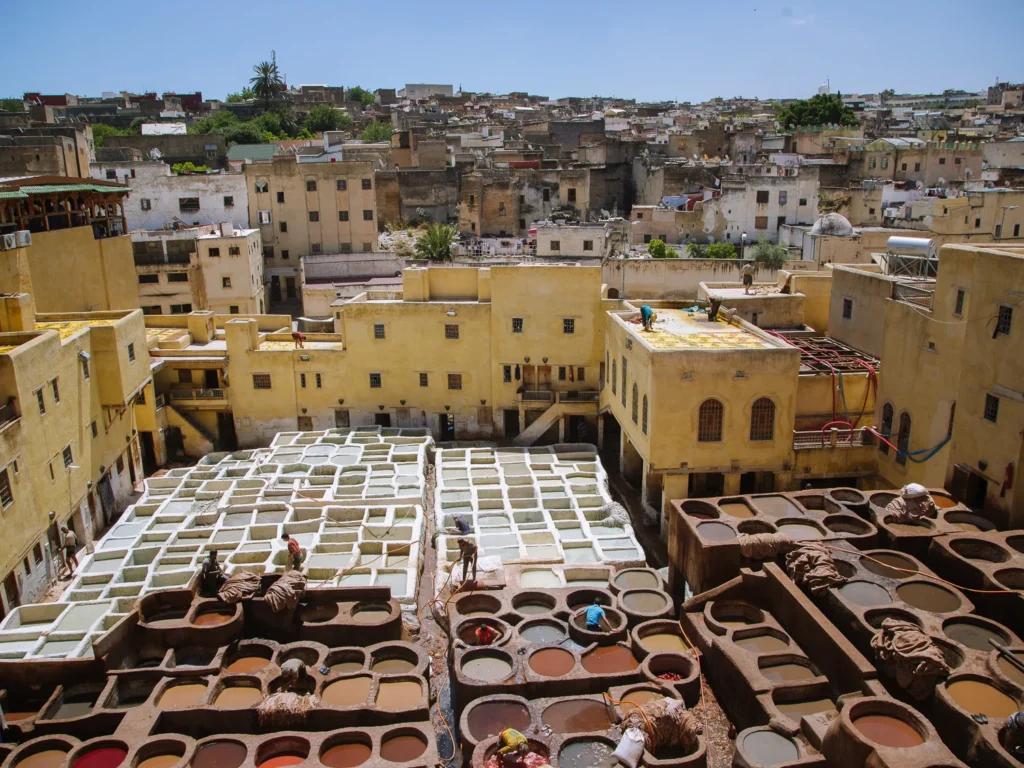
The Chouara Tannery is one of the most striking images of Fez.
Dating back to the 11th century, it is one of the world’s oldest tanneries, using methods that have hardly changed over the years.
From the terraces of the leather shops that surround it, you look down into a patchwork of stone vats filled with vivid dyes while workers move between them.
It’s a mesmerising scene.
The smell, however, is something else. The hides are soaked in pigeon dung as part of the tanning process, and the aroma hits you well before the view does. The leather shops will often hand you a sprig of mint to hold under your nose.
Tip for visiting – We paid the owner of Number 10 (a leather shop) a few dirhams to go up to his store and view the tanneries from 3 floors up.
3. Al-Attarine Madrasa
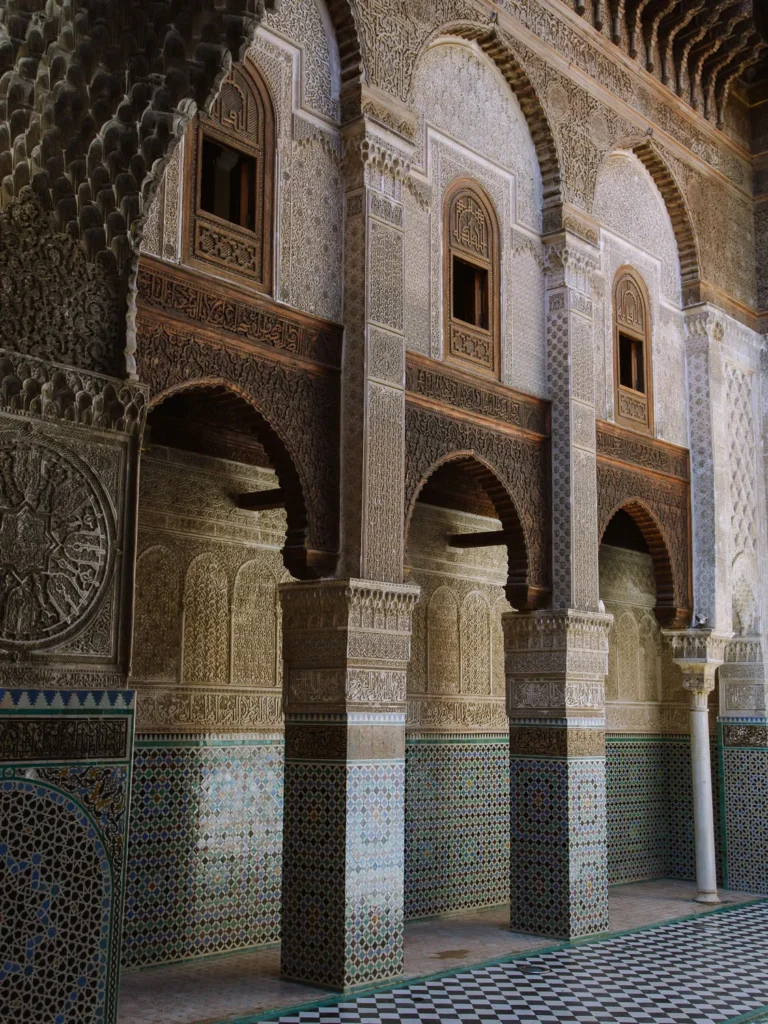
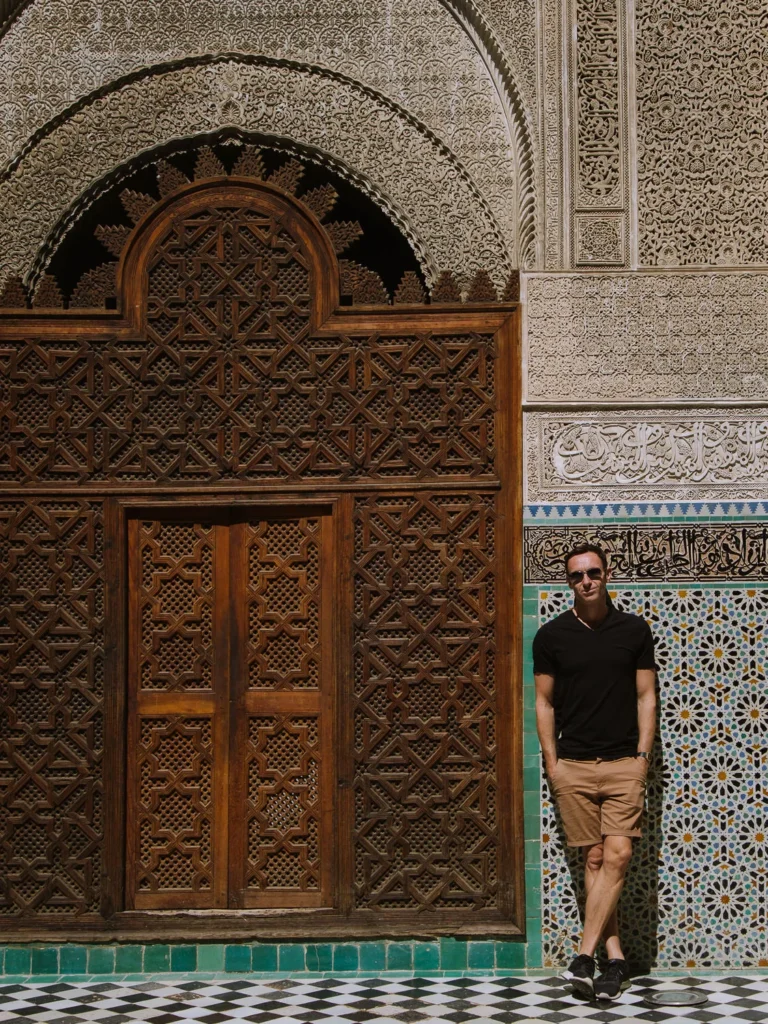
Hidden just a few steps from the Karaouine Mosque, the Al-Attarine Madrasa is one of the most beautiful buildings in Fez.
Built in the 14th century by the Marinid Sultan Abu Said, the madrasa served as a student residence attached to the great mosque.
Today it’s open to visitors, and it was one of our highlights in Fez.
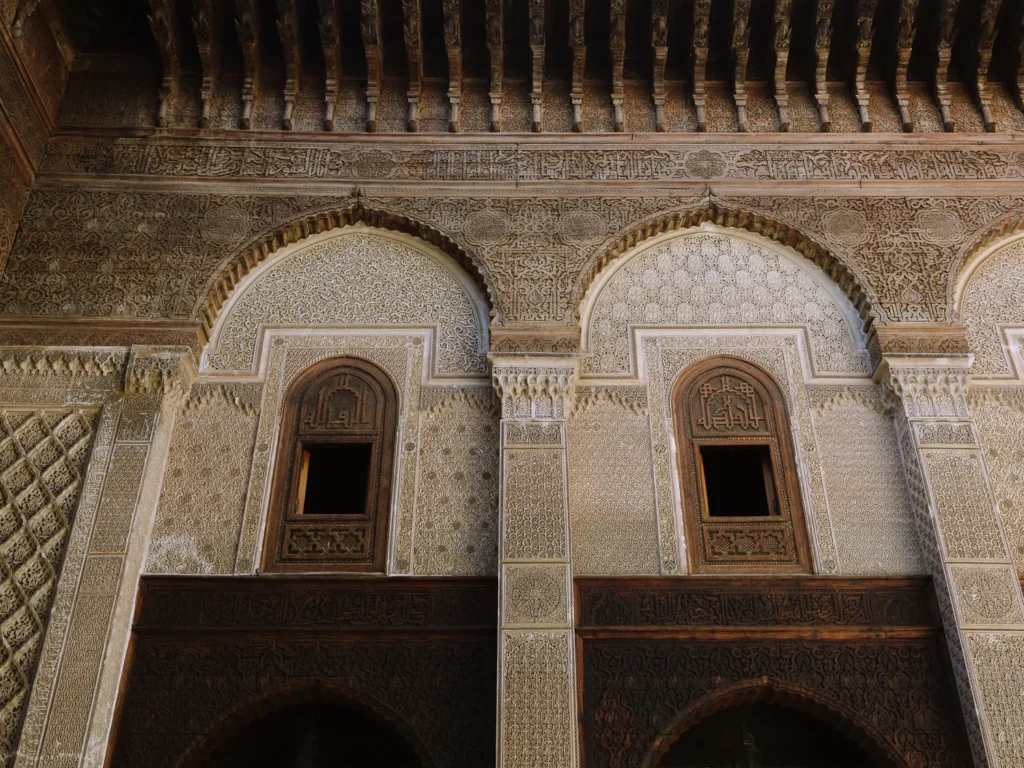
The lower walls are covered in intricate zellij tilework, the middle section in carved stucco, and the upper section in carved cedarwood.
The central courtyard, with its marble fountain and carved archways reflecting in the still water, is genuinely breathtaking.
4. University of Al-Qarawiyyin
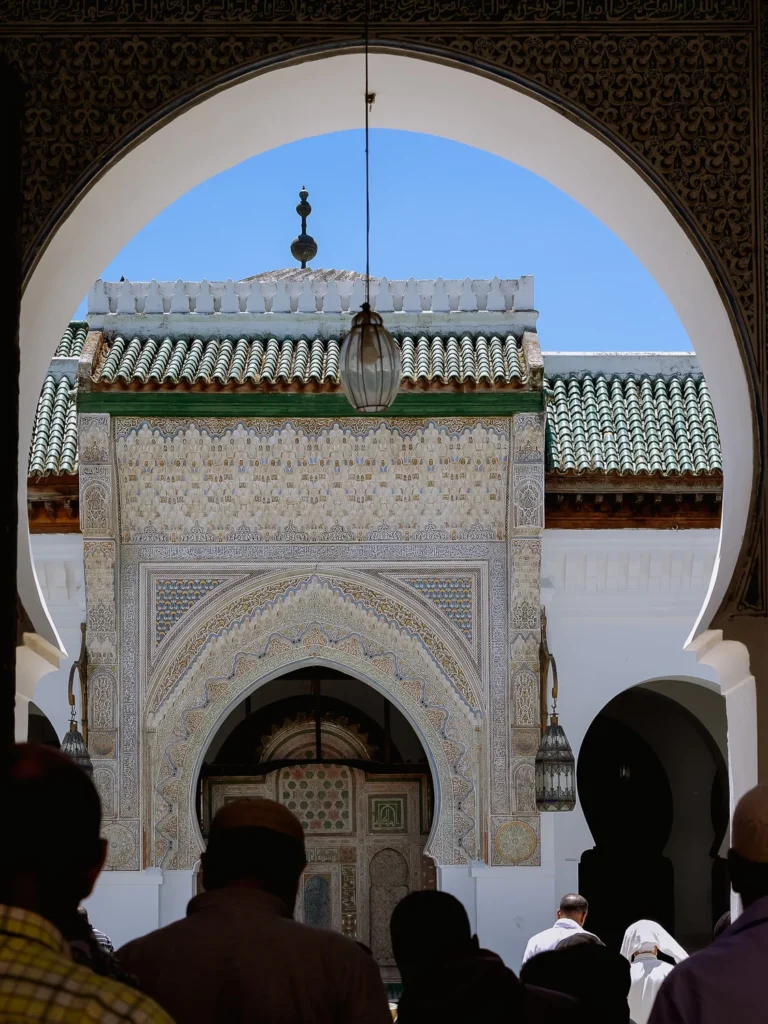
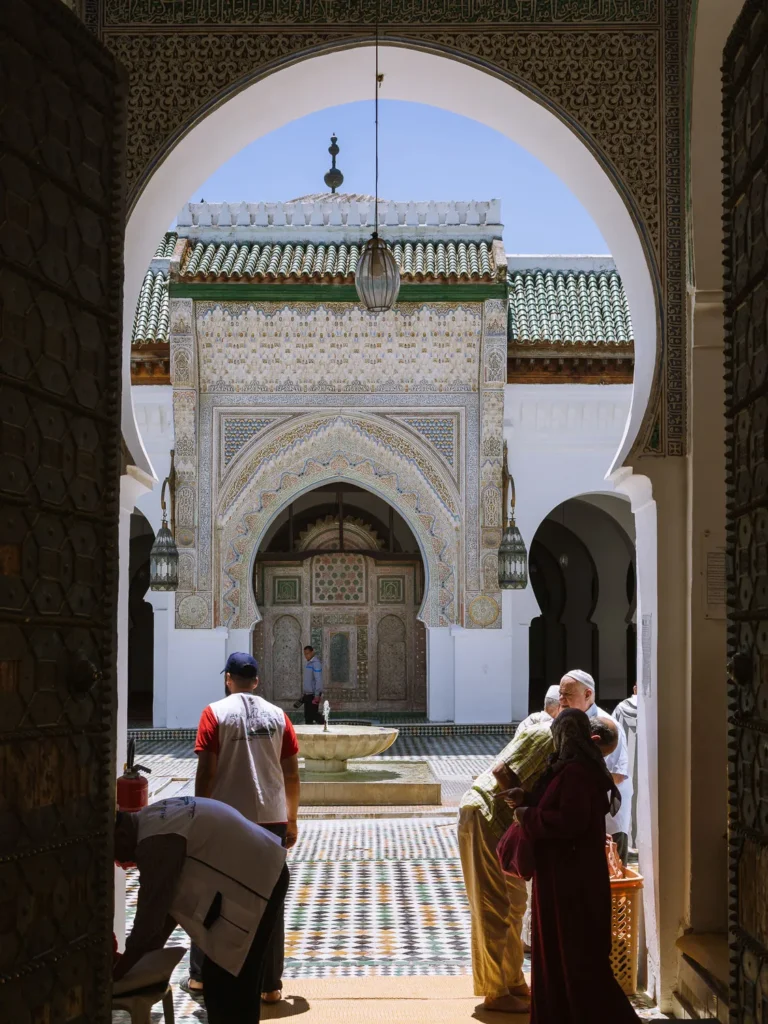
Founded in 859 AD, the University of Al-Qarawiyyin (Al-Karaouine) holds the distinction — recognised by UNESCO and Guinness World Records — of being the world’s oldest continuously operating university.
It began as a mosque and grew into one of the great centres of Islamic learning. Its library holds some of the oldest manuscripts in the world.
Non-Muslims are not allowed to enter the mosque or the university itself, but the entrance gate is visible from the alleyway.
Photography from the entrance is welcome, though be respectful of worshippers coming and going. As a general rule across Morocco, always ask before photographing people.
5. Bou Inania Madrasa
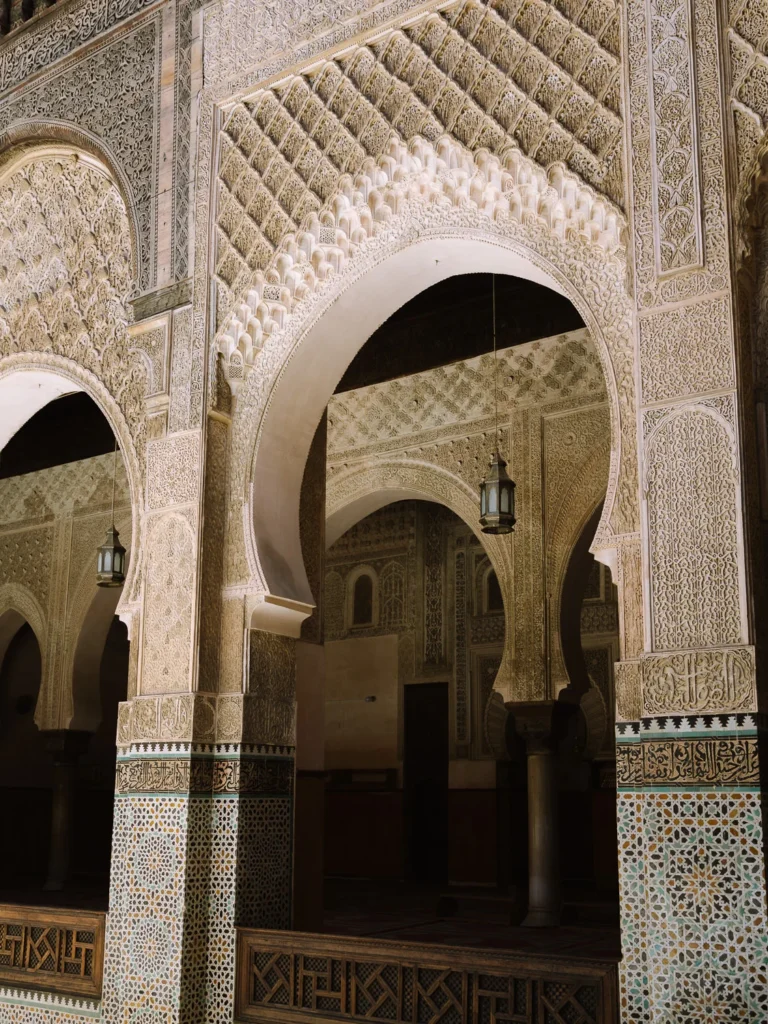
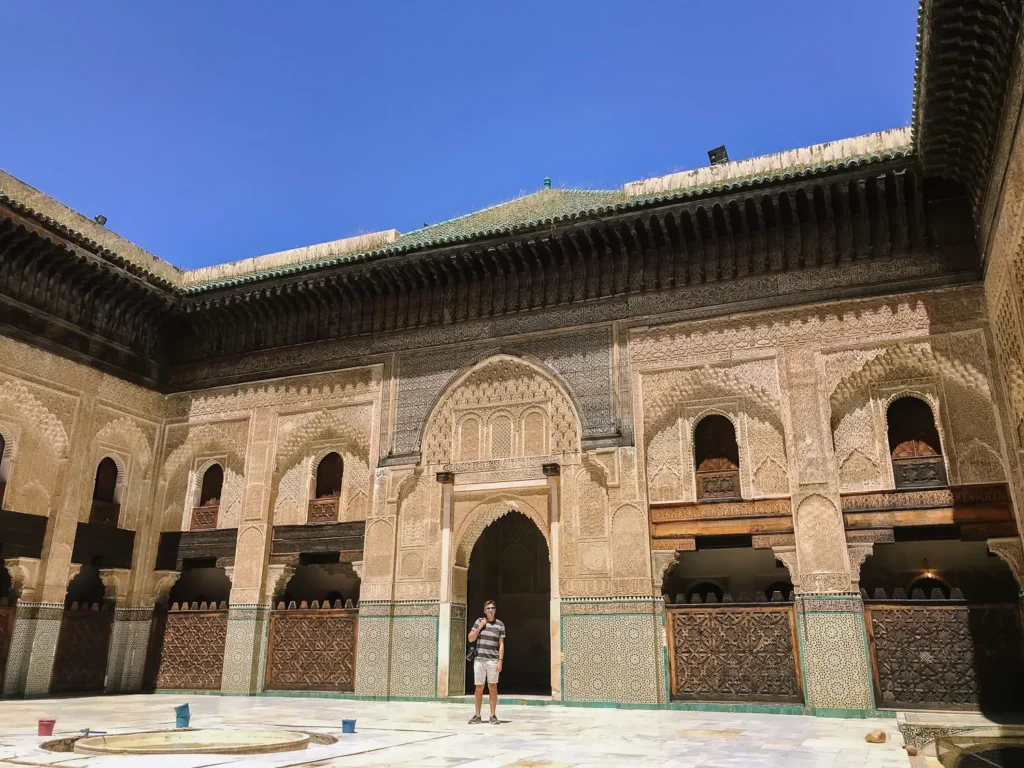
This 14th-century madrasa, built by Sultan Bou Inan, is exceptional in that it functions as both a madrasa and a mosque, making it one of the few religious buildings in the medina that non-Muslims can enter.
The architecture is considered the finest example of Marinid craftsmanship in Morocco.
The tilework, carved plaster, and cedarwood here are even more elaborate than at Al-Attarine, and the madrasa has a rare ablutions room with running water — a feature unique among Moroccan madrasas.
Don’t miss the carved wooden screen on the upper level, which stretches across the full width of the courtyard and is one of the most intricate pieces of woodworking you’ll ever see.
6. The Mellah — Fez’s Jewish Quarter
The Mellah is the historic Jewish quarter of Fez, established in the 15th century.
It’s a fascinating and often overlooked part of the city, with a distinct character that sets it apart from the surrounding medina.
The architecture here is different, with a style more influenced by Andalusian design than traditional Moroccan.
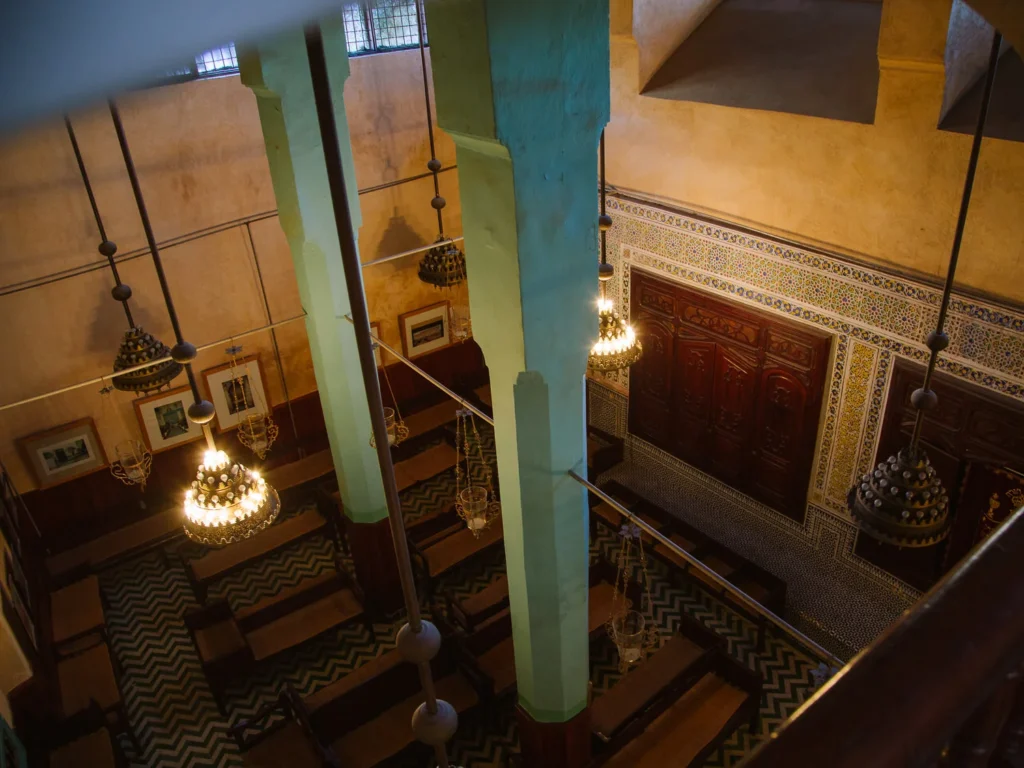
The Ibn Danan Synagogue, beautifully restored, is open to visitors and offers a moving insight into the long history of Jewish life in Fez.
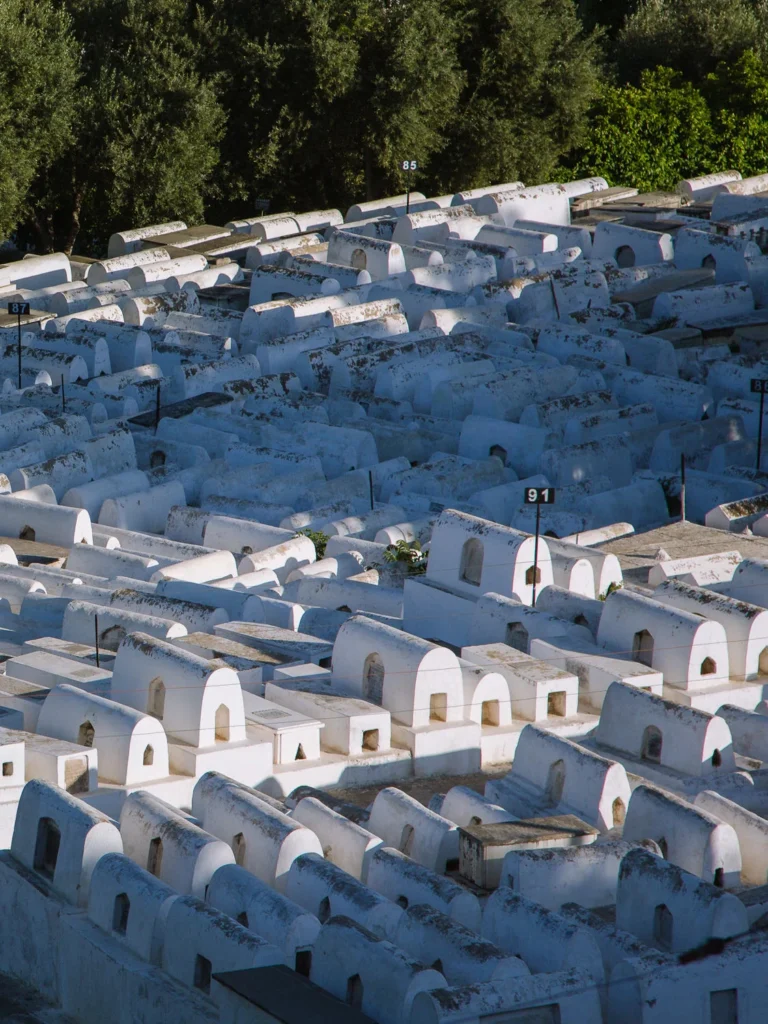
The Jewish cemetery nearby is one of the largest in Morocco.
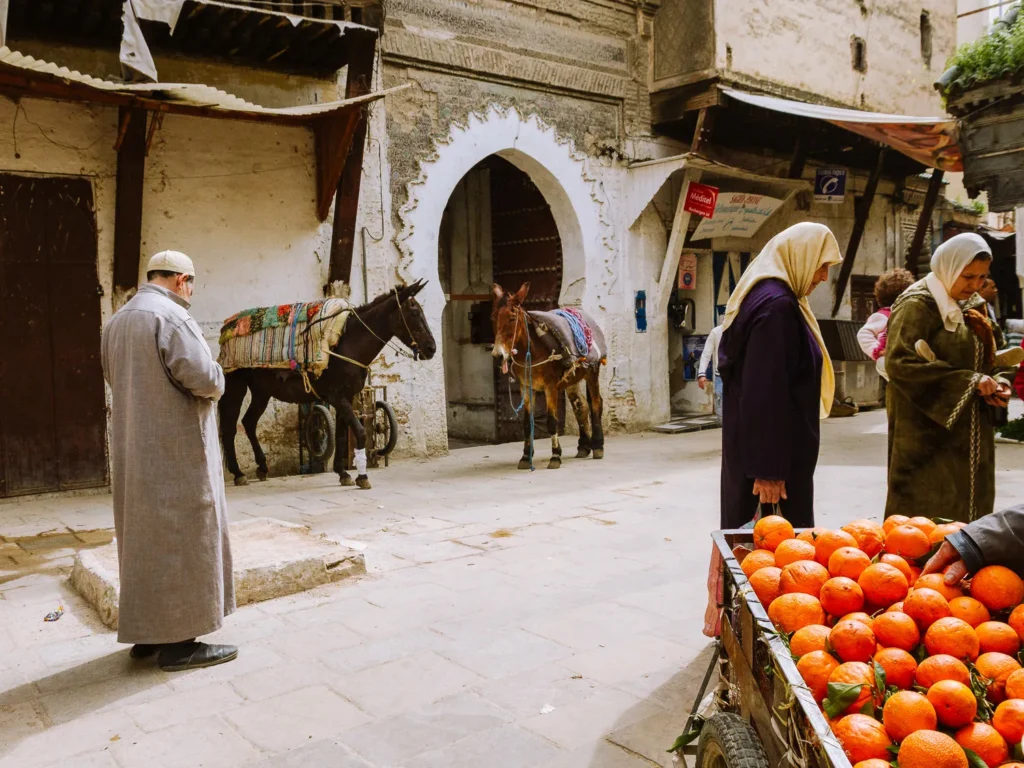
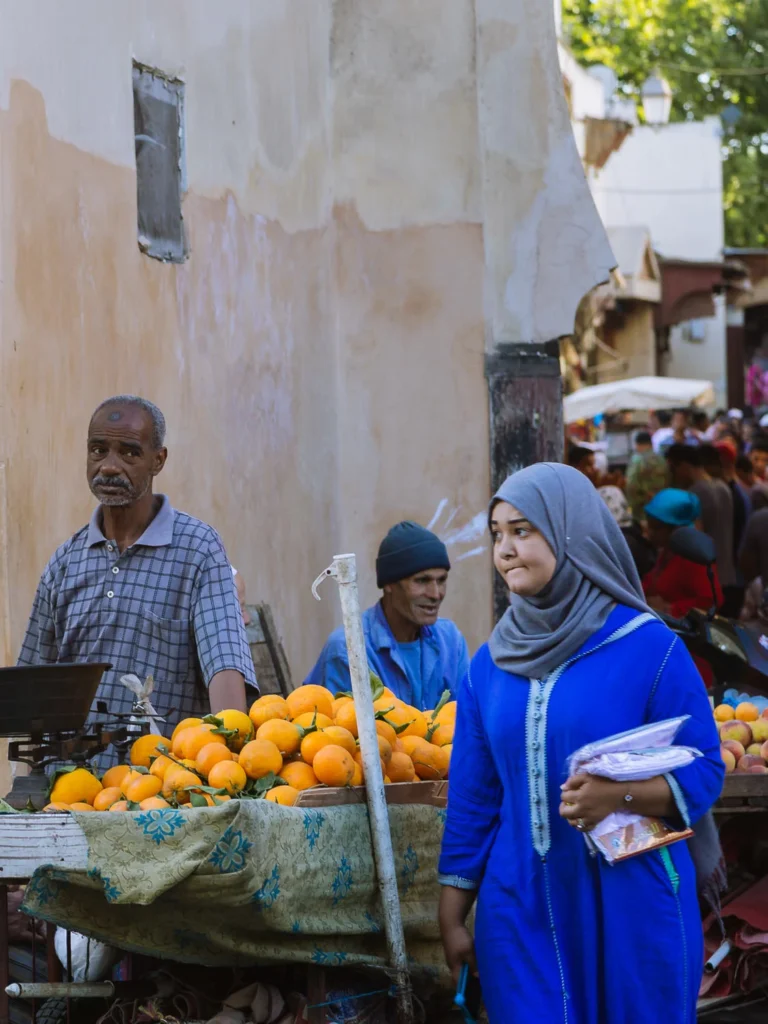
The street market at the entrance to the Mellah has piles of fresh produce, including olives and spices, and it’s a great spot for people-watching.
7. Merenid Tombs & the View Over Fez
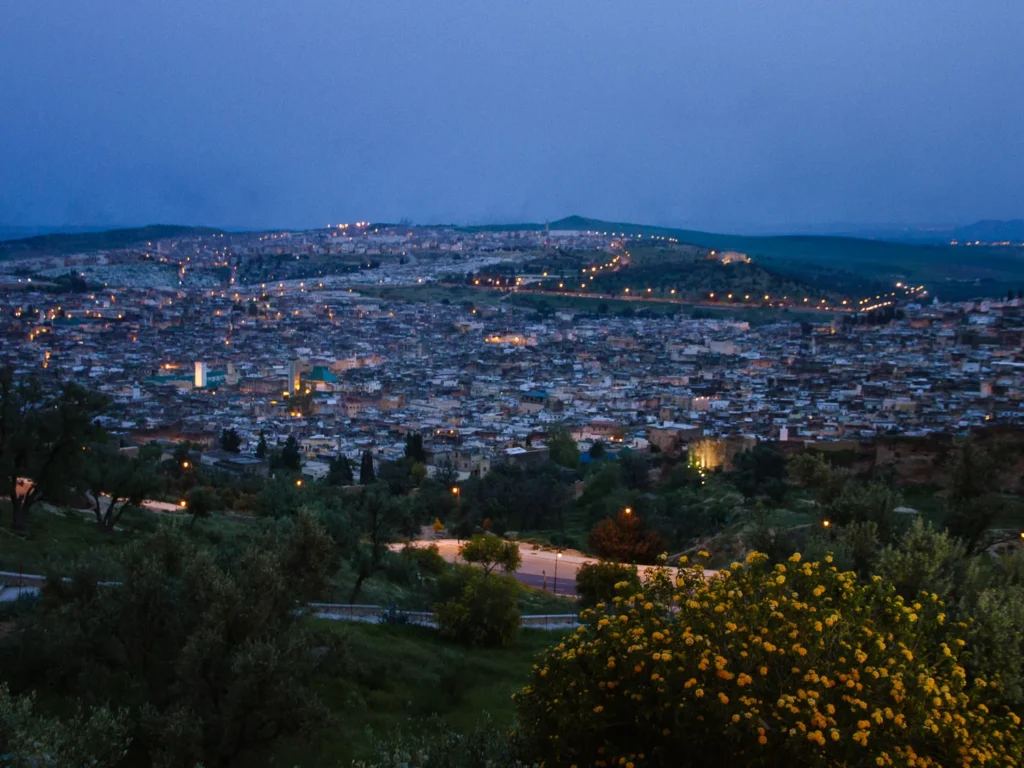
For the best view over the medina, head to the ruined Merenid Tombs on the hilltop above the city.
The tombs themselves are more atmospheric than informative — but the view over the Medina is excellent.
The best time to come is either early morning or at dusk, when the medina starts to glow in the golden hour light.
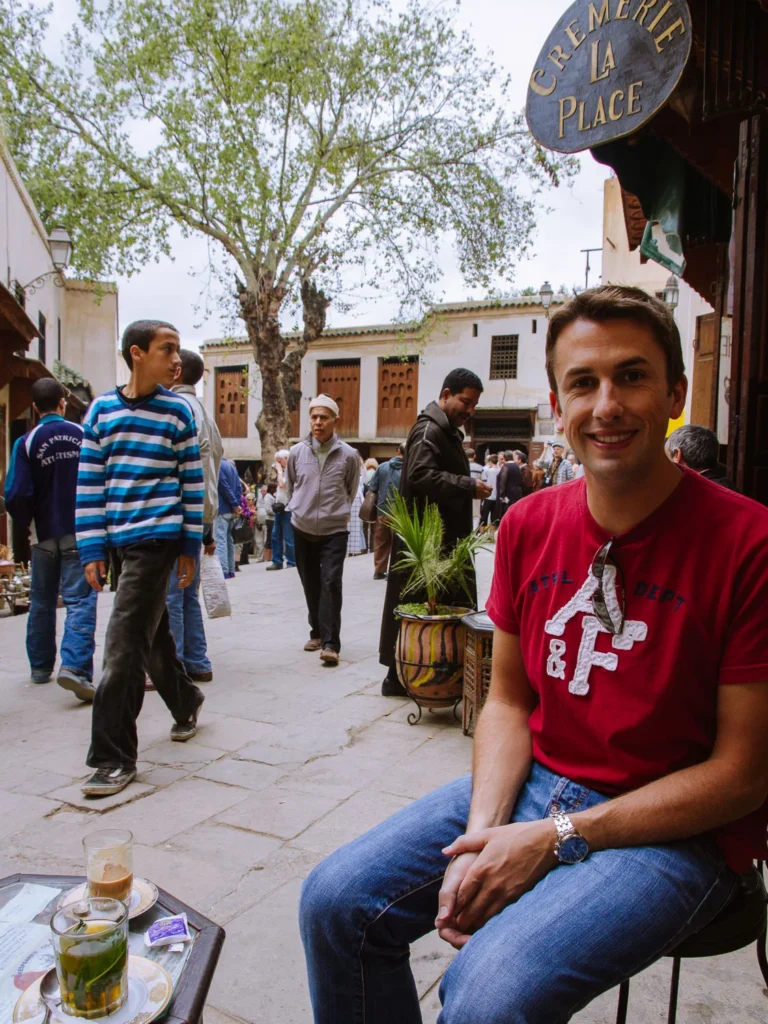
There are cafe terraces near the tombs where you can take in the view with a mint tea.
8. Moroccan Food in Fez
Fez has a reputation as the culinary capital of Morocco, and a meal here — eaten properly, not rushed — is one of the great pleasures the city offers.
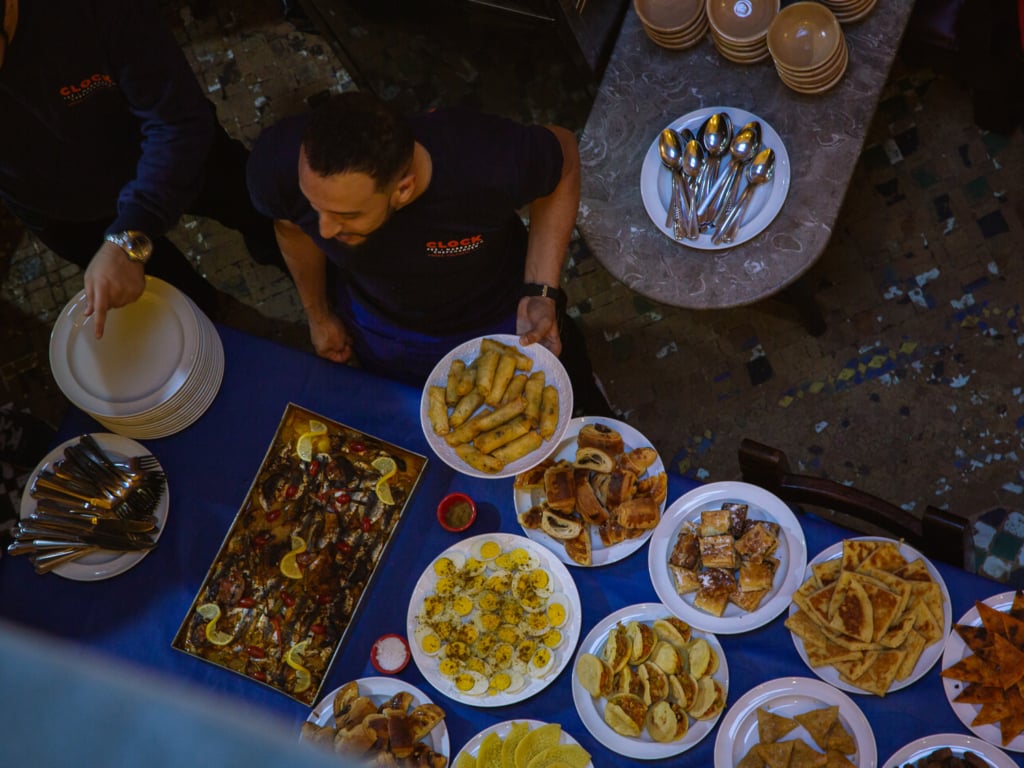
The city’s cuisine is known for its complexity and depth. Slow-cooked tagines, fragrant couscous, and the famous pastilla — a flaky pastry filled with pigeon or chicken, almonds, and spices, dusted with icing sugar and cinnamon — are all worth seeking out.
What to Eat
- Pastilla — the dish Fez is most famous for. Sweet, savoury, and unlike anything you’ll have eaten before.
- Harira — a rich, tomato-based soup with chickpeas and lentils, traditionally eaten to break the fast during Ramadan, but available year-round.
- Mrouzia — a slow-cooked lamb tagine with honey, raisins, and ras el hanout spice, uniquely Fassi.
- Briouat — small fried pastry parcels filled with cheese, meat, or seafood.
Where to Eat
- Café Clock is an institution in the medina, popular with both locals and visitors. Their camel burger is famous, but the Moroccan dishes are just as good. They also host storytelling evenings, music, and cultural events.
- Ruined Garden is a beautiful restored riad restaurant with an excellent menu of traditional Fassi cooking. The setting, around a candlelit courtyard garden, is magical in the evenings.
- Street food in Rcif Square — as evening falls, the square fills with vendors selling msemen (Moroccan flatbread), grilled meats, and harira. This is where locals eat, and the food is wonderful.
9. Nejjarine Square & the Fondouk Museum
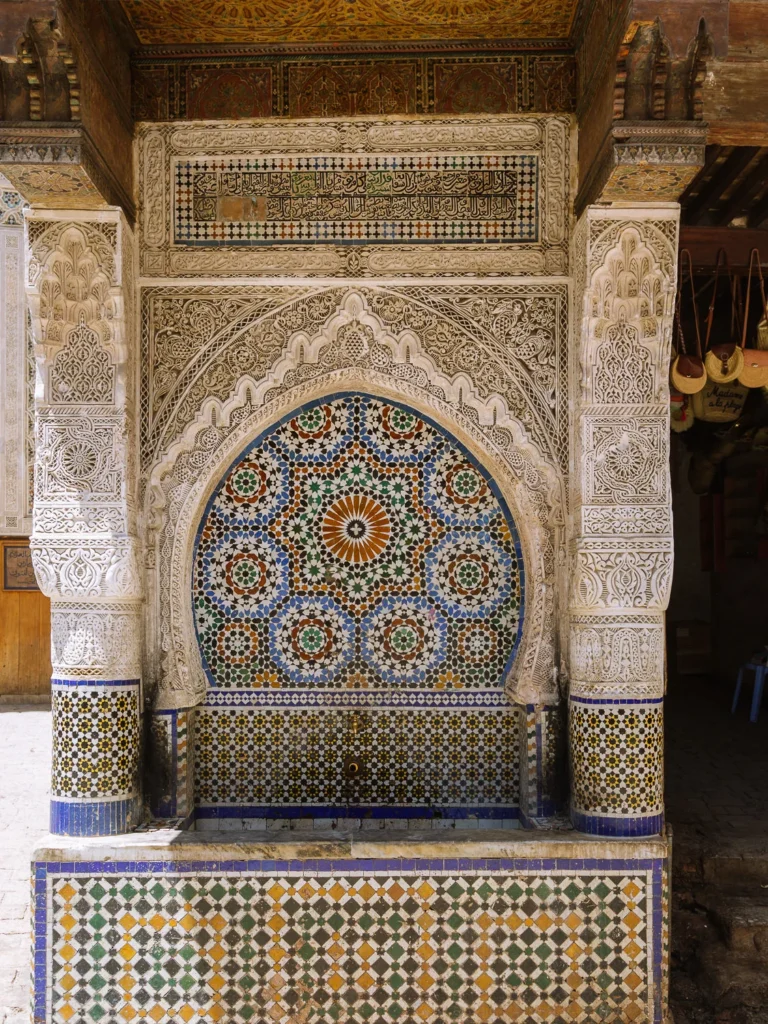
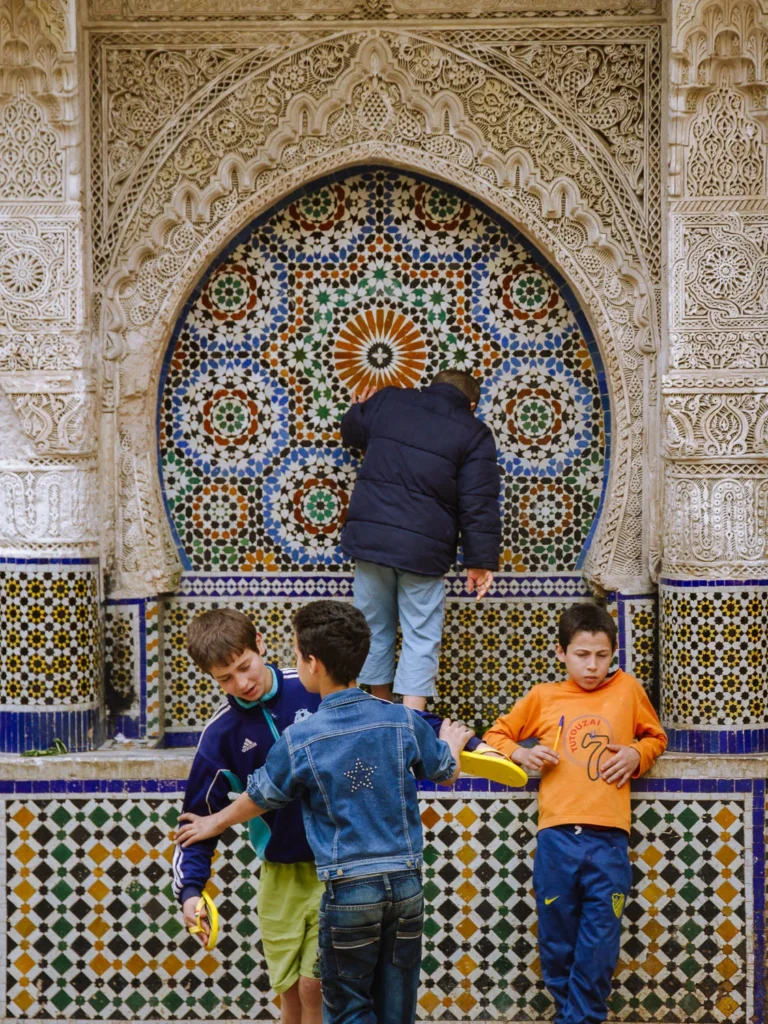
One of the most beautiful corners of the medina, Nejjarine Square (Place Nejjarine) is centred around an ornate 18th-century fountain.
The square is home to woodworkers and artisans, and you can watch craftsmen at work in the surrounding workshops.
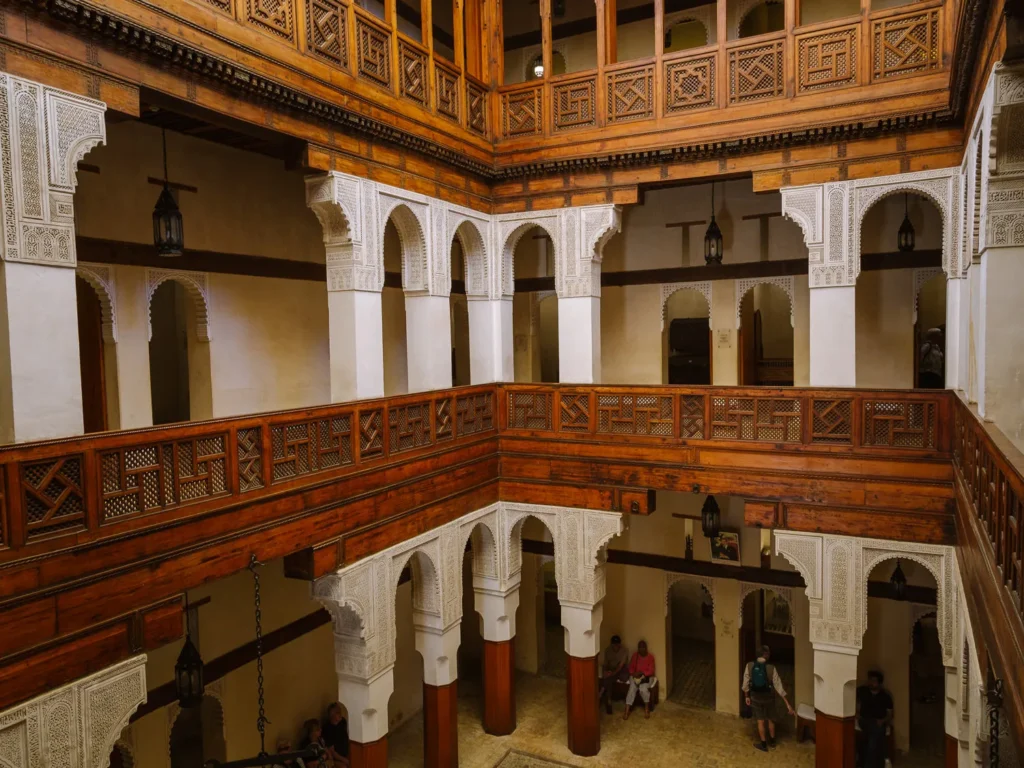
The Nejjarine Fondouk (caravanserai) beside the square has been beautifully restored and now houses the Museum of Wooden Arts and Crafts.
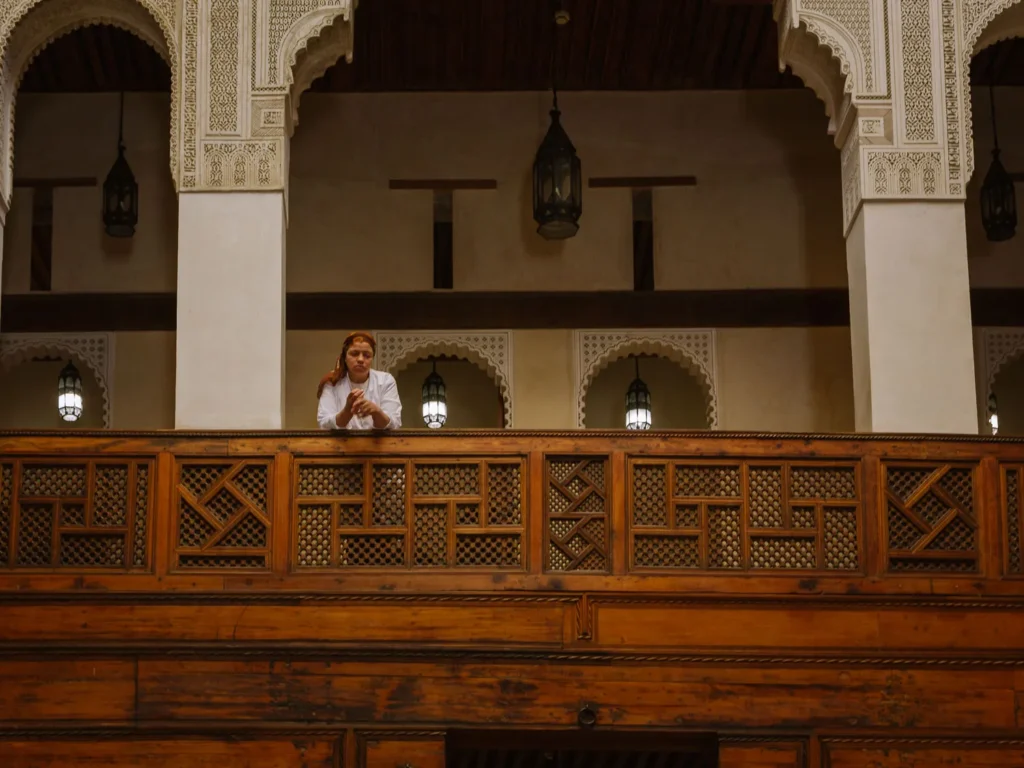
It’s worth the entrance fee as much for the building itself as for the exhibits — the three-storey atrium with its carved wooden galleries is spectacular.
10. Fes El-Jdid & the Royal Palace
The newer (though still medieval) city, called Fes el-Jdid, is worth an afternoon’s exploration.
Founded in the 13th century by the Marinid dynasty, it sits just to the west of the ancient medina.
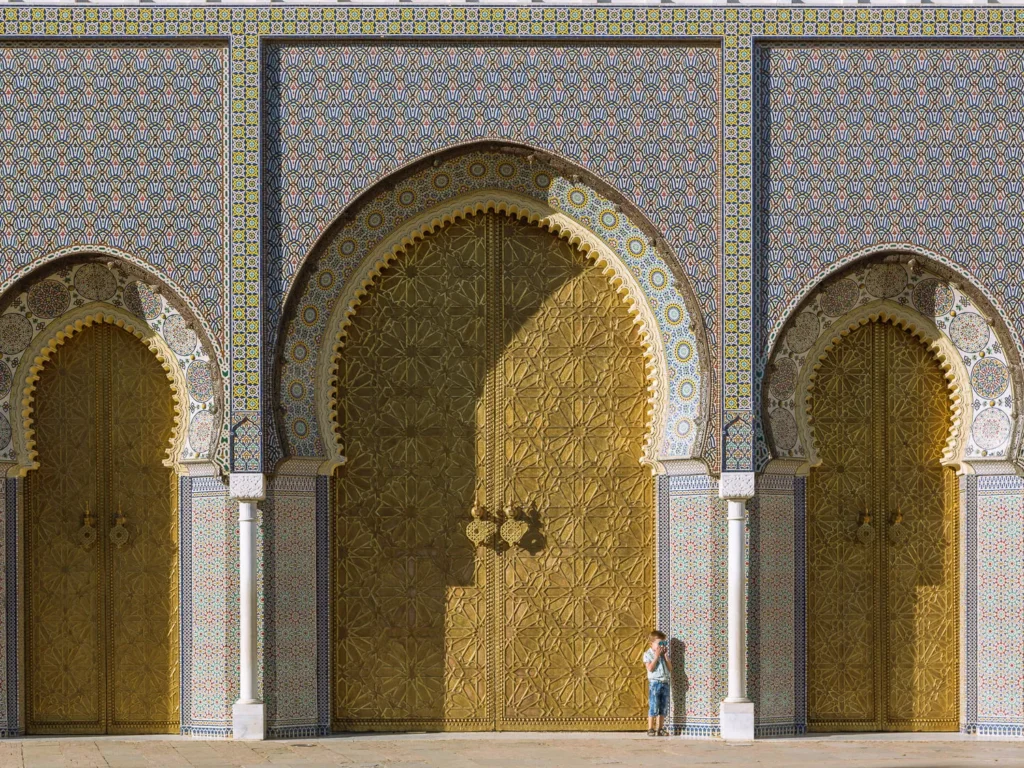
The main draw is the Royal Palace of Fez — the Dar el-Makhzen.
The palace itself is not open to visitors, but the huge golden brass doors of its main entrance are a spectacular sight. You’ve probably seen photos of them before.
The surrounding gardens of Jnan Sbil (Bou Jeloud Gardens) are a lovely place to take a breath from the intensity of the medina — peaceful, tree-lined, and popular with local families on weekend afternoons.
11. Shopping in the Souks
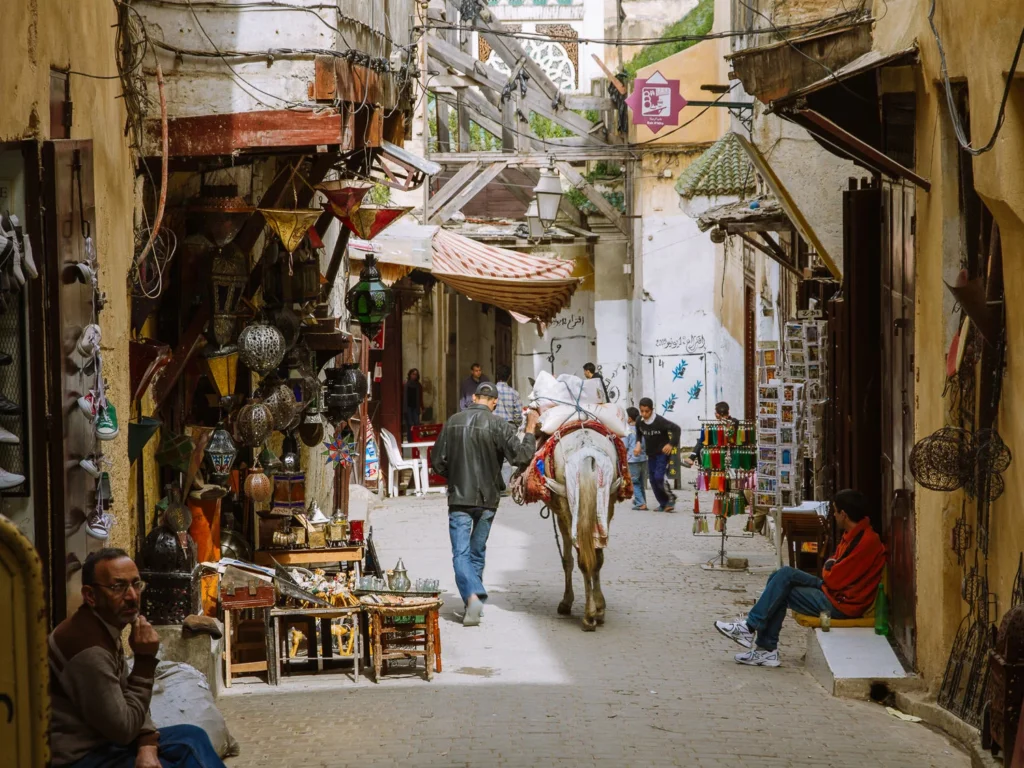
Shopping in the Fez medina is an experience in itself, quite apart from whatever you actually buy.
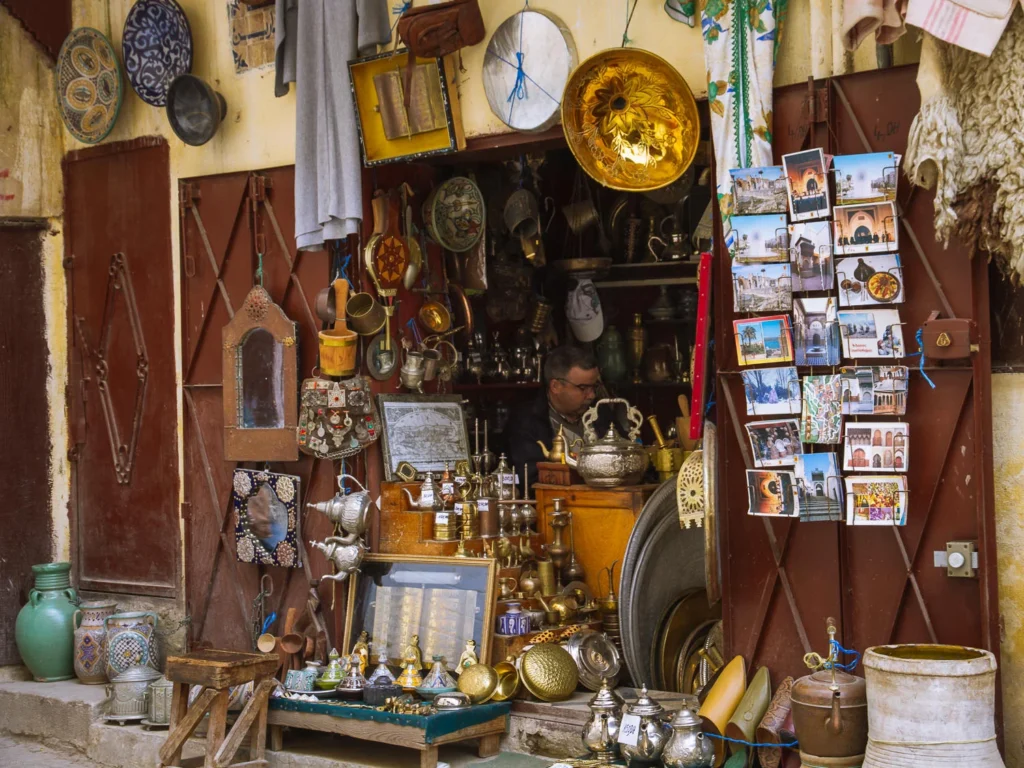
The souks are organised loosely by trade — the dyers’ souk, the copper souk, the leather souk, the spice market — and exploring them is like peeling back the layers of the city.
Fez is particularly well-known for:
- Leather goods — wallets, bags, and babouches (the traditional pointed slippers) in vegetable-tanned leather from the tanneries
- Zellij tilework and ceramics from the pottery district, particularly the blue-and-white style distinctive to Fez
- Handwoventextiles, including the famous Fassi embroidery with its geometric patterns in silk thread.
- Spices and argan oil from the spice market near Rcif Square.
A word on bargaining: it’s expected, and it can be fun. Start around 40–50% of the asking price and meet somewhere in the middle. Don’t feel pressured, and never begin negotiating for something you’re not prepared to buy.
12. Staying in a Riad
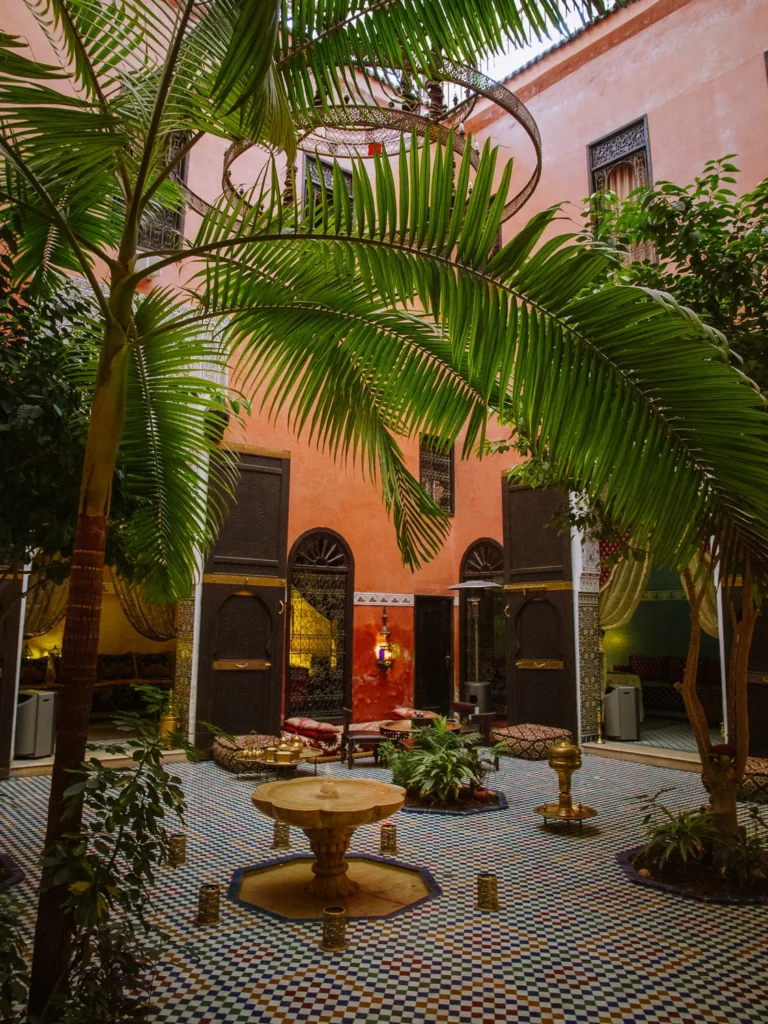
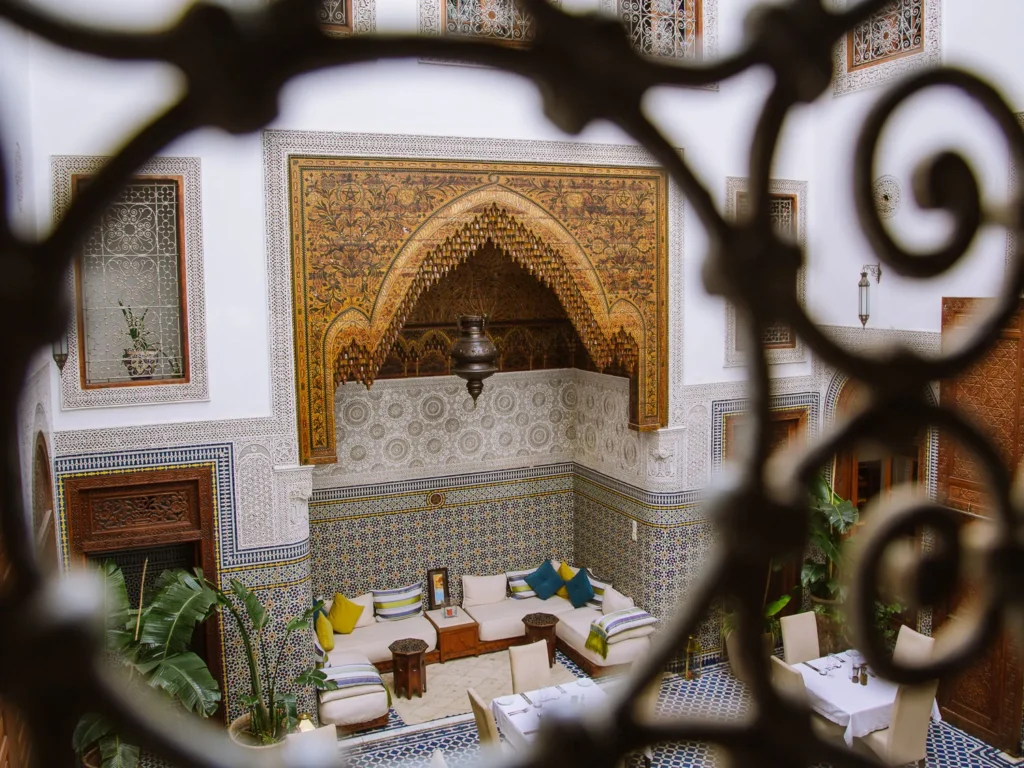
Staying in a riad inside the medina is, in our view, non-negotiable in Fez.
From the outside, riads are indistinguishable from the surrounding walls of the alleyway — a plain door in a plain wall.
Step inside, and you find a world of tranquillity: a central courtyard open to the sky, a fountain murmuring, orange trees in terracotta pots, and the sounds of the medina reduced to a distant hum.
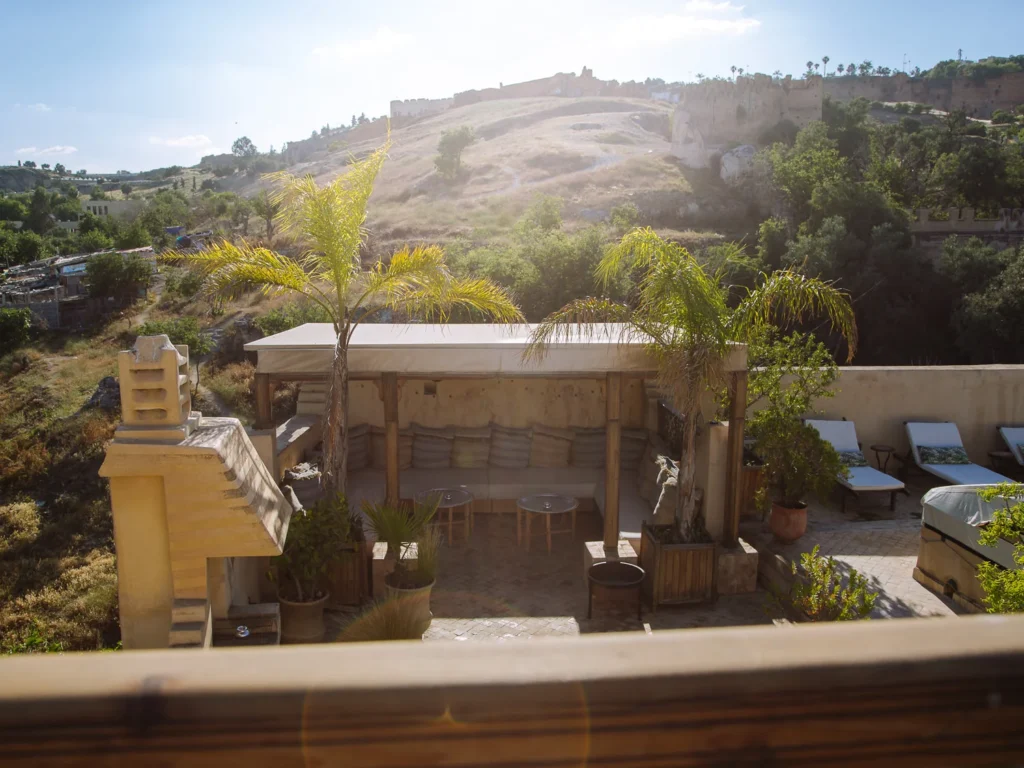
Breakfast on a riad rooftop terrace, looking out over the medina’s sea of white and terracotta rooftops, with the hills rising beyond — this is one of the great travel experiences Morocco has to offer.
Riads in Fez vary enormously in quality and price. Some of our favourites include:
- Riad Laaroussa — a beautifully restored 17th-century riad with exceptional attention to detail and one of the finest kitchens in the medina.
- Dar Bensouda — a more modest but characterful riad with very helpful hosts, excellent breakfasts, and a lovely rooftop.
- Riad Fes — for a splurge, this is one of the great riads in Morocco, with a spa, rooftop pool, and rooms that feel like living in a work of art.
Logistics & Practicalities
How to Get to Fez
Fez-Saïss Airport (FEZ) is around 15 kilometres south of the city. It’s well-connected to European cities, with direct flights from London, Paris, Amsterdam, Madrid, and several other hubs.
Ryanair, easyJet, and Royal Air Maroc all operate routes into Fez.
Taxi from the airport is the easiest option. The ride to the medina takes around 20–25 minutes. Agree the price before you get in — a fair fare is around 150–200 MAD (roughly £12–16).
By train from Casablanca or Marrakech is a comfortable and scenic option. Fez railway station is just outside the medina, and the ONCF train network is reliable and good value.
Getting Around Fez
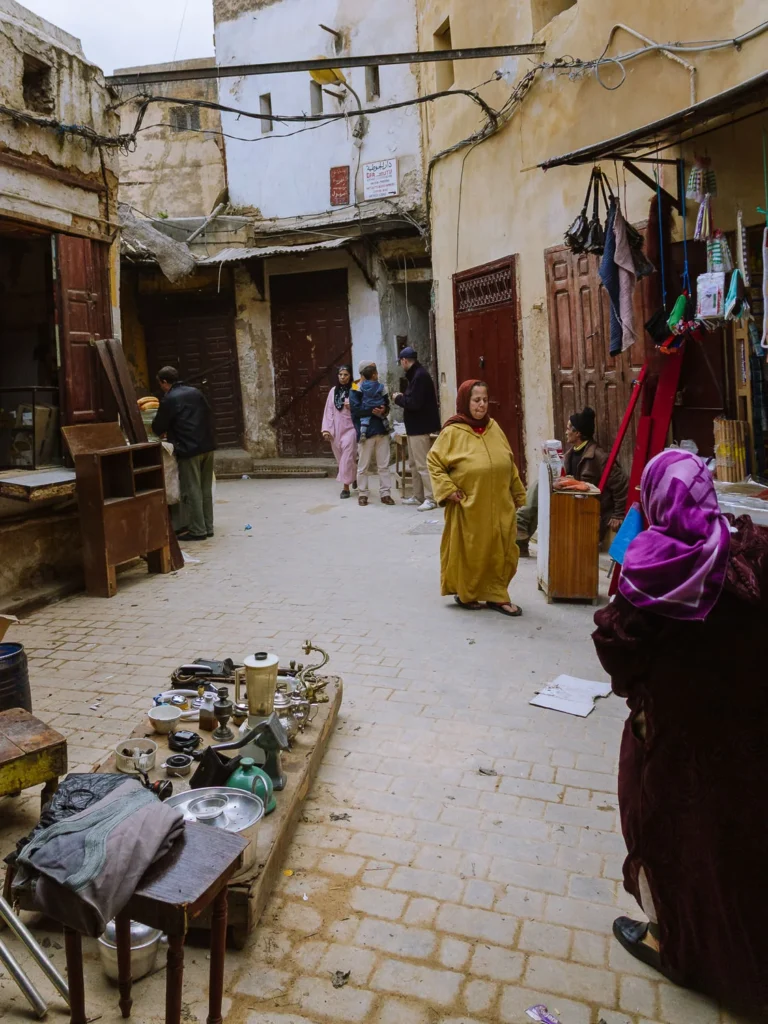
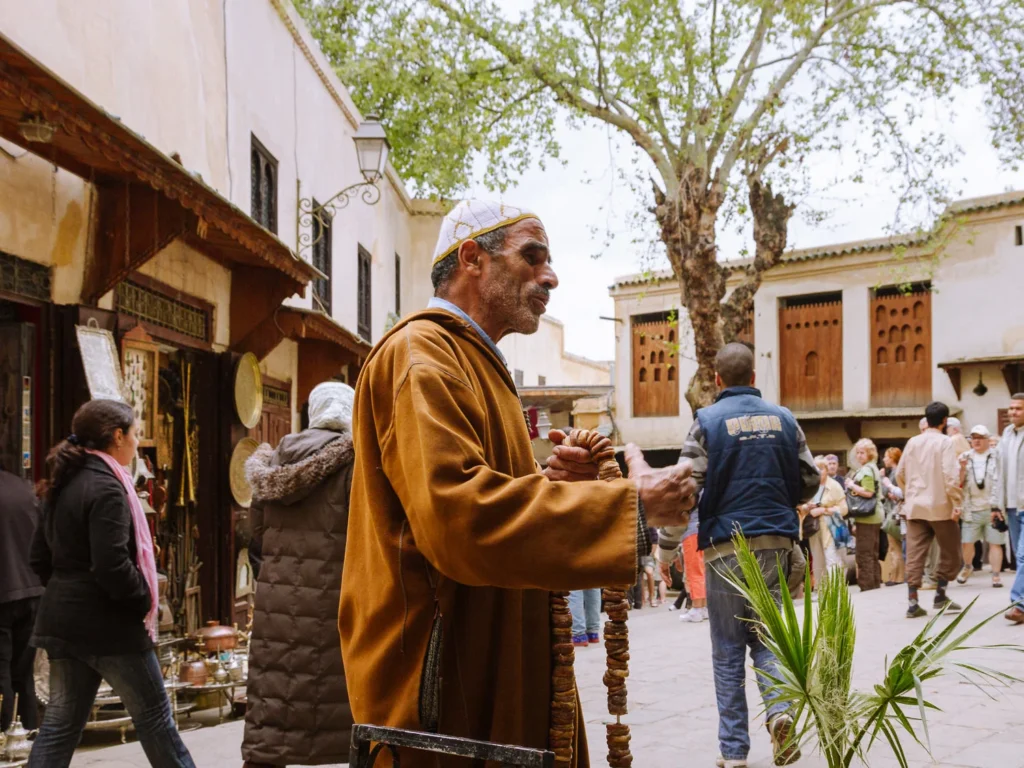
Inside the medina, you’re on foot — there’s no other option.
Good walking shoes are essential. The medina is hilly in places, the alleys can be cobbled and uneven, and you’ll cover a lot of ground each day.
Between the medina and the Ville Nouvelle, petit taxis (small, metered cabs) are cheap and the most practical way to get around.
Make sure the driver uses the meter, or agree a price beforehand.
The Ville Nouvelle — the French-built new town — is about a 20–25-minute walk from the medina, or a very short taxi ride.
Where to Stay in Fez
Staying inside the medina in a riad is the experience we’d always recommend.
It’s noisier than staying in the Ville Nouvelle, but the atmosphere more than compensates. That said, if you have mobility issues or prefer more conventional hotel comforts, the Ville Nouvelle has several well-regarded options.
- Riad Laaroussa (Medina) — exceptional restoration, superb food, atmospheric rooms.
- Dar Bensouda (Medina) — mid-range, characterful, warm hosts.
- Riad Fes (Medina) — luxury splurge with rooftop pool and spa.
- Hotel Sahrai (Ville Nouvelle hillside) — contemporary design hotel with spectacular medina views from the pool terrace.
How Long?
We’d recommend a minimum of 2 full days in Fez to get a genuine sense of the city.
If you’re combining Fez with other Moroccan cities, Chefchaouen is a 2–3-hour drive north, and Meknes is only 45 minutes away.
Best Time to Visit Fez
Spring (March to May) and autumn (September to November) are the sweet spots. The weather is warm but not punishing, the light is beautiful, and the city feels alive without being overwhelmed by summer crowds.
Summer can be very hot — temperatures in July and August regularly exceed 38°C, which makes exploring a walled medieval city on foot fairly challenging.
That said, the evenings are magical in summer, and Ramadan (dates vary year to year) brings a special atmosphere to the medina after sunset.
Winter is mild and often overlooked — it’s quieter, cooler, and the city has a different, more intimate character. It can rain, but rarely for long.
More Morocco Guides
- Our 10-day Morocco itinerary covers Marrakech, Fez, the Atlas Mountains & the Sahara Desert.
- Read our guide to the most beautiful places to visit in Morocco.
- Our 3-day Marrakech itinerary covers all the big sights plus some local neighbourhoods.
- This walking tour of the Fez Medina is a great way to experience the city.
- Enjoy the beautiful and remote Ouirgane Valley.
- All you need to know about driving in Morocco.
- Take a coastal break with our guide to Essaouira, Morocco.
- Go off the tourist trail in the Atlas Mountains.
- Explore the activities around Ait Ben Haddou.

reader-supported
When you buy through links on our site, we may earn a small affiliate commission at no extra cost to you.
Thanks for your support // Paul & Mark