


Beautiful gardens, incredible architecture, delicious food. Singapore has earned every one of its superlatives. Enjoy the best the island nation has to offer with our pick of the best things to do in Singapore.
By: Paul Healy // Last Updated:
In recent decades, few cities have seen as much change as Singapore. Transformed from a colonial outpost to a garden city at the heart of Asia, Singapore’s journey has been remarkable.
Today, famously clean streets, framed by leafy gardens, are overlooked by colonial-era shophouses, all set under a futuristic skyline.
Tucked amongst the diverse neighbourhoods are a host of excellent activities unique to Garden City.
We’ve been to Singapore several times, mainly because it’s our favourite stopover city on the way from London to Australia (where I’m from).
But this culture-rich, food-obsessed city-state is well worth a few days.
Here are the things we loved most about Singapore on our last visit. To help put your stopovers together, read this alongside our 2- or 3-day Singapore itinerary.

Map: Singapore Attractions
Singapore’s public transport system, the MRT, is quick and efficient. However, this is a compact city, and we generally walked everywhere.
Click on the top right corner to open our map in your Google Maps app. Click the star next to the title to save it to your Google account.
What to Do in Singapore?
1. Gardens by the Bay
Gardens by the Bay is Singapore’s most spectacular modern attraction—a massive 101-hectare horticultural wonderland on reclaimed land next to Marina Bay. This futuristic park combines cutting-edge sustainable design with breathtaking botanical displays.
There are several different attractions at Gardens by the Bay. Here are the ones we recommend.
Supertree Grove & Outdoor Gardens
Supertree Grove is a group of 12 supertrees ranging from 25 to 50 meters tall. In addition to being one of Singapore’s most photographed sights, they are vertical gardens that contain over 200 plant species.
The structures also collect rainwater and serve as ventilation ducts for the conservatories below. It’s free to stroll around the Supertree Grove.

Flower Dome & Cloud Forest
Flower Dome is the world’s largest glass greenhouse. Cooled to a comfortable 23°C-25°C (73°F-77°F), it showcases a diverse collection of exotic plants and flowers from climates worldwide.
You’ll find rare and colourful blooms from Australia, South Africa, California, and the Mediterranean, ancient trees from Spain and succulents from the Americas.
Right next door, the Cloud Forest is an indoor tropical forest with a 35-meter waterfall. It replicates a misty highland environment, housing rare plant species found only above 2,000 meters.
The best way to see it is to take the elevator to the top and then descend via the elevated walkway through the lush forest. Exit through the Secret Garden cave.
Tickets: Flower Dome & Cloud Forest skip-the-line tickets.


Supertree Observatory
The Supertree Observatory is located on the highest tree at Supertree Grove (50 m). From the top, you can see the whole of the Gardens by the Bay complex, including the Kingfisher Wetlands.
This is the best view of the complex, and it’s a great vantage point for taking in the Marina Bay area. It’s higher than OCBC Skyway (see below), which you look down over.
This would be our pick for the best paid things to do at Gardens by the Bay.
Tickets: Supertree Observatory Tickets.
Ocbc Skyway
The OCBC Skyway is a 128-metre curved walkway, 22 metres above the ground. It connects 2 of the supertrees, giving you a closer look at the structures and their plants.
It’s lower than the Supertree Observatory, so the view is not quite as good. It’s not essential, but it’s still worth doing if you don’t mind the additional cost.
Tickets: Book your OCBC Skyway tickets.


2. Skypark Observation Deck
The boat-shaped roof of the Marina Bay Sands Hotel has made it an iconic feature of Singapore.
The SkyPark Observation Deck at the top of the hotel has amazing panoramic views of Singapore, and it’s the best place to get your first overall impression of Singapore – as you can see from our shots below.
There is a small bar selling drinks and basic snacks. However, it’s standing room only on the observation deck. There are no seats on the deck, and the rooftop bars are not accessible with a SkyPark ticket.
If you want to have a drink (and a seat) while watching the sun go down, you can try one of the rooftop bars in the Marina Bay Sands.
Tickets: SkyPark skip-the-line tickets.


3. Spectra Sound & Light Fountain Show
Spectra, a sound-and-light show on the Marina Bay Promenade, is one of Singapore’s best free activities.
The 15-minute outdoor production features dancing water fountains, light projections, and lasers. The whole thing is choreographed to an orchestral soundtrack.
It’s an awesome spectacle that easily rivals the Bellagio Fountains in Las Vegas.
We watched Spectra from Event Plaza, the promenade just in front of the Marina Bay Sands Shopping Mall, which is a great location to see the display up close.
Showtimes are 8 PM and 9 PM Sunday to Thursday, with an additional 10 PM show on Fridays. Arrive 15-20 minutes early to secure a good viewing spot, as it gets crowded quickly.


4. Hawker Centres & Street Food
Hawker Centres are open-air food courts that serve a variety of cuisines from around the world. They are an essential part of Singaporean life and were recognised by UNESCO as Intangible Cultural Heritage in 2020.
You can’t go to Singapore without trying a Hawker Centre.
Most meals at hawker centres cost between S$3 and S$8. They’re great for a quick, tasty lunch, and in the evening, they’re buzzing with life.
At the Hawker centre, you claim your seat by leaving a packet of tissues on the table before ordering. It’s etiquette to return your tray to the collection points.
Most Hawker stalls are cash-only, although card payments are becoming more common.
You’ll find plenty of Hawker Centres as you stroll around, but these are the ones we really loved.
- Boon Tat Street (Satay Street): Every evening from 7 PM onwards, Boon Tat Street transforms into Singapore’s famous Satay Street.
- Makansutra Gluttons Bay: A small selection of hawker stalls in an open-air setting right on the Marina Bay waterfront.
- Chinatown Complex: Largest hawker centre in Singapore, with 260 stalls. This is where you’ll find Liao Fan Hong Kong Soya Sauce Chicken Rice & Noodle (stall 02-126), the world’s first Michelin-starred hawker stall.
- Maxwell Food Centre One of Singapore’s most famous hawker centres, where you can try the legendary Tian Tian Hainanese Chicken Rice (stall 10-11)


5. Singapore Botanical Gardens
The Singapore Botanical Gardens are one of the most impressive gardens we’ve visited. It’s the first and only tropical garden in the world to be designated a UNESCO World Heritage Site.
The gardens were established on the current site in 1859 and played an important role in transforming Singapore into a Garden City.
Spread across 82 hectares, the gardens are a wonderful mix of stunning flowers, landscaped lawns, jungle walks and pretty ponds. It’s a great way to spend some downtime.
The highlight is the National Orchid Garden, which features thousands of orchid species. It’s a beautiful space.
Tickets: The gardens are free, but you need to book tickets for the National Orchard Gardens.


6. National Gallery of Singapore
The National Gallery of Singapore opened in 2015 after a 10-year renovation. The project converted two of Singapore’s most important colonial buildings, the City Hall and Supreme Court, into the world’s largest collection of modern Southeast Asian Art.
The primary focus is on the influence of European culture as told through Asian art techniques. There is also a special focus on life in Singapore throughout the years.
After strolling through the galleries, you can stroll through the old government buildings, which is a great thing to do.
The former Supreme Court foyer has an interesting history of Singapore. The Rotunda Library and Archive is one of the best photo opportunities in the building.
Tickets: Book skip-the-line tickets for the National Gallery of Singapore.


7. Garden Rhapsody
Garden Rhapsody is a 15-minute sound and light show that turns Gardens by the Bay into a nighttime spectacular.
The Supertrees come alive with a light display, choreographed to a melodic soundtrack.
We watched from the circular platform between the Marina Bay Sands Hotel and the gardens, which we think is probably the best free place to see it.
Follow the signs from the hotel to Gardens by the Bay, then take the path to the viewpoint platform.
The other good spot is from the top of the Marina Bay Sands Hotel, where the photo below was taken, but you are much further away.
There are two performances each day, at 7:45 PM and 8:45 PM.

8. Boat Quay & Clarke Quay
Boat Quay is a historic section of riverside entertainment set beneath Singapore’s modern skyscrapers. A charming row of colonial-style buildings is bursting with every conceivable cuisine.
In our opinion, this is not the best-quality food Singapore has to offer, and the touts encouraging you to enter their venues are very annoying.
But it’s if you’ve got some extra time and you’re up for a boozy night out, it might just work.
Clarke Quay is a purpose-built entertainment venue, reclaimed from old warehouses. It’s particularly busy on Friday and Saturday nights, with pubs lining the water and a host of restaurants in the area.
It’s popular with tourists and the after-work crowd, and great for a night out. There are plenty of great meal deals, fancy restaurants, cocktail bars and pubs.
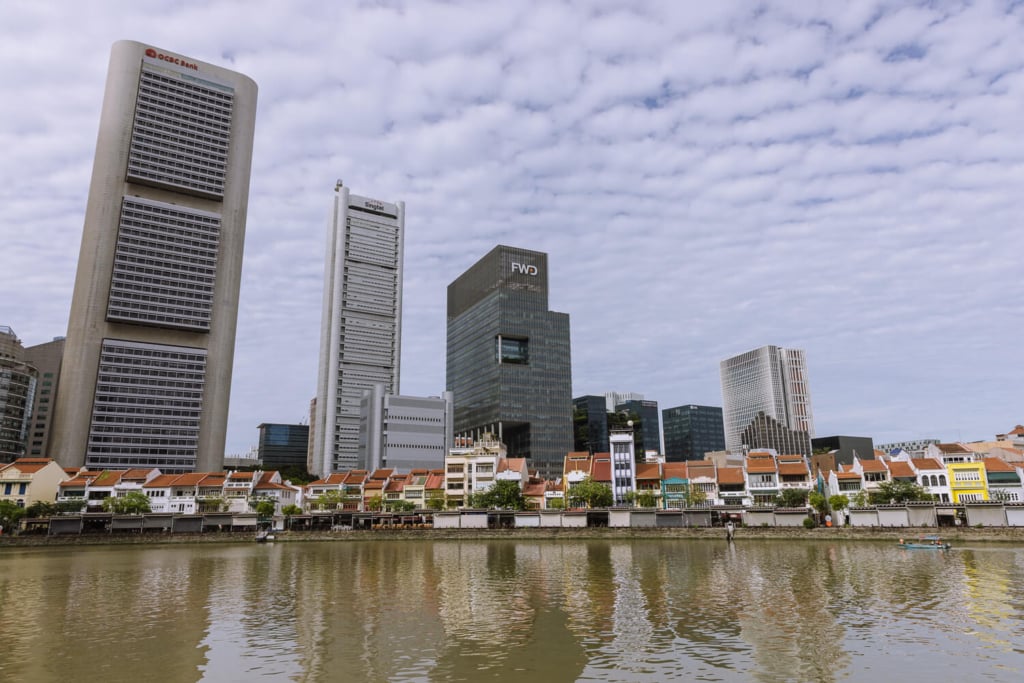

9. Colonial District (CIVIC Centre)
The area north of the river is Singapore’s Colonial District, laid out by Sir Stamford Raffles as the city’s European civic core in the 19th century.
Wonderful neo‑classical buildings serve as a reminder of British rule from the 19th to the mid-20th century.
The old colonial buildings, backed by modern skyscrapers, make it feel like the heart of Singapore.
There are a few notable buildings to check out in the area:
- Raffles Hotel – The city’s most famous colonial hotel. Wander the public areas and arcade, and consider a (pricey) Singapore Sling in the Long Bar (more about that below).
- Asian Civilisations Museum – Trace the origins of Asian cultures, from Islamic West Asia through Southeast Asia to China, in this interesting museum.
- The Fullerton Hotel – A grand former General Post Office turned luxury hotel. Pop into the lobby for a photo opportunity in one of Singapore’s prime addresses.
- St Andrew’s Cathedral – Singapore’s largest cathedral was unfortunately under scaffolding on our last visit, but it is still worth a look.

10. Chinatown
Chinatown is Singapore’s epicurean epicentre. It’s a maze of narrow roads with souvenir shops, boutiques, and trendy wine bars.
We love this diverse part of the city, which is more about the vibe than the must-visit attractions.
The highlight for us in Chinatown is eating and drinking. But here are the main points of interest you might want to visit:
- Buddha Tooth Relic Temple – An eye-catching 5-story Buddhist temple said to hold Buddha’s tooth.
- Chinatown Complex – A hawker centre with an amazing array of street food on Smith Street.
- Thian Hock Keng Temple: One of Singapore’s oldest and most important Hokkien temples.
A great way to see both Chinatown and the Civic Centre is via this well-rated City Highlights Bike Tour.


11. Kampong Glam
Kampong Glam is Singapore’s Muslim Quarter and one of the city’s oldest residential areas.
There aren’t many attractions as such, but it’s a great place to stroll around and soak up Singapore’s diversity. You’ll find a mix of Malay and Arab cultures, heritage sites, colourful streets, and trendy boutiques.
The best streets to explore are Haji Lane and Arab Street, where 19th-century shophouses have been converted into boutiques and restaurants.
The main points of interest are:
- Sultan Mosque – An iconic landmark known for its impressive golden domes and intricate Islamic architecture.
- Malay Heritage Centre – Learn about the contribution of the Malay community in a beautifully restored palace.

12. Little India
Little India is one of Singapore’s most sensory neighbourhoods. The air smells of jasmine and spices, and shop fronts overflow with colourful saris and gold jewellery.
It’s also the grittiest area in Singapore, far removed from the polished Marina Bay area.
On Sundays, Little India transforms as Singapore’s South Asian migrant worker community gathers here on their day off.
It’s not as good as Chinatown or Kampong Glam, in our opinion, but it’s a quick look to get a sense of Singapore’s multicultural history.
The main points of interest are:
- Sri Veeramakaliamman Temple – One of Singapore’s most vivid Hindu temples, dedicated to the goddess Kali. The exterior is covered in intricate sculpted figures.
- Serangoon Road – The heart of the neighbourhood, lined with textile shops, jewellers, and restaurants.
- Tekka Centre – A busy wet market and hawker centre that’s a great place to try roti prata, fish head curry, and other South Indian dishes.
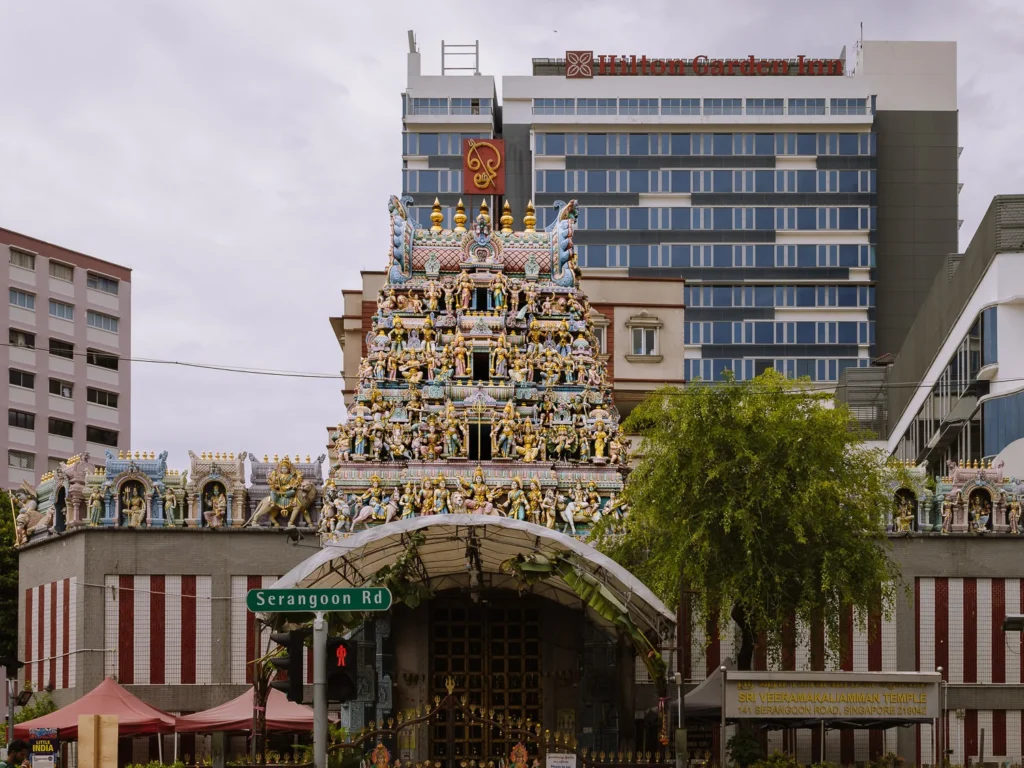
13. Long Bar Raffles
Raffles is a luxury colonial-style hotel in the heart of Singapore, and having a drink in the Long Bar is on everybody’s list.
Although it has had many homes within the hotel, the current Long Bar retains the earthy décor inspired by Malay life in the 1920s.
In keeping with the bar’s relaxed roots, it’s still acceptable to throw your discarded peanut shells on the floor. It’s about the only place in Singapore where littering is tolerated.
The Singapore Sling was invented in the Long Bar. As of our last visit, it is $37. Other cocktails are a slightly more reasonable $28. We were just there for the atmosphere, so we both had a beer.
We had a long queue to enter (about 1 hour). Honestly, if we didn’t write this blog, we probably wouldn’t have bothered waiting that long.


14. Southern Ridges Walk
The Southern Ridges is a 10-kilometre hiking trail connecting 5 of Singapore’s most popular open spaces. These are Kent Ridge Park, Hort Park, Telok Blangah Hill Park, Mount Faber Park, and Labrador Nature Reserve.
Hiking in these green spaces, as skyscrapers flit in and out of view, was the highlight of our last trip to Singapore.
It’s especially good on a hot day when the shady path provides a cool escape from the city.
The best section of the walk is about 6 kilometres long and takes about 2 to 3 hours. It begins at Car Park B at the top of Vigilante Road in the Kent Ridge Park and winds its way eastwards along the top of the ridge.


15. National Museum of Singapore
The National Museum of Singapore is the city’s oldest museum and offers a fascinating look into Singapore’s history. You are guided through the city’s evolution across various engaging exhibitions.
The Singapore History Gallery is a walk-through of the history of early Singapura and modern Singapore.
Modern Colony showcases Singapore’s cosmopolitan life as a British Colony in the 1920s. For us, this was the most interesting section.
Growing Up explores life in Singapore in the 1960s. It’s a great insight into the emerging cultural style and the uncertainty that accompanied Singapore’s new independence.
Tickets: Book skip-the-line tickets for the National Museum of Singapore.


16. Have a Night Out on Amoy Street
Amoy Street in Chinatown has been a popular night-out destination in Singapore for decades. Originally the home to Malay, Chinese, and Arab immigrants, Amoy Street later became the opium-smoking centre of colonial Singapore.
The street’s iconic shophouses you see today were added in the 1830s. Here you’ll find cool bars and cafes catering to food-obsessed Singaporeans.
We loved Amoy Street because it had a great blend of local culture while still being friendly to tourists looking for a good night out.
- Dumpling Darlings – Delicious, creative dumplings and a winning cocktail list.
- Hashida – Top-end dining and a refined experience by master chef Kenjiro Hashida.
- Birds of a Feather – Sichuan flavours in a restored shophouse blending Western cuisine with Asian flair.
- Employees Only – A hidden cocktail bar with a dark and moody speakeasy vibe.

17. Take in the Views from a Rooftop Bar
Singapore’s skyline is worth savouring from above. Rooftop cocktail bars have become a thing recently, so of course, we had to check the mout.
Here are the ones we recommend.
Level 33 is a microbrewery with one of Singapore’s best views. Located in the Marina Bay Financial District, the bar has sweeping views of Marina Bay Sands and the city skyline. To score a good seat on the outdoor deck, it’s a good idea to book in advance.
Cé La Vi is the rooftop bar and restaurant at the Marina Bay Sands Hotel. They have a restaurant and a club, but for the best views, it’s hard to go past the Skybar. Booking ahead is advisable.
SKAI Bar at Swissôtel The Stamford offers awesome views in a Scandi-inspired setting. It’s great for contemporary dining and crafty cocktails.


18. Jewel Changi Airport
More than just a transport hub, Jewel at Changi Airport is one of Singapore’s top attractions. This 10-story dome houses a host of entertainment options, restaurants, and retail outlets.
The highlight is the 40-metre rain vortex, surrounded by a rainforest containing over 2,000 trees.
On the rooftop, you can stroll among 14,000 square meters of gardens, walking trails, and play areas.
You also need to pay for some attractions, including the Hedge Maze, the Walking Nets, and the Canopy Bridge. None of which we thought were particularly worth the cost.


19. Merlion Park
Merlion Park is home to Singapore’s most iconic symbol — the half-lion, half-fish statue that has become synonymous with the city itself.
It’s not somewhere you’ll spend a long time, but it’s an easy and rewarding stop, particularly in the early morning or at dusk when the light over Marina Bay is at its best.
The views across to Marina Bay Sands and the city skyline are great, making for a great photo stop on any first visit.

20. Orchard Road
Orchard Road is Singapore’s most famous shopping street — a 2.2-kilometre boulevard lined with some of the world’s most prestigious malls, department stores, and international brands.
Even if shopping isn’t your main reason for visiting, it’s worth a stroll.
The street has a buzzing, cosmopolitan energy, and the sheer scale and variety of what’s on offer — from luxury flagships to mid-range high street names — is impressive.
Having said that, it’s basically what you’d find in any major city: luxury brands and international chains in massive malls. So, if you are not particularly interested in shopping, this might be a good way to free up some time.

More Things to Do in Singapore
Everything we listed above is the top attractions we think you shouldn’t miss on a trip to Singapore. But if you have more time or are planning your second trip, here are a few other things to consider.
Singapore Flyer
The Singapore Flyer is a 165-metre observation wheel in Singapore’s central district. You get stunning 360° views of the city, including Gardens by the Bay, Marina Bay, and the Singapore River. On a clear day, you can even see Malaysia. Book your skip-the-line Singapore Flyer tickets.
Singapore Zoo
The Singapore Zoo occupies 26 hectares in a forested catchment area on the northwest side of the island. It’s regarded as one of the world’s best rainforest zoos. Open 8 am to 6:30 pm daily. Book skip-the-line Singapore Zoo tickets.
Universal Studios Singapore
Get a dose of adrenaline at Universal Studios Singapore with rides, shows and attractions across various themed sections based on blockbuster movies and TV shows. The park is open from 11 am to 6 pm. Book skip-the-line Universal Studios tickets.
S.e.a. Aquarium
The S.E.A Aquarium on Sentosa is one of the largest aquariums in the world. There are over 100,000 marine animals from over 1,000 species. The experience is designed to be immersive with interactive programmes and close encounters with the animals. Book skip-the-line S.E.A. Aquarium tickets.
Planning & Logistics
Where to Stay in Singapore?
To make the most of Singapore’s compact city centre, we’d suggest staying as centrally located as possible. Chinatown, the Colonial District, and the Marina Bay Sands area are all great choices.
Here are a few places we recommend. We also have a guide to the best places to stay in Singapore, with accommodation suggestions for each of the main areas where you may want to base yourself.
- The Clan by Far East Hospitality ($$$) – Elegant stay with a superb infinity pool and floor-to-ceiling windows with top views. They offer free guided tours.
- Naumi Hotel ($$$) – A stylish Small Luxury Hotel property with all the boutique hotel trimmings, including earthy tones and high-tech bathrooms.
- KINN Capsule ($) – Smart, clean, very budget-friendly cabins in an excellent location near the quays. They have a shared lounge, sun terrace and free WiFi.

Getting Around Singapore
Singapore has a highly efficient public rail system, the MRT (Mass Rapid Transit).
To save some cash, check out the Singapore Tourist Pass. It gives you unlimited travel for 1, 2, or 3 days on all buses and trains.
Taxis are generally easy to get in Singapore. In some places, you’ll find a taxi rank where you need to press a button to call a cab. Uber does not operate in Singapore, but Grab is the most popular ride-sharing app.
When to Go?
Singapore sits just one degree north of the equator, which means it’s hot and humid all year. There is no ideal time to visit.
Temperatures hover between 25-32°C (77-90°F) with minimal seasonal variation. The real difference is rainfall.
The wettest months are December and January, but this time also sees fewer tourists.
June to September generally have the most consistent weather, making it slightly easier to plan.
Tips for Visiting Singapore
- Tap water in Singapore is drinkable, so there’s no need to buy bottled water.
- Happy Hour runs from around 5 pm to 9 pm at bars across the city. It’s a great time to go out.
- Tipping is not expected in Singapore restaurants, but a service charge may be added to your bill.
- Spitting and littering are illegal in Singapore.
- Be prepared for a tropical climate; Singapore is warm and wet.
- If you need an eSIM, we recommend Airalo

How Long Do You Need in Singapore?
From our first visit to Singapore over 20 years ago, there seems to be much more to do nowadays. It’s no longer just a quick stopover between Europe and Asia; Singapore is worth exploring.
To see a good selection of the main attractions, we’d recommend 3 days.
This gives you enough time to see the major attractions without rushing, explore a few neighbourhoods properly, and enjoy Singapore’s incredible food scene. You’ll have time for Gardens by the Bay, the Botanic Gardens, museums, and evenings to experience the different districts.
You can hit the highlights in 2 days, but you’ll be moving quickly. If this is all you have, I would just focus on the Marina Bay area, pick one or two museums, and have a night out around Amoy Street.
Read our 3-day Singapore itinerary to see how we did it.


More Asia / South Pacific Guides
- Top things to do in Sydney
- Our 2-week Cambodia itinerary.
- The best things to do in and around Siem Reap.
- Where to stay in Bangkok – a guide for first-time visitors.
- Visit the beautiful Banaue Rice Terraces in the Philippines.
- The best things to do in Bangkok.
- Best areas to stay in Singapore.
- Our 3-day Bangkok itinerary.
- Our complete itinerary for Sri Lanka.

reader-supported
When you buy through links on our site, we may earn a small affiliate commission at no extra cost to you.
Thanks for your support // Paul & Mark
super – thanks for all of the ideas
You’re welcome.