

By: Mark Barnes // Last Updated:
The Atlas Mountains offer breathtaking landscapes, remote Berber villages, and historic Kasbahs. Explore a traditional way of life and sublime scenery well off the beaten path.
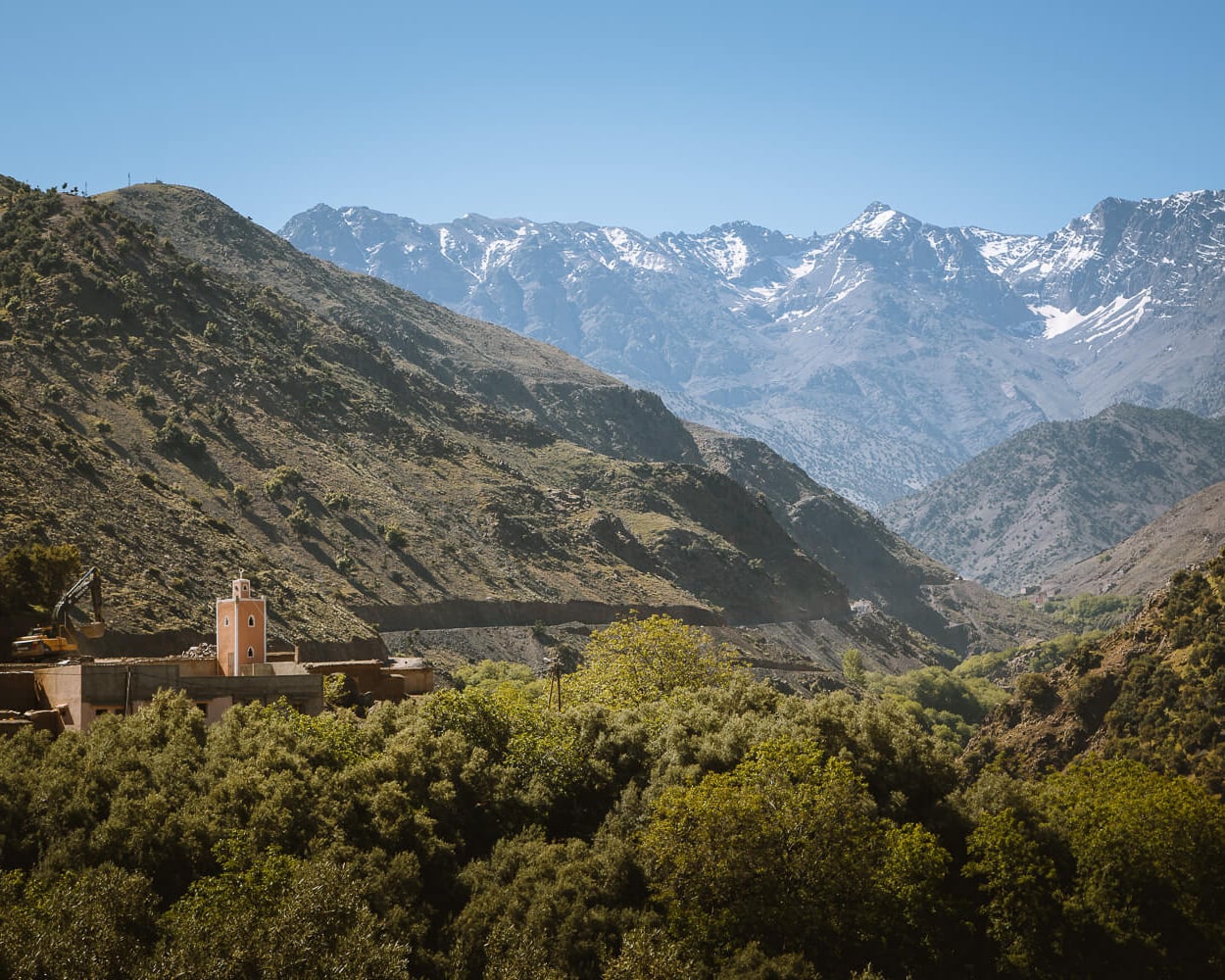
Beneath mountains capped with snow, rivers cut an oasis of life through dramatic red rock canyons.
Women tend to the fields while shepherds escort their nomadic flocks. Children play in riverbanks, and local markets buzz with Berber life.
The mountains of North Africa are diverse and rugged. The Atlas Mountains in Morocco are no exception.
Take a wonderful day hike through a dramatic valley. Explore surreal red rock canyons. Visit evocative ruined Kasbahs immortalised on film.
The Atlas Mountains have always been a highlight of our trips, and they are among our top places to visit in Morocco.

Where Are the Atlas Mountains?
The Atlas Mountains are a series of mountain ranges extending for almost 2,500 kilometers (1,600 miles) across North Africa. They pass through Morocco, Algeria, and Tunisia, separating the Sahara Desert from the Mediterranean Sea.
The High Atlas Mountains are in central Morocco and reach a height of 4,167 meters. This is the highest and most dramatic section of the Atlas Mountains.
On the northern and western edges, more rainfall and gentler slopes create lush green valleys. This ecosystem supports the traditional Berber way of life.
The southern edge is much drier and rockier. Here, red rock canyons weathered over the years have smoothed into breathtaking shapes.

Atlas Mountains Map
To help you get your bearings, our map includes all the top places to visit in the Atlas Mountains in this guide. We have also included our assessment of the road quality for each of the main passes you would need to take.
Click on the top right corner to open our map in your Google Maps app. Click the star next to the title to save it to your Google account.
Places to Visit in the Atlas Mountains
1. Ourika Valley
The Ourika Valley lies in the foothills of the Atlas Mountains. Its expanse of terraced fields and cascading waterfalls is a dramatic change from the dusty Moroccan plains.
Most head to Setti Fattma, the last small town on the paved road that heads up the Ourika Valley. It is the departure point for day hikes into the Atlas Mountains, the most popular of which visits 7 waterfalls.
You can go for a stroll, take a (very chilly) dip, and sit at restaurants perched over the river.
In March and April, the cherry and almond orchards are stunning, and so are the wildflowers that cover the picturesque riverside.
Just over a one-hour drive from Marrakech, it offers an escape to cooler weather. As a result, it can get very busy. But, if you are short on time, it’s a great day trip.
Book // Day tour to Ourika Valley

2. Imlil and Mount Toubkal
Imlil is a small village that has become the centre for high mountain trekking.
It may lack the charm and tradition of other Berber villages in the Atlas Mountains, but it makes up for it in adventure and scenery.
Imlil is surrounded by often snow-capped peaks, the highest of which is Mount Toubkal at 4167 meters.
Almost everyone who makes the journey to Imlil is here for one thing: hiking.
There are several short day hikes around the valley and multi-day treks to the highest peaks.
The most popular is the hike eastwards to the summit of Mount Toubkal. You can complete the hike in as little as two days or over five days, depending on your pace.
Another great option is to hike west to the Azzadene Valley and Ouirgane. This area is home to some of the most traditional Berber villages.

3. Ouirgane Valley
Ouirgane is lower altitude and much warmer than Imlil.
The valley floor near the riverbanks is enriched with plums, blackberries, olives, figs, and almond trees. Whereas up in the hills, onions, potatoes, alfalfa, wheat, and barley sustain a very rural way of life.
It’s a great destination to see how the Berbers use this unique landscape.
You can stay in authentic yet very nice accommodation, close to traditional Berber life. Share a meal with your Berber host. Then end the day lazing by the pool.
What to Do Around Ouirgane
- Take a guided walking tour up to local villages.
- Hike into the Azzadene Valley.
- Driving to Assif Zagawari for stunning scenery.
Read more in our guide to visiting Ouirgane.


4. Cascades D’ouzoud
The Ouzoud Falls are Morocco’s most impressive and a popular day trip from Marrakech.
Tumbling 110 meters, the falls are nestled in a jungle paradise. It can be a relaxing relief from the harsh Moroccan sun.
There are a variety of interesting walks around the canyon and plenty of restaurants to stop for lunch while taking in the scenery.
A path zigzags down the valley wall as spray from the falls clings to dense green foliage and cools the air.
The signs forbidding swimming are ignored by tourists and locals alike. Boat rides are available at very affordable prices, offering a unique vantage point of the falls.
Tour // Day trip from Marrakech to Ouzoud Waterfall


5. Aït Bouguemez
Set in the northern reaches of the High Atlas Mountains, Aït Bouguemez is often considered the most beautiful valley in Morocco.
A patchwork of wheat and barley fields is fed by a maze of irrigation channels dropping from terraced hills.
It’s a sea of green under the towering rocky summit of M’Goun Massif – the third highest in Morocco.
Berber villages dot the landscape, and their way of life is ever-present in the valley.
There are a few riads and hotels providing accommodation and meals, but beyond that, facilities are limited.
Getting here is a little trickier than in other Atlas Mountain destinations.
The paved roads were only completed at the turn of the century, and can be a little hairy in places. But, providing you take care, it’s a great experience. The scenery between Demnat and Aït M’Hamed is particularly stunning.
Aït Bouguemez is excellent for village-to-village hiking in Morocco.


6. Aït Ben Haddou & Ounila Valley
The Ounila Valley carves its way from the high Atlas Mountains to the barren plains just north of the Sahara Desert.
For centuries, it was the caravan route between Marrakech and the Sahara. Tradesmen came to exchange their wares while the powerful extracted their taxes.
The remnants of that power is still clear in the magnificent decaying homes of Telouet Kasbah and Tamdaght Kasbah. Also in the fortified towns of Anmiter and Ait Ben Haddou that line the valley floor.
It’s a stunning landscape of grand ruins set on the edge of rocky red canyons.
Several films have taken advantage of the landscape, including Gladiator, Jesus of Nazareth, Kingdom of Heaven, and Prince of Persia.
The well-paved road that connects the ruins is a fantastic and easy drive.
While the southern end of the valley around Aït Ben Haddou can be busy with tourists, the northern end is equally impressive and largely empty.


7. Dadès Valley
While the northern and western sides of the Atlas Mountains are greener and richer in life, the southern side is a sea of boulders and rock.
Snowmelt from the High Atlas Mountains has cut deep ravines and dramatic valleys. The Dadès Valley is one of the most impressive.
Driving in from the south, the red rock valley gradually narrows until it is a little wider than the road. The drive to Café Timzzillite is the popular Instagram location in the valley, but there’s so much more to see.
The slot canyons and rivulets of Monkey Fingers are breathtaking to explore on foot. Pass beautiful villages, friendly people, nomadic camps, and stunning scenery.
We highly recommend a night at Auberge Chez Pierre for incredible Moroccan cooking in a stunning setting.
We included this area on our 10-day Moroccan road trip.


8. Todra Gorge
Just a couple of hours east of the Dadès Valley is the Todra Gorge.
The most dramatic of the red rock canyons in Morocco, it’s almost 200 meters high and only 10 meters wide at its narrowest point.
It opens onto the Tinghir Oasis, a vast expanse of green that breaks the monotony of the desert. It is a remarkable contrast of red rock boulders and swaying green palms.
The town of Tinghir makes this a much busier place, but drive some of the back roads, and you quickly find yourself all alone.
We also highly recommend this Todra Gorge hike.
Alternatively, stay at Auberge le Festival and follow their network of signed footpaths or ask them to provide you with a guide.
From Todra, you can continue south and east to the Sahara or north across the Atlas Mountains. The paved road to Agoudal and Imilchil is a glorious journey into a much less-visited side of Morocco.


Logistics & Planning
How to Get Around the Atlas Mountains
The Atlas Mountains are more remote but surprisingly accessible for most people. There are 4 ways to get around:
- Take Morocco’s public transport
- Join a tour in a grand taxi
- Drive yourself
- Take a private tour
Public Transport
There are two bus companies serving tourists: CTM and Supratours.
Both run regular buses between Marrakech and Ouarzazate, which take 4 hours and 30 minutes, including a 25-minute break. However, they do not stop at any tourist destinations on the route.
Supratours also runs infrequent services to Kalaat M’Gouna at the bottom of the Roses Valley and Tinghir at the bottom of the Todra Gorge Valley.
Grand Taxis
Grand Taxis are better for getting to some of the smaller towns and villages.
Grand Taxis are large cars that take 4 to 6 people. They operate between fixed destinations at a fixed price and only run when full.
In the cities, they tend to be quite modern, but the more remote you are, the more likely you’ll be in a clapped-out banger.
It can be a social way to travel and a good way to connect cities to more remote destinations such as Aït Bougmez, Ouirgane, and Imlil. Patience is required, however.


Driving in the Atlas Mountains
Once you have arrived at the city or village, you often need to make your way to other sights or attractions.
A better option for exploring the Atlas Mountains is self-driving.
Driving in the Atlas Mountains is easier than many think. The main roads are well-paved and well-signed, petrol stations are frequent, and traffic is usually fairly light.
There are so few road choices that navigation is easy with Google Maps. A road trip in the Atlas Mountains is by far the best way to see the area.
We have some tips in our guide to driving in Morocco.
Do You Need a 4X4 in the Atlas Mountains?
Recently, the road through the Ounila Valley was paved, so all the sights on this list can be accessed by any confident driver in a 2WD.
The exception is Aït Bouguemez, which has a paved road but was in very poor condition on our last trip. While locals happily bounced along in a 2WD, I suspect most tourists would be happier in a 4×4.
The added bonus of hiring a 4×4 means you can head off the main roads and explore.
These more remote roads can range from deteriorating paved roads to gravel piste or boulder-strewn, steep tracks. Clinging to narrow tracks on the edge of precipitous valleys as you head to tiny villages is a lot of fun and enables you to see a very rural and remote side of Morocco.
If you have any questions about road quality or which areas or routes you might need a 4×4 for, please ask us in the comments below.

Tours to the Atlas Mountains
If driving yourself or waiting for buses all sounds like too much hard work, then there are loads of tours zipping around the Atlas Mountains.
The main hub for tours exploring the Atlas Mountains is Marrakech (with its international airport) in the north. Although gradually, Ouarzazate in the south is also starting to offer a range of trips.
Tours usually last 1 to 4 days. Here is a sample of the best tours to the Atlas Mountains.
When to Visit the Atlas Mountains?
The Atlas Mountains are at their most beautiful in spring when flowers line the valley floor and the crops are a bright green.
However, in early spring, snow can be slow to melt, and heavy rainfall can erode the rock supporting roads, making them impassable. So an ideal time to visit is mid-April to late May.
In summer, temperatures rise, wheat and barley turn brown, and snow leaves the tops of the mountains, making the scene slightly less picturesque. The heat can also be stifling at lower altitudes, making walking draining.
After the summer temperatures drop, September to October is also a great time to visit, although the colours are not as vibrant as in spring.
Finally, avoid the winter months from December to March. Snow can cover the high mountain roads, making them impassable.

More Morocco Guides
- Our 10-day Morocco itinerary covers Marrakech, Fez, the Atlas Mountains & the Sahara Desert.
- Read our guide to the most beautiful places to visit in Morocco.
- Our 3-day Marrakech itinerary covers all the big sights plus some local neighbourhoods.
- This walking tour of the Fez Medina is a great way to experience the city.
- Enjoy the beautiful and remote Ouirgane Valley.
- All you need to know about driving in Morocco.
- Take a coastal break with our guide to Essaouira, Morocco.
- Go off the tourist trail in the Atlas Mountains.
- Explore the activities around Ait Ben Haddou.

reader-supported
When you buy through links on our site, we may earn a small affiliate commission at no extra cost to you.
Thanks for your support // Paul & Mark
Really liked the pics and lovely words. Morocco is always magical. Thanks for sharing.
Congratulations to the beatiful pictures and useful informations about Morocco.
Would like to know about road conditions in early November from Marrakech to Ait Ben Haddou. Is there risks of show? Is the road good and safe? I intend to travel by day and stay 1 night there.
Thanks for any advice.
Best wishes.
Hi Mario –
Thanks for your nice comments, glad you found the guide useful. The road to Ai Ben Haddou is very good. The road is generally open all year, but it can be closed when there is snow. In early November it is possible to get snow, so you’ll need to check the condition before you leave.
Paul.
Really comprehensive, well-laid out options and descriptions of each. Much appreciated!
The Atlas Mountains in Morocco are a breathtaking destination that should be on every traveler’s bucket list. With its rolling hills and stunning vistas, it offers a welcome escape from the hustle and bustle of city life. And the best part? Our travel company can help you customize the perfect Morocco tour to make your visit even more memorable. From trekking through the rugged terrain to taking in the views, we will ensure that you have an unforgettable adventure in the heart of Morocco. So what are you waiting for? Let us help you plan your dream trip to the Atlas Mountains today!
Fantastic blogs and great advice. Thank you.
I am travelling with my wife and daughter in October 2023. I was considering visiting Atlas Mountains for a day and rather than returning to Marrakech, moving on to Ourazazte for the night and then seeing the sights there the next day before returning to Marrakech.
Is this possible? If yes, this would mean reducing car travel by a day and enjoying Marrakech for an extra day.
Hi Arun,
Yes that sounds like a good plan. We went from the Atlas Mountains to Ouarzazate on our 10-day Itinerary and it’s a fantastic drive.
We’d suggest going via the Tizi n’Tichka pass, then through Telouet which is a much more interesting drive than taking the main road to Ouarzazate. You could also stop at Aït Ben Haddou on the way. All the details for this drive are on our Ounila Valley guide.
We have a few ideas for what to do around Ouarzazate on our Ouarzazate guide before heading back to Marrakech.
If you haven’t already seen it, here is our guide to the best things to do in Marrakech.
Hope this helps and have a great trip.
Paul.
Amar,
We (2 persons) are interested in a 3-day trip in Atlas Mtns leaving Marrakesh Oct. 26 and returning to Marrakesh airport Sunday morning Oct. 29. Can you assist?
We 3 girls from USA traveled to Morocco for 10 days (from Marrakech to the desert and all the way to fes and Chefchaouen, the blue city.
The experience was OUTSTANDING, we visited many sites of interest; starting from the Atlas Mountain and Ait Ben Haddou kasbah , Hollywood of Africa then to the Sahara desert where we experienced the camel ride to the camp through big dunes enjoying the sunset, sunrise.
Our driver, Addi (he is the best!!) was really knowledgeable, he also have been supersympathetic and kind, he explained everything about their country and Berbers, my thanks to you Addi for the best experience you gave us and what you shared with us, it was great. You made us feel like ‘home away from home’ you made us feel so safe, you took care of us like our own. Thank you so much!!
If you are in dilemma between group tour and private tour, we will strongly recommend the private tour because you can tailor it the way you want to.. number of stops, duration, and get a personalized experience.
I recommend everyone to do this tour with this company, they are the BEST! & ask for Addi as your driver/ guide, you will have an experience you will remember forever. Here is their business website daysmoroccotours.com
I’m an Australian,I visited Morocco in 1968 and stayed in a village called ‘Arbalou’ (sic) in the foothills of the Atlas, there was a hotel being built by our landlord whom we rented a mud brick house off and stayed for a month, I still have photo’s of his family and how it was then,I’m 76 years old now and would like to venture back with my wife and have a nostalgic look around and perhaps meet up again with those wonderful people that I remember for looking after us back then, Is there anybody that can help me with infomation?especially after that terrible ‘Earthquake’? my email adress is edwin_cameron@hotmail.com would appreciate any dialogue.
Hi Edwin, Not sure we can help you here. I don’t know ‘Arbalou’, and could not find it on google maps. Perhaps it’s worth finding a hotel in the area and getting in touch with them. They may well speak English and can help you out. Kind regards, Mark
Hello!
This is really helpful. Are there any updates on which towns/villages are advisable to travel given the earthquake? We were looking at going to ouirgane in February but may go to ourika instead. Secondly, we’re travelling in Feb which is winter I see! Which areas are considered the “high” atlas mountain roads that could be closed, would getting to ourika or ouirgane be easy enough? Thank you!!
Hi Jennifer,
Assuming you are going from Marrakech, there is no high pass to get to Ourika, so you should be able to get there easy enough. Ouirgane is higher and the roads may be closed, so you’d need to check this closer to your dates. Ouirgane also suffered some damange from the earthquake. Currently travel is not advised there, but the situation may change by February.
Hope that helps.
Paul.
Hi, I truly enjoyed your guide, and the thoroughness of details provided. Thank you! My partner and I are planning to rent a 4×4 for Mid-February, for a 10 day road trip, and were hoping to understand:
Are you aware of how road P2028 between Ourika Valley and Imlil is?
Any insight you have is appreciated!
Hi Kalpita, Sorry but we did not take to P2028. We took the P2010 which was absolutely fine. Although the conditions of the roads may well have changed due to the earthquake that occurred since our last visit. Would love to hear how you go on your adventure, so please let us know. I wish I was going with you! Sorry I could not be of more help. Mark
Hi, the information is very helpful. Thank you so much.
My partner and I are visiting mid to end November Morocco and we thought the weather would be nice. Is there snow at that time?
Also, in relation to high atlas we were thinking from Marrakesh, visiting Ourika valley, then Ait ben haddou, Ouarzazate, Kasbah Amridil, Dades Valley, Toddra Gorges (Tinghir) and then head to Erfoud for the desert. We have rented a 2WD car. Do you think this will be sufficient?
Additionally, this is for two days (stay in Ouarzazate and then desert). Is it manageable?
Thank you in advance.
Hi Angela,
Thank you, glad you found it useful.
Generally snow starts in the Atlas Mountains around January / Feburary, but obvious, anything can happen in the mountain. But November it would probably be considered unusual to get snow.
Yes, a 2WD should be sufficient for your trip. We have more information in our Morocco Road Trip itinerary which you might find useful.
Have a great trip.
Paul.
Hi,
You have a very nice website!
Great style, easy to read, great info!
We are going to Marrakech in 2 weeks (beginning of March 2025) and we would rent a Toyota Prado 4×4 for 1 day.
Do you have any tips for a 1 day tour where we can have some “Off-road” fun as well? Just some very basic off-roading or unpaved road driving, not winching or deep sand or anything like that…
Kind Regards,
Joannes
ELUPAS – Automotive & Marine
Hi Joannes,
We have only ever hired a 2WD car and made our way on recognised roads – despite some being in relatively poor condition.
You could try off-roading in the Agafay desert, although I am not quite sure where.
The P2022 between Majjat and Ouirgane was in pretty poor condition and quite adventurous last we went, but that was a few years ago now.
I am sorry not to be of more help. Perhaps your accommodation might have some ideas.
Good luck and let us know what you do.
Mark.