

By: Mark Barnes // Last Updated:
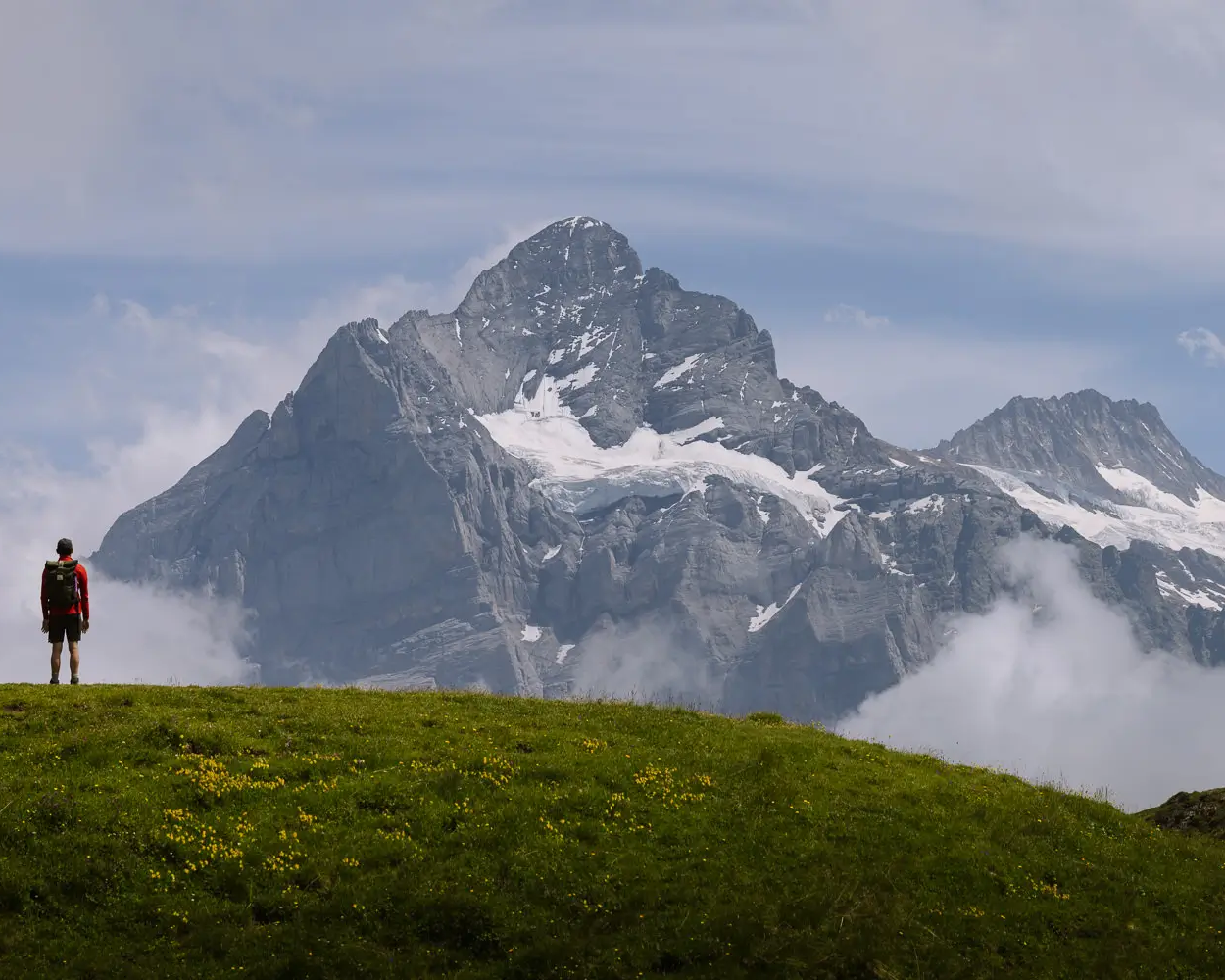
Interlaken is the central hub of the Bernese Oberland, a remarkable Swiss landscape of snow-capped mountains and deep-sided valleys. Here are the best hikes near Interlaken, including maps and trail tips.
The Bernese Oberland is quintessential Switzerland.
Snow-capped mountains overlook grassy meadows dotted with alpine flowers and picture-perfect wooden chalets. Plunging waterfalls cut steep-sided valleys, and turquoise lakes reflect rugged rock faces.
It’s one of the most beautiful places to visit in Switzerland.
At its centre is Interlaken. With a myriad of cable cars and trains connecting a maze of trails, it’s the perfect base for hiking in the region.
Paul and I have been here 3 times and walked many of the trails on multiple occasions. Sometimes drenched in rain and at other times bathed in sun.
After much debate, these are our top hikes near Interlaken organised via easy, medium and challenging. All can be easily reached by public transport.
We have included maps, route instructions, and tips for getting that perfect photo.


Where Is Interlaken?
Interlaken is the central hub of the Bernese Oberland, a mountainous region of Switzerland. It is located southeast of the Swiss capital of Bern.
The region is home to some of the most dramatic mountain scenery in Europe, including many of the highest peaks in the Alps. There are 9 4,000-metre peaks in the Bernese Oberland.
The most famous peaks over 4,000 metres are:
- Finsteraarhorn (4,274 m)
- Mönch (4,107 m)
- Jungfrau (4,158 m)
- Aletschhorn (4,193 m)
Other highlights include the Lauterbrunnen Valley and the turquoise lakes of Brienz and Thun. There are also charming villages, including Wengen, Gimmelwald, and Mürren.
Interlaken is the most convenient place to stay for easy access to the widest range of hiking trails.

If We Had to Pick the Best
Most people only spend three or four days in the Bernese Oberland, so there’s no chance you’d be able to complete all these hikes in one trip.
We’ve hiked a lot in Switzerland, and these are the hikes near Interlaken we think you shouldn’t miss.
- Easy – Männlichen Panorama Trail
- Moderate – Oeschinen Lake Panorama Trail
- Challenging – Schynige Platte to First Hike
Map: Best Hikes Near Interlaken
The map below shows all the routes in this guide. Each hike is colour-coded. All the details are included in the descriptions further down in this guide.
Click on the top right corner to open our map in your Google Maps app. Click the star next to the title to save it to your Google account.
Easy Hikes Near Interlaken
Our 5 easy hikes near Interlaken are under 7 kilometres and can be done in less than 2 hours and 15 minutes. They have relatively little uphill with an ascent of no more than 150 metres.
1. Jungfrau Eiger Walk
This is a great little trail that can be done in conjunction with a visit to Jungfraujoch. The walk only takes 30 minutes; it’s all downhill, and the views are tremendous throughout.
It begins at Eigergletscher Station, which is best accessed via Grindelwald and the new Eiger Express Cable Car or from the Jungfraujoch Train.
From the station, you can almost touch the tongues of snow and ice clinging to the rocky faces of Mönch and Jungfrau.
The hike passes a charming wooden mountain hut that peers over the Lauterbrunnen Valley. It then descends to the artificial lake of Fallbodensee and onto Kleine Scheidegg.
At Kleine Scheidegg, you can take the train back to Grindelwald or Lauterbrunnen, then on to Interlaken.
Keep an eye out for photo opportunities of the Jungfraujoch train as you walk down.
- Distance: 2.5 kilometres (1.5 miles)
- Time: 30 minutes
- Elevation: 260 metres (850 feet) descent
- Difficulty: Easy
- Start: Eigergletscher
- End: Kleine Scheidegg
- Map: Peach trail


2. Grütschalp to Mürren
This easy trail ascends the balcony between Grütschalp and Mürren.
The path goes in and out of trees, revealing glimpses of the stunning Lauterbrunnen valley.
There are grand views across to the town of Wengen and up to the mighty Eiger, Mönch and Jungfrau mountains.
The walk ends in Mürren, where cute wooden chalets surround car-free lanes.
This is an easy and pleasant walk, but you can also get many of the same views on the train that runs between Grütschalp and Mürren. So, you could save your energy for another hike.
- Distance: 4.5 kilometres (2.8 miles)
- Time: 1 hour and 30 minutes
- Elevation: 150 metres (490 feet) ascent
- Difficulty: Easy
- Start: Grütschalp
- End: Mürren
- Map: Light grey trail


3. Männlichen Panorama Trail
This is our favourite of the easy hikes in the Bernese Oberland. The scenery at all times is breathtaking, and it has the best views of the steep-sided Lauterbrunnen Valley.
It starts at the Männlichen Cable Car Station, which overlooks the Lauterbrunnen Valley and the Staubbach Waterfall.
The trail then heads towards Kleine Scheidegg with the trio of snow-capped giants – Eiger, Mönch, and Jungfrau in front of you and the town of Grindelwald on your left.
The path is well-signed and very easy to follow. As you make progress, the 1,800m high, daunting north face of the Eiger becomes more and more imposing.

Just before reaching Kleine Scheidegg, stop at Restaurant Grindelwaldblick for a break. Head up to its watchtower for one of the most scenic views in Switzerland.
From the Männlichen cable car, an optional detour takes you to the Männlichen summit. The views from here are even better. It is a little higher, so it has a better angle looking down the Lauterbrunnen Valley. Add 500 metres each way and 120 metres of ascent and descent to include this detour.
- Distance: 4.6 kilometres (2.85 miles)
- Time: 1 hour 30 minutes
- Elevation: 160 metres (525 feet) descent
- Difficulty: Easy
- Start: Männlichen
- End: Kleine Scheidegg
- Map: Blue trail


4. Lauterbrunnen Valley Walk
The Lauterbrunnen Valley is the most beautiful valley in Europe. Its sheer-sided walls are cut by 72 waterfalls, some of which drop up to 400 metres.
This easy hike follows the valley floor between Stechelberg and Lauterbrunnen. There is almost no ascent or descent, making it a very pleasant stroll in pretty surroundings.
There are also two waterfalls worth a detour.
The first is Trümmelbach Falls (April to November 9 am to 5 pm), Europe’s largest subterranean waterfall carrying up to 20,000 litres of water per second.
Deep inside the valley walls, the 10 roaring falls are accessible by a series of lifts, tunnels, and platforms. Allow 1 to 2 hours to explore the falls. Bring a raincoat and shoes with good grip.
The second is Staubbach Waterfall, a beautiful wisp of water dropping 297 metres. It’s the third-highest waterfall in the Lauterbrunnen Valley, and just a short detour from the path.
This hike is an excellent option for a cloudy day when the tops are all covered. The waterfalls that plunge over the valley walls seem to just appear out of the mist.
- Distance: 6.8 kilometres (4.25 miles)
- Time: 2 hours
- Elevation: 120 metres (395 feet) descent
- Difficulty: Easy
- Start: Stechelberg
- End: Lauterbrunnen
- Map: Green trail


5. Schynige Platte Panoramaweg
This easy circular walk provides rewarding views in all directions, but part of the reason we have included it on the list is the journey getting there.
Take the train from Interlaken to Wilderswil and then change onto the cogwheel train to Schynige Platte. Built in 1892, the vintage train with wooden carriages climbs 1,420 metres over 7.3 kilometres. Winding in and out of the trees, glimpses of 4,000-metre mountains flicker through the windows.
From the Schynige Platte train station, there are several well-signed Panorama Trails of different lengths./p>
The one we have included on our map is the longest, but all of them offer wonderful views. To the south are the high peaks of the Berner Oberland. To the north are the shimmering turquoise lakes of Lake Thun, Brienz, and Interlaken.
There’s a short 150 metre ascent between Schynige Platte and Daube. But the ridge walk from Daube past Oberberghorn towards Loucherhorn is easy and wonderful.
More adventurous hikers will want to include this on the Schynige Platte to First hike, which is number 14 on this list.
Sit on the right-hand side of the train for the best views.
- Distance: 5.6 kilometres (3.7 miles)
- Time: 2 hours and 15 minutes
- Elevation: 150 metres (500 feet) ascent and descent
- Difficulty: Easy to Moderate
- Start & End: Schynige Platte
- Map: Orange trail


Moderate Hikes Near Interlaken
Our 6 moderate walks are up to 9 kilometres long and require a bit more ascent or descent, or walking through snow. They take between 2 hours and 4 hours to complete and are more physically demanding.
6. First to Bachalpsee Hike
This there-and-back hike has tremendous views over Bachalpsee Lake.
It begins at the top of the Grindelwald – First Cable Car Station, where a viewing platform hangs over the Grindelwald Valley.
Next to the platform, the First Cliff Walk is a 300-metre metal walkway suspended on the side of the cliff. You can skip it, but it does mark a dramatic start to the walk.
The wide, easy-to-follow trail now slowly heads up to Bachalpsee Lake. This is one of the most popular hikes near Interlaken, so you won’t have the trail to yourself. But the lake, backed by the triangular shape of Wetterhorn, is one of the finest photo opportunities in the region.
After visiting the lake, return to First, where there are several great family-friendly activities to finish the hike.
The First Flyer is a zipline down to Schreckfeld Cable Car Station, the First Glider drags you backwards from Schreckfeld and then glides you back down at 83 kilometres per hour. There are also mountain cars, trottibikes, and scooters.
- Distance: 6 kilometres (3.75 miles)
- Time: 2 hours and 30 minutes (round trip)
- Elevation: 200 metres (650 feet) ascent and descent
- Difficulty: Easy to Moderate
- Start & End: First
- Map: Yellow trail


7. North Face Trail
This hike can be completed in either direction.
Going downhill from Allmendhubel to Mürren, we would rank it as easy. Going uphill from Mürren to Allmendhubel, we’d call it moderate.
Either way, the trail is well-signed. Simply follow the blue ‘North Face-Trail’ markers at each junction.
The trail is a great exploration of grassy meadows dotted with cute wooden chalets. Cows, pigs, goats, and horses dot the landscape as the path meanders past rustic barns and working farms.
There are grand views up to the Schilthorn and across the upper end of the Lauterbrunnen Valley.
Allmendhubel has a restaurant and play area. Mürren, perched on the edge of a vertical cliff, is one of the more enchanting villages in Switzerland.
- Distance: 6.5 kilometres (4 miles)
- Time: 2 hours 30 minutes
- Elevation: 390 metres (1,280 feet) ascent and 60 metres (200 feet) descent
- Difficulty: Easy to Moderate
- Start: Allmendhubel
- End: Mürren
- Map: Brown trail


8. Mönchsjochhütte
One of the best things to do at the Jungfraujoch is to hike to Mönchsjoch Hut, one of the highest mountain huts accessible without mountaineering experience at 3,658 metres.
All year round, snow and ice surround the rocky pinnacle on which it stands.
Fortunately, it’s only 1.5 miles from the Jungfraujoch Observation Deck at 3,463m. However, hiking through snow at high altitudes often takes longer than you think. We’d recommend allowing 2 hours for the round trip and only going on a fine day.
Mönchsjoch Hut itself is in a wonderful setting, and there can be few better places to warm up with coffee and cake.


A few suggestions for this hike:
- The high-altitude trail can often be closed, so check before you leave.
- It’s very cold at the summit of this hike (zero degrees even in peak summer), so bring warm clothes and waterproof boots.
- It can also be very sunny, and the reflection off the snow can be blinding, so don’t forget your sunglasses and sunblock.
- No mountaineering skills are required; it’s just a simple walk through the snow.
This is a great hike to do if you already plan to take the train up to Jungfraujoch. But make sure you check conditions before making the journey.
- Distance: 4 kilometres (2.5 miles)
- Time: 2 hours
- Elevation: 210 metres (690 feet) ascent and descent
- Difficulty: Moderate
- Start & End: Jungfraujoch
- Map: Black trail

9. Niederhorn Ridge Hike
All the best hikes in the Bernese Oberland listed so far are in the Jungfrau region between Grindelwald, Mürren, and Interlaken.
This hike explores a different part of the region: the ridges to the north of Interlaken with wonderful views over Lake Thun.
Start by taking the Beatenberg Cable Car up to the Niederhorn Cable Car Station and head to the far side of the restaurant to soak in the views of the lake. If you are lucky, paragliders and hang gliders will be hurling themselves from the summit.
Next, head along a magnificent ridge to Burgfeldstand for fine views down into the valley. Then double back and follow the trail through the trees to Vorass.
It’s a good hike if you like wildlife with chances of spotting ibexes, marmots, and even the occasional chamois.
From Vorass, take the cable car back down to Beatenberg.
Although this hike came highly recommended to us, bad weather meant we could not complete it on our last visit. We are saving it for next time.
- Distance: 7.2 kilometres (4.5 miles)
- Time: 3 hours
- Elevation: 110 metres (360 feet) ascent and 480 metres (1,575 feet) descent
- Difficulty: Moderate
- Start: Niederhorn
- End: Vorass
- Map: Dark Blue trail


10. Eiger Trail
The north face of the Eiger is infamous amongst mountaineers. Its 1,800-metre sheer face attracts climbers from all over the world.
The best way to get close to it and understand the challenge (without the risk) is to hike the Eiger Trail.
The path begins at Eigergletscher and heads between steep alpine meadows on one side and the scree slopes of the north face on the other. It’s a lovely narrow mountain trail making its way through grass and rock.
There’s nothing too challenging on the route, and the trail gradually descends.
The views don’t change too much as you are always facing the same way, but there’s something bewitching about walking under the sheer cliff face.
The hike ends at Alpiglen, where a train can take you down to Grindelwald or up to Kleine Scheidegg.
- Distance: 6.15 kilometres (3.8 miles)
- Time: 2 hours 30 minutes
- Elevation: 80 metres (260 feet) ascent and 780 metres (2,550 feet) descent
- Difficulty: Moderate
- Start: Eigergletscher
- End: Alpiglen
- Map: Light green trail


11. Oeschinen Lake Panorama Trail
Oeschinen Lake is one of the most beautiful in Switzerland.
Blue-green waters are surrounded by 3,500-metre-high jagged peaks that rise from its shores. The entire area looks like a massive cauldron of ice and rock. When the sun is shining, its turquoise waters appear incandescent.
A trail called the Panoramaweg winds its way above the lake, providing breathtaking views. It is our favourite of the moderately difficult hikes near Interlaken.
The hike can be undertaken by anyone with a reasonable level of fitness, and the trail is easy to follow and well signed.
Although it’s a little out of the way, it’s worth the effort to get there.
You can read all about it in our Oeschinen Lake Panoramaweg guide.
- Distance: 8.5 kilometres (5.25 miles)
- Time: 3 hours and 45 minutes
- Elevation: 420 metres (1,375 feet) ascent and descent
- Difficulty: Moderate
- Start & End: Oeschinen Cable Car Station
- Map: Aubergine trail


Challenging Hikes Near Interlaken
Our 4 challenging hikes are all over 11 kilometres, taking between 5 and 11 hours to complete. They have over 900 metres of ascent or descent and require a good level of fitness.
The Männlichen to Alpiglen hike is almost in the moderate section. The Hardnergrat should have its own ‘extremely’ challenging section.
12. Männlichen to Alpiglen Hike
This wonderful hike combines three shorter trails and collects many of the best views of the Bernese Oberland region.
It begins at the Männlichen Cable Car Station. From here, you can take an optional detour to the top of Männlichen for excellent views of the Lauterbrunnen Valley.
Next, the trail follows the Männlichen Panoramaweg. This path traverses under the ridgeline towards Kleine Scheidegg. Glorious views of the three mighty peaks of Eiger, Mönch, and Jungfrau tower in front of you.
At Kleine Scheidegg, the path follows the Jungfrau Walk, climbing up to Eigergletscher.
From here it follows the Eiger Trail, which traverses under the mighty north face of the Eiger.

It ends at Alpiglen Train Station, where you can return to most destinations in the Berner Oberland region.
There is nothing technically difficult on this walk, and all the trails are well signed. Restaurant Grindelwaldblick is our choice for lunch. It has a little watchtower to catch the best of the views.
- Distance: 13.25 kilometres (8.25 miles)
- Time: 5 hours
- Elevation: 340 metres (1,115 feet) ascent and 945 metres (3,100 feet) descent
- Difficulty: Moderate
- Start: Männlichen
- End: Alpiglen
- Map: Blue, peach, and light green trails


13. Schilthorn to Mürren Hike
This hike starts from Piz Gloria Cable Car Station at the top of the Schilthorn. The rotating restaurant with 360-degree views featured in the James Bond film, On Her Majesty’s Secret Service.
The first hour of this hike is a lovely walk along a wild rocky ridge.
Although it has steep drops on either side, the path is wide and not too exposed. There are a couple of metal ladders and handrails to assist, and often large piles of rocks to protect you on one side.
At the end of the ridge, the path drops steeply down the flanks of the mountain. This is a long 1,000-metre descent. The rocky trail gradually turns to grassy meadows dotted with alpine flowers. The mountains of the Berner Oberland spread out in front.
The trail can be tricky to spot in places, so make sure you keep referring to the map.
About 90 minutes after leaving the ridge, the trail reaches Rotstochhütte, a perfect spot to stop for lunch.
From here it’s just over 2 hours and 400 additional metres of descent back to Mürren. The last part of the trail is part of the North Face Trail.
It’s a challenging hike that takes about 5 hours walking, but you’ll want to leave at least 6 hours for lunch and photos.
Even if you don’t complete the hike, exploring the paths around the summit of the Schilthorn is a lot of fun.
- Distance: 11 kilometres (6.8 miles)
- Time: 5 hours
- Elevation: 1,400 metres (4,600 feet) descent
- Difficulty: Moderate to Challenging
- Start: Schilthorn
- End: Mürren
- Map: Dark grey trail


14. Schynige Platte to First Hike
If we had to choose one walk as the best hike in Switzerland, this would be it.
It combines two popular walks, the Schynige Platte Panoramaweg and Faulhornweg. Along the way, you’ll encounter grand views of 4,000-metre peaks, turquoise lakes, a lofty summit, a hanging walkway, and a charming mountain hut.
The hike begins at the Schynige Platte Cog Railway Station. The trail follows the Panoramaweg (hike 5 in this list) towards Daube and Oberberghorn with wonderful views down to Interlaken and Lake Brienz.
At Loucherhorn, the Panoramaweg meets up with the Faulhornweg and starts to climb.


The trail winds past a massif cliff face to reach Männdelen Hut. From here, the walk contours under the mountaintop before suddenly appearing on the ridgeline. Magnificent views of multiple 4,000-metre peaks dominate the skyline.
A stiff climb brings you to the top of Faulhorn (2,681m), where a charming hut is the ideal place to stop for lunch. It’s now a gradual descent to Bachalpsee, then onto First.
The day ends with a scenic ride on the Grindelwald-First cable car to Grindelwald, followed by the train back to Interlaken.
There is nothing technically difficult on this trail, but it’s considered challenging because of the distance and the total ascent of 1,000 metres.
Get one of the first two trains to Schynige Platte to allow plenty of time.
- Distance: 16.5 kilometres (10.25 miles)
- Time: 7 hours
- Elevation: 940 metres (3,080 feet) ascent and 740 metres (2,430 feet) descent
- Difficulty: Challenging
- Start: Schynige Platte
- End: First
- Map: Orange, red, and yellow trails


15. Brienzergrat
This challenging 13-mile hike features over 9,000 feet of total elevation change. Additionally, nearly half of the distance is along a very narrow ridge.
It should only be undertaken by very fit people, with plenty of walking experience and no fear of heights. You should also only attempt it on dry, clear days.
The path runs along a thin ridge between the funicular at Harder Kulm (1,321m), with wonderful views down to Interlaken, and the Brienz Rothorn Cable Car & Train Station (2,350m). The best views are in the area around Augstmatthorn (2,167m), where it’s possible to spot a colony of ibex.
If you undertake the walk from Harder Kulm to Rothorn, it is called the Hardnergrat. From Rothorn to Harder Kulm, it’s called the Brienzergrat.

We suggest you do the Brienzergrat starting at Rothorn and ending at Harder Kulm for three reasons:
- The hardest and most interesting part of the walk is towards the Rothorn end, so if you decide the hike is not for you its shorter to turn round and head back.
- There is only 1,100m of ascent in the Brienzergrat direction, rather than 2,030m in the Hardnergrat direction.
- The Harder Kulm cable car stays open much later than the Brienz Rothorn cogwheel train, so you are not rushing as much to get the last cable car down.
We have not actually completed this hike. We took the cogwheel train from Brienz to Rothorn, but the cloud came over, and the wind picked up, so we ended up coming back down.
Tip | Book a seat on the first train in the morning from Brienz to Rothorn. Trains leave one hour earlier on weekends than on weekdays. An extra hour to complete the walk might come in handy.
- Distance: 20.4 kilometres (12.7 miles)
- Time: 9 to 11 hours
- Elevation: 1,100 metres (3,600 feet) ascent and 2,030 metres (6,660 feet) descent
- Difficulty: Extremely Challenging
- Start: Rothorn Train Station
- End: Harder Kulm
- Map: Purple trail


Planning & Logistics
Getting to the Bernese Oberland
The Bernese Oberland is easily reached by train from both of Switzerland’s main international airports.
From Zurich Airport, the journey to Interlaken takes around 2 hours by direct train.
From Geneva Airport, it’s around 2 hours to Interlaken Ost via Bern. Both routes are straightforward and fully covered by the Swiss Travel Pass.
Interlaken is the main gateway to the region and has two train stations — Interlaken West and Interlaken Ost.
Most connections to Grindelwald, Lauterbrunnen, and the mountain railways depart from Interlaken Ost, so it’s worth knowing which station you need before you arrive.
Read all our Switzerland guides to plan your ultimate hiking trip.
Switzerland
Where to Stay in the Bernese Oberland
Interlaken is the most practical base for exploring the region, with the widest choice of accommodation, restaurants, and transport connections.
It sits between Lake Thun and Lake Brienz and gives you easy access to both the Grindelwald and Lauterbrunnen valleys.
If you’d prefer to be closer to the trails, Grindelwald and Lauterbrunnen are both excellent alternatives.
Grindelwald suits hikers focusing on the Männlichen, First, and Eiger trails, while Lauterbrunnen is ideal for the valley walks and access to Mürren and the Schilthorn.
Mürren itself — car-free and perched on a clifftop — is one of the most atmospheric places to stay in the Alps if you’re happy to be based higher up.

How Long Do You Need?
We recommend spending at least three full days in the Bernese Oberland. This gives you enough time to explore the different areas and complete the three best hikes.
- Day 1 – Hike from Schynige Platte to First.
- Day 2 – Hike the Männlichen Panorama Trail combined with visiting either the Jungfraujoch and/or Mürren and the Lauterbrunnen Valley.
- Day 3 – Hike the Oeschinen Lake Panorama Trail.
You could easily spend five to seven days in the area, taking boats on the lakes, trying out the other hikes and visiting pretty villages.
Hiking Tips for the Bernese Oberland
A little preparation goes a long way in the Alps. Here’s what to keep in mind before heading out from our experience:
- Start early — mountain weather can change quickly in the afternoon, with cloud and rain more common after midday in summer.
- Wear layers — even on warm days, temperatures drop significantly at altitude; always carry a mid-layer and a waterproof jacket.
- Footwear matters — proper hiking boots with ankle support are essential for anything above the easy difficulty hike in this guide.
- Sun protection — UV exposure is significantly stronger at altitude; bring high-factor sunscreen, sunglasses, and a hat.
- Carry water and snacks — some trails have mountain huts where you can stop for great food with an excellent view, but don’t rely on them; always carry enough water for the full route.
- Download offline maps — the Switzerland Mobility app (Schweiz Mobil) is excellent and works offline; it covers all marked trails in this guide
- Check conditions — trail closures due to snow or ice are common at higher elevations in early June and late October; check local conditions before setting out at schweizmobil.ch

Getting Around: Transport Tips
The Bernese Oberland has one of the best mountain transport networks in the world, but it pays to plan ahead — especially in peak season.
- Swiss Travel Pass covers most trains, buses, and boats in Switzerland and gives discounts (typically 25–50%) on mountain railways and cable cars, including the Jungfrau Railway, Männlichen Cable Car, and Schilthorn Cable Car — it’s well worth it if you’re spending several days in the region.
- Jungfrau Travel Pass is a regional pass covering unlimited travel on most mountain railways, cable cars, and buses in the Jungfrau region for 3, 4, 5, or 6 consecutive days — ideal if you’re based in the area for a week of hiking.
- Book Jungfraujoch in advance — the train to the “Top of Europe” sells out quickly in July and August; book online ahead of time to secure your preferred departure
- Cable cars and cogwheel trains run seasonally — most operate from late May/early June through to late October; always check the operating dates for your specific route before planning your hike.
- Car-free villages — Mürren and Wengen are both car-free; park at Stechelberg (for Mürren) or Lauterbrunnen (for Wengen) and take the cable car or train up.
- Validate your pass — if using a Swiss Travel Pass or Jungfrau Pass, make sure it’s validated before boarding; inspectors check regularly on mountain routes.

Best Time to Hike in Bernese Oberland
The hiking season in the Bernese Oberland runs from late June to mid-October, when most trails are clear of snow, and the mountain transport network is fully operational.
That said, the best time to visit depends on the type of hiking you’re planning and how much company you want on the trails.
July and August have the warmest temperatures, the longest daylight hours, and guaranteed access to all trails, including the higher-altitude routes like the Mönchsjochhütte and Schynige Platte to First.
These are also the busiest months.
June is a beautiful time to visit; however, some higher trails may still have patches of snow or ice in early June. The Jungfrau Travel Pass and most cable cars are operational from mid-June.
September is our favourite month for hiking in the Bernese Oberland. The summer crowds have thinned, the air is crisp and clear, and the landscapes take on stunning autumnal colours at lower elevations.
Temperatures are still comfortable for a full day on the trails, and accommodation prices often drop after the August peak.
October can still offer good hiking at lower elevations — the valley walks around Lauterbrunnen, and the Männlichen Panorama Trail are still enjoyable well into the month.
However, higher routes can close quickly once the first snowfall arrives, so always check trail status locally at schweizmobil.ch before heading out.


What’s Nearby?
If you are planning a hiking holiday in the area, make sure to read our best hiking destinations in the Alps.
If you want to visit multiple centres, our favourite nearby hiking destinations are Appenzell & Zermatt.
Zermatt is better known as a ski town, but the range of hikes (read our guide: best hikes in Zermatt) is excellent, and the Matterhorn makes a great focal point for photos. It is more desolate and rugged than the Bernese Oberland, and we love hiking here.
Appenzell is much less visited than the others, and the narrow ridge walks surrounded by spiky peaks remind us of the Dolomites. The area is a hidden gem in Switzerland, and we highly recommend visiting. You can read more on our Appenzell Guide.


More Switzerland Guides
- Plan your trip using our 3-day Jungfrau Itinerary.
- Try one of these amazing hikes near Lauterbrunnen.
- See the beautiful Oeschinen Lake on the most scenic hike in the area.
- These hikes near Interlaken range from Easy to Challenging.
- Ready for a city break? We loved medieval Bern.
- Here are the best things to do in Lucerne.
- Looking for more? Read about our favourite places to visit in Switzerland.
- These are our 12 favourite hikes in Switzerland.

reader-supported
When you buy through links on our site, we may earn a small affiliate commission at no extra cost to you.
Thanks for your support // Paul & Mark