

By: Mark Barnes // Last Updated:
This free 4-hour self-guided walk sees all the best parts of Richmond Park and Village. It starts and ends at Richmond Station, and visits hidden gardens, a National Trust mansion, and numerous excellent pubs. Here’s the full route with map and instructions.
We love this walk because it’s a mix of London’s wildest park and best riverside village.
It starts among Georgian townhouses and cobbled lanes, then within twenty minutes you’re climbing through wild open parkland with deer grazing just metres away and the city nowhere in sight.
The views are excellent, stretching to Windsor Castle in one direction and St. Paul’s in the other. There’s wildlife everywhere, from red and fallow deer to herons and skylarks. And on a spring day, the colourful gardens in Isabella Plantation and Pembroke Lodge are spectacular.
The walk ends with the grandeur of National Trust-run Ham House and a leisurely stroll along the Thames.
As with all our walks, there are several great options for lunch, and three pubs to choose from for an end-of-walk pint.
The circular walk begins and ends at Richmond Station. It is 9.2 miles (14.8km) and takes around four hours at a steady pace or a full day with stops.
The post includes a map and instructions along with restaurant and pub recommendations. The walk itself is free, though Ham House charges an entry fee.
It’s one of our favourite walks in London, and a highlight of our London self-guided walks series.


Richmond Park Walk Overview
- Start / End – Richmond Station
- Distance – 9.2 miles (14.8 kilometres)
- Walking Time – 4 hours
- Best For – London’s wildest park and riverside village
The walk begins at Richmond Station and starts by exploring the charming village of Richmond, with its numerous cafes and brunch spots.
It then ascends Hill Rise to Richmond’s Terraced Gardens for grand views over Petersham Meadows and the River Thames, before entering Richmond Park.
There are hundreds of trails traversing the park, but we have picked a route that passes the best parts. Along the way, you’ll see birdlife around Pen Ponds, exotic plants in Isabella Plantation, colourful garden beds around Pembroke Lodge, and sweeping views from Henry’s Mound.
Along the way, keep an eye out for red and fallow deer, nesting skylarks, and the odd red fox, rabbit, or vole.
The route now descends into Petersham (a great spot for lunch) and its imposing 17th-century National Trust-run Ham House.
From there, it’s a wonderful walk along the Thames Footpath back into Richmond Village. Here you can explore the film locations used in Ted Lasso and pick from one of three excellent pubs for an end-of-walk pint, before returning to Richmond Station.
You can complete this circular walk in either direction, but we recommend going clockwise. That way, the coffee and brunch spots are at the start of the walk, and the pubs are at the end.
If you walk without stopping, it will take about 4 hours. But stop for coffee, lunch, and a pint, and it’ll take most of the day.
The walk is free, but it costs to enter Ham House (unless you are a National Trust member).


Map: Richmond Park Walk
Below is a map of the walk. We have marked the main attractions, so you don’t miss any of the sights. We have also included our coffee, lunch, and pub recommendations along the route.
If you have the map open on your phone as you walk around, you can follow your progress.
You can also use an OS Map of the route.
Click on the top right corner to open our map in your Google Maps app. Click the star next to the title to save it to your Google account.
When to Do the Walk
This walk is great any time of year.
In spring, the azaleas and rhododendrons in Isabella Plantation and the flowers in Pembroke Lodge are spectacular. In summer, the mix of walking along the Thames and pushing your way through the high bracken and burnt grasses of the park is fun. And in winter, the pubs in Richmond are a great way to warm up after a winter walk.
However, our favourite season is autumn. The red, yellow, and orange leaves in the park are magnificent, and if you are lucky, you can see the deer rutting.
Start mid-morning and either take a picnic for lunch, stop at one of the kiosks in Richmond Park, or get a bite at Petersham Nurseries. Then, in the late afternoon, grab a pint at one of Richmond’s excellent pubs before heading home.
The walk is on a mix of pavements, sandy gravel tracks, and earthen grassy paths. It is dog-friendly, though you will need to keep your dog on a lead in certain sections of the park – especially where skylarks nest on the ground.
Where to Eat & Drink
This walk starts and ends in Richmond Village, which has tons of restaurants, coffee shops and pubs. Richmond Park itself has several kiosks serving snacks and drinks, and Petersham has the excellent Petersham Nurseries restaurant and teahouse.
Here are the places we recommend, in the order you’ll reach them on the route.
Ole & Steen – On George Street, just a short walk from Richmond Station. it serves solidly good coffee and some excellent baked goods.
Kapucin – Our pick for brunch, this tiny cafe on Hill Rise has two tables on the pavement, perfect for enjoying their freshly baked pastries and homemade brunch before heading into the park.
Richmond Park Kiosks – The walk passes two food kiosks in Richmond Park; Pen Ponds Kiosk and Pembroke Lodge Kiosk. Both serve snacks such as bacon baps and hot dogs, as well as flapjacks and other baked goods. The ice latte is a great option on a warm day.
Petersham Nurseries – This destination restaurant is our recommendation for a more substantial lunch. There are two options, both beautifully set amongst the plants in the nursery. The Teahouse (11 am to 4:30 pm) serves excellent light lunches using wholesome ingredients (walk-in only). Whereas the main restaurant is much smarter with 2-course (£70) or 3-course (£80) options (book ahead – especially at weekends). If you are making a reservation, the restaurant is about 2/3 of the way around the walk.
Gaucho – Towards the end of the walk, as you reach Richmond Village, there are plenty of restaurants with fine views over the river. Our pick is Gaucho. It has lovely outdoor seating set under the trees with the Thames just a stone’s throw away.
Richmond Village Pubs – Richmond has many pubs, but we always find ourselves drawn to one of these three.
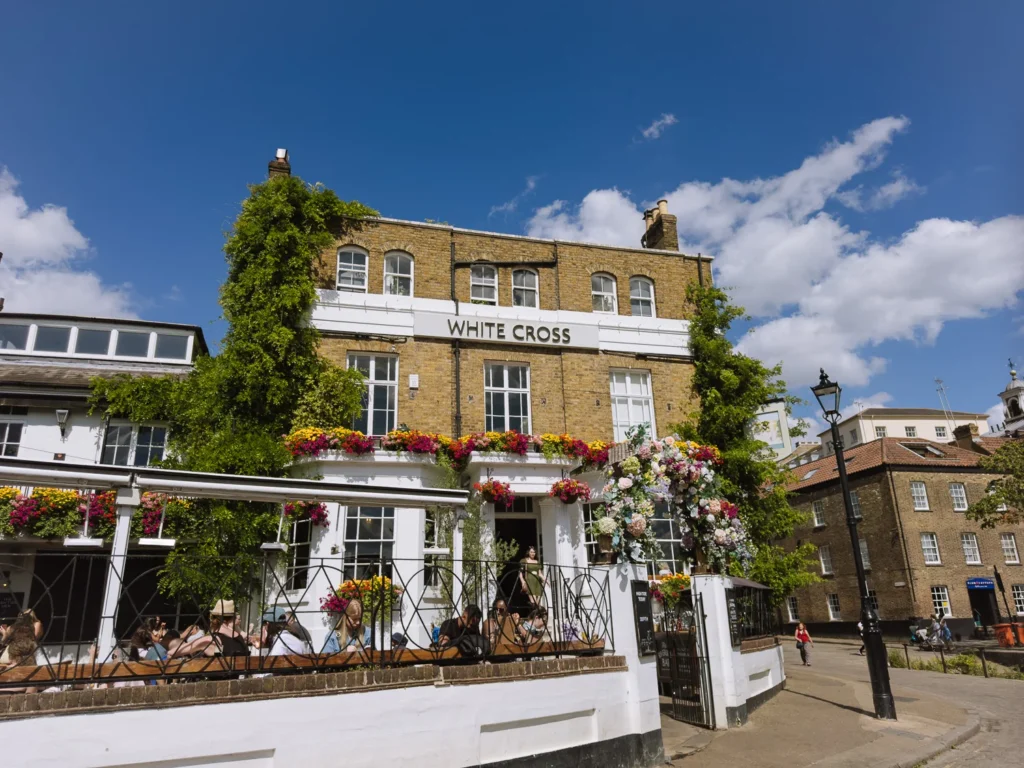
- The White Cross — So close to the River Thames that it often floods, this Richmond institution is the place to come to on a warm summer’s day. Grab one of the high stools looking over the river and savour that well-earned pint.
- The White Swan — We tend to come here in autumn and winter for its real fires and Sunday Roasts. Built in 1787 it is a tiny, warm and cosy place to settle down.
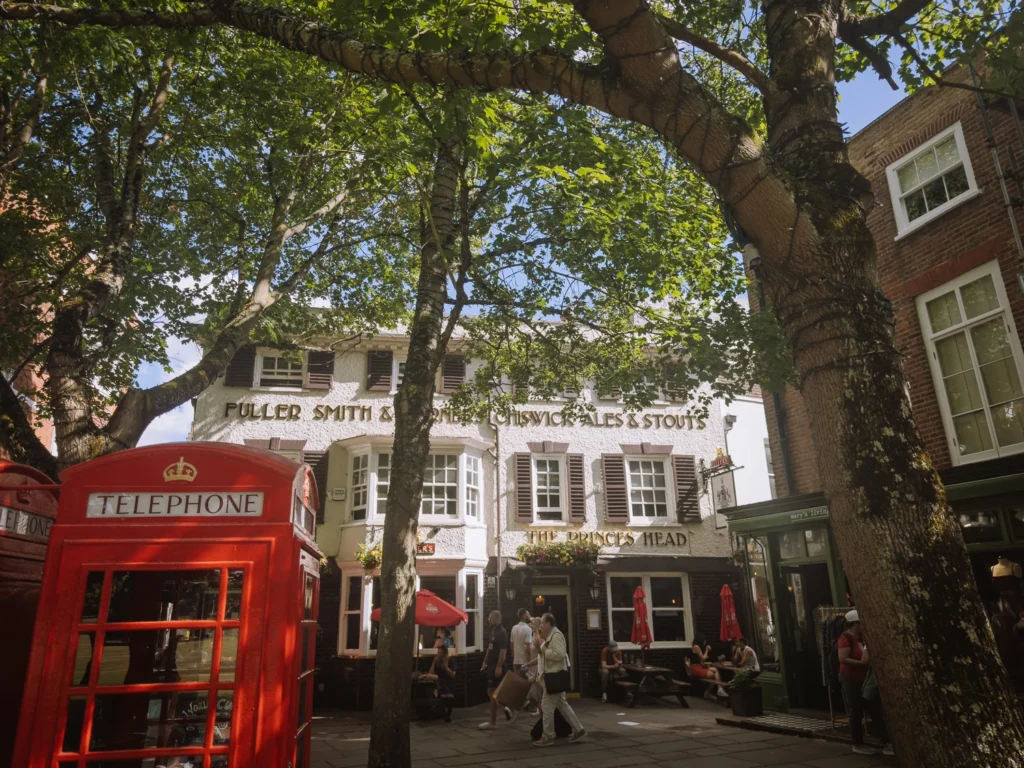
- The Prince’s Head — Overlooking Richmond Green, the pub became famous as ‘The Crown and Anchor’ in the TV series Ted Lasso. Sadly, you are unlikely to be served by Annette Badland, who played the no-nonsense landlady Mae Green in the show.
Our Self-Guided Richmond Park Walk
Richmond Village
The walk begins in Richmond, a leafy, gentrified Thames-side corner of southwest London with Georgian townhouses and cobbled lanes.
Take the District Underground Line or main line South Western Railway (from Waterloo) to Richmond Station and follow the route on the map above.
Exiting the station, turn left onto The Quadrant, which quickly turns into George Street. We often take a quick detour to Electric Coffee Richmond for our morning caffeine fix, then grab a pastry from Ole and Steen, before setting off.
At the end of George Street, turn left onto Hill Street, and when the road splits take the left fork which ascends Hill Rise. Here you’ll find Kapucin, a great option for a pavement brunch before heading into the park.
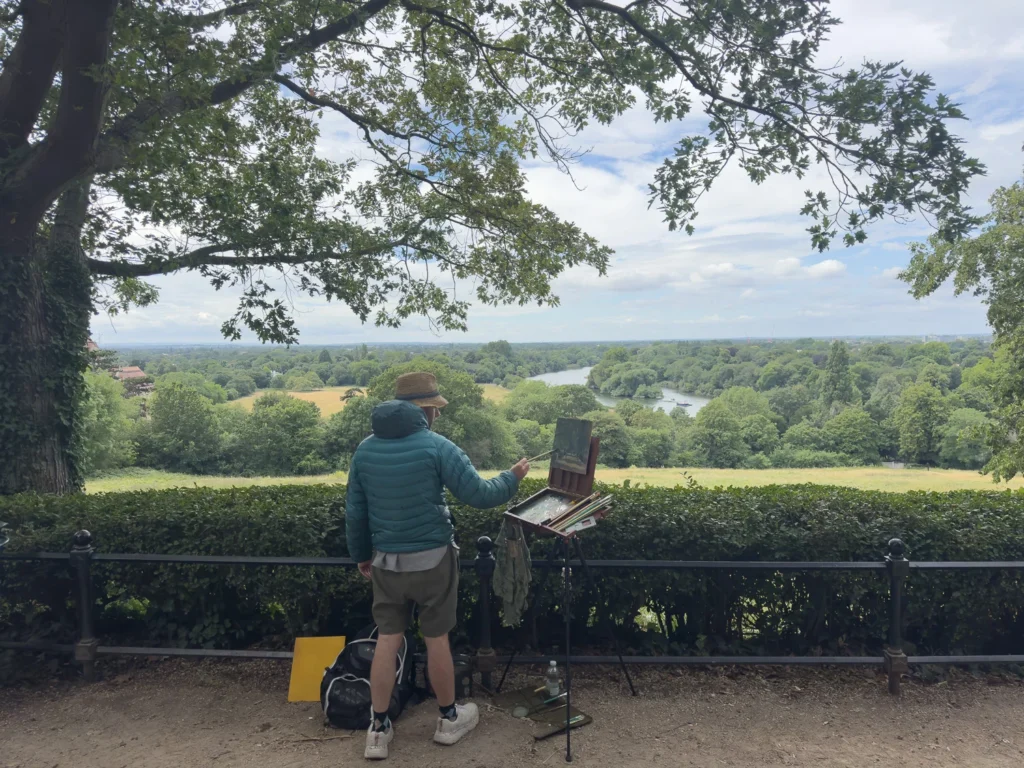
Hill Rise turns into Richmond Hill and shops give way to residential flats and homes. On your right, views open up over Richmond’s Terraced Gardens and the River Thames below.
An information board highlights the most striking buildings, including the Victorian Gothic Petersham Hotel and Ham House, rising out of the trees in the distance. Last time we were here, an artist was painting the scene.
Continue up the hill, cross over a roundabout, and enter the park through Richmond Gate.

Richmond Park
Richmond Park is the largest of London’s Royal Parks, sprawling across nearly 2,500 acres of ancient woodland, grassland, and ponds on the edge of southwest London.
It’s been a royal hunting ground since the days of Charles I, and that history still shows in its wildness — over 600 red and fallow deer roam freely here, largely unbothered by the joggers, cyclists, and dog walkers who share the space.
Paths criss-cross the park, but we have picked our favourite route, which captures all the highlights. We have described the route below, but its probably easier to follow on the maps above.
After entering the park, pass a roundabout, then almost immediately after, turn right and cross over Sawyer’s Hill Road. Now follow a sandy-gravel track, which, after about 100m, splits. Take the left turn and follow another sandy-gravel track, which skirts the northern edge of Sidmouth Wood.
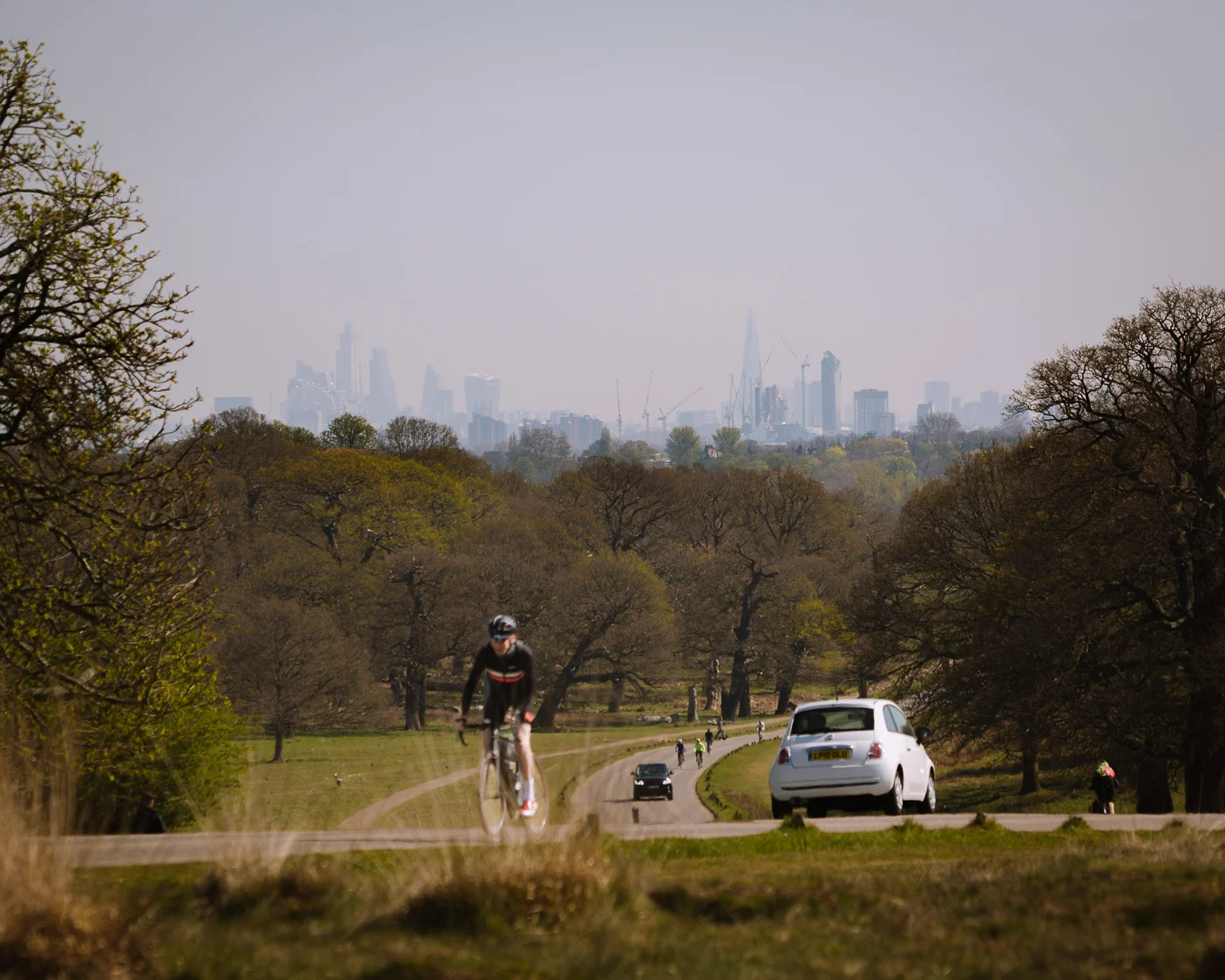
Peer into the distance and you can see views of the city, the Shard, and Canary Wharf, shimmering in the distance.
When the path reaches the end of the fenced wood, it splits. Stay right on the lighter, less-sandy trail, keeping the fenced wood on your right. The path now gradually descends to Pen Ponds.


Pen Ponds
Pen Ponds sit at the heart of Richmond Park — two linked lakes that were originally dug in the 18th century for gravel extraction and now form one of the park’s most popular spots for wildlife-watching. They draw a steady cast of herons, great crested grebes, and other waterfowl.
Although the water is inviting, no swimming is allowed, and dogs need to be kept on leads.
After passing between the two ponds, turn immediately left and take the path through the bracken along the banks of the pond. At the end of the pond, keep straight for 200m, then turn right on Queens Ride and head uphill towards White Lodge.
This section of the walk is excellent for spotting deer. Last time we were here, a small herd were gathered under the trees. Come in autumn, and you may be lucky enough to see them rutting.
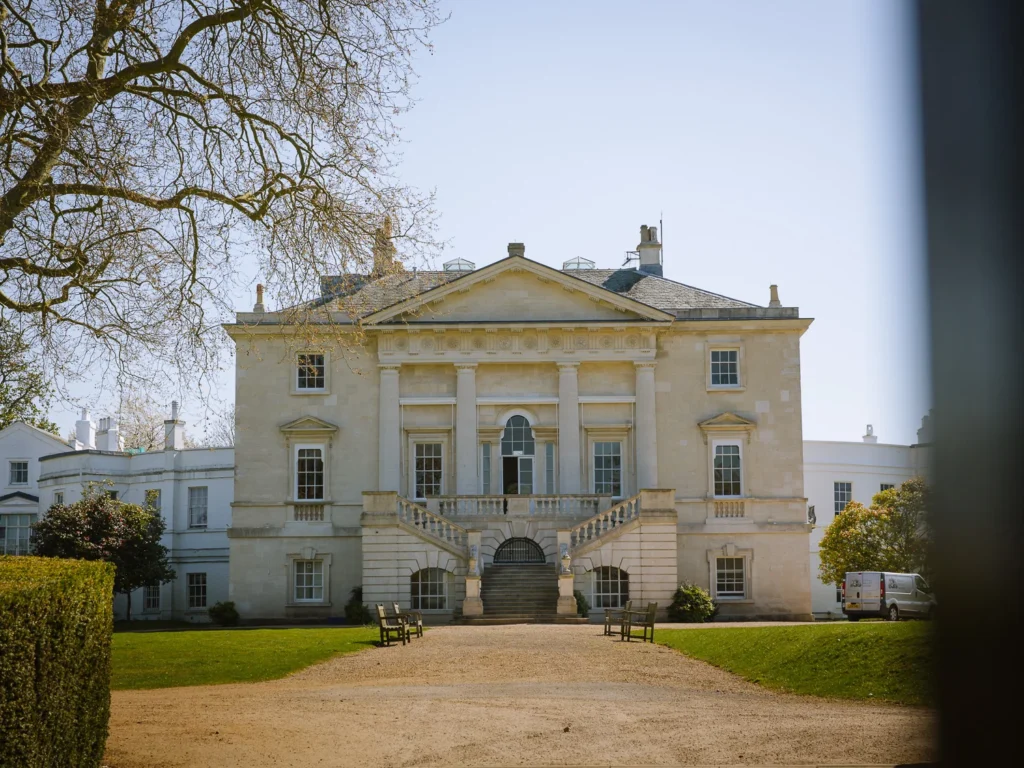
White Lodge is an elegant 18th-century Palladian villa built originally as a royal hunting lodge for George II and later home to several members of the Royal Family, including briefly the young Princess Elizabeth.
Today, it houses the Royal Ballet School and is closed to the public, but you can peer through the black iron gates to its striking facade.
Turn right at the lodge and follow the tarmac road past Spankers Hill Wood to Pen Ponds Kiosk. This little kiosk serves basic snacks and drinks; it’s a great spot for a rest or having a homemade picnic, and there’s a decent chance of seeing deer nearby.
Isabella Plantation
Take the sandy-gravel path that leaves from the left-hand side of Pen Ponds Kiosk (as you face it). Cross over the cycle track and continue on the trail as it slowly climbs.
Just as you reach the top of the hill, leave the sandy-gravel trail (which bends left) and follow the path with two tyre tracks, which descends to the Brookfield Hill Gate Entrance to Isabella Plantation.
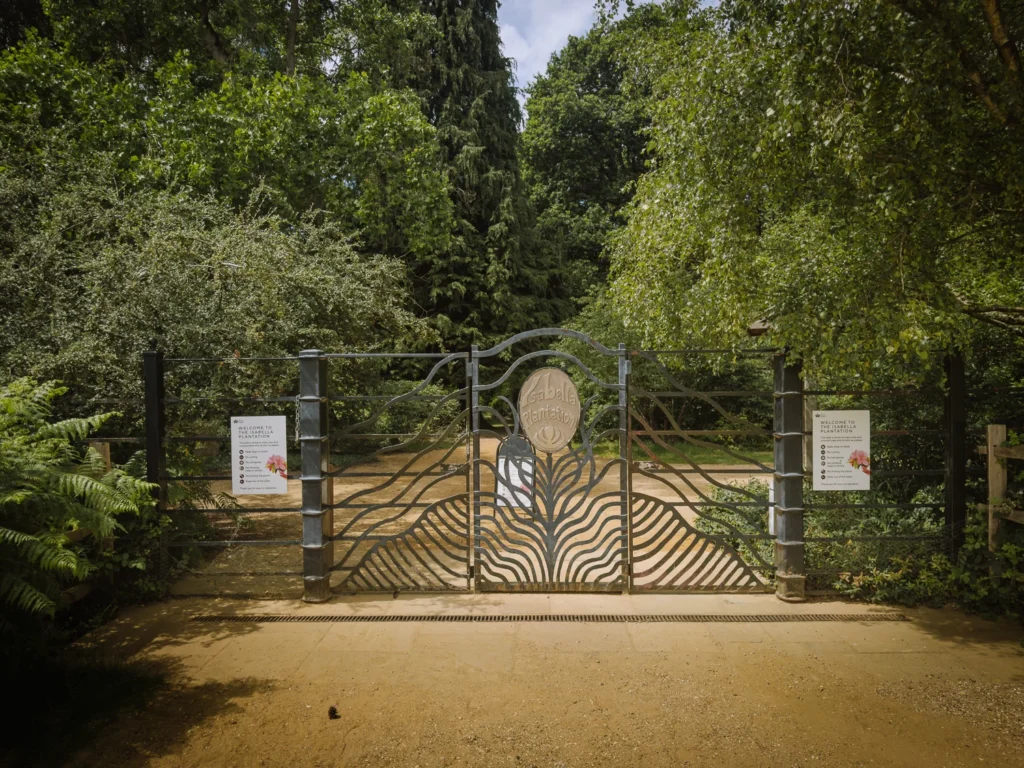
Isabella Plantation is a 40-acre woodland garden tucked into the southwest corner of Richmond Park, first planted in the 1830s and later developed from the 1950s onwards into the ornamental gem it is today.
It’s best known for its spectacular collection of azaleas and rhododendrons, which erupt into colour throughout April and May, but it’s worth popping in any time of year. Camellias bloom in late winter, bluebells and irises appear through spring and early summer, and Japanese maples bring rich colours in autumn.
Fenced on all sides, it’s like a secret garden within the much bigger park. There are three different routes through the garden. A map at the entrance shows you the options. Take your or simply walk all three of them, making sure you exit at Peg’s Ponds Gate.
There are toilets at both the entrance and exit gates.
Pembroke Lodge
Exit the plantation at Peg’s Pond Gate. Keep straight and make a beeline for Queen’s Road. Turn right on the sandy-gravel track just before the road and wind your way to Pembroke Lodge.
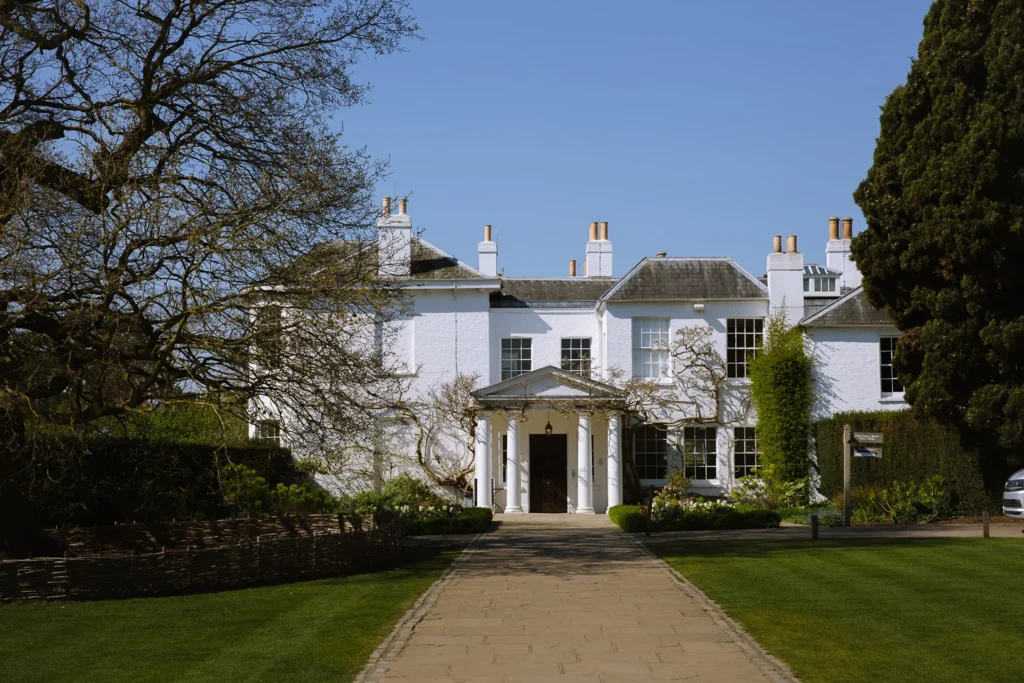
Pembroke Lodge is a Georgian mansion perched high on Richmond Hill. It was once the childhood home of philosopher Bertrand Russell, whose grandfather Lord John Russell was granted use of the house by Queen Victoria. Today, it is a function venue, and we have attended two excellent weddings here over the years.
There is a snack shop and toilets near the entrance gate.
Enter the grounds through the large metal gate and head towards the mansion. It is not possible to enter the building, but the grounds are stunning. Turn right and head into Pembroke Lodge Gardens.
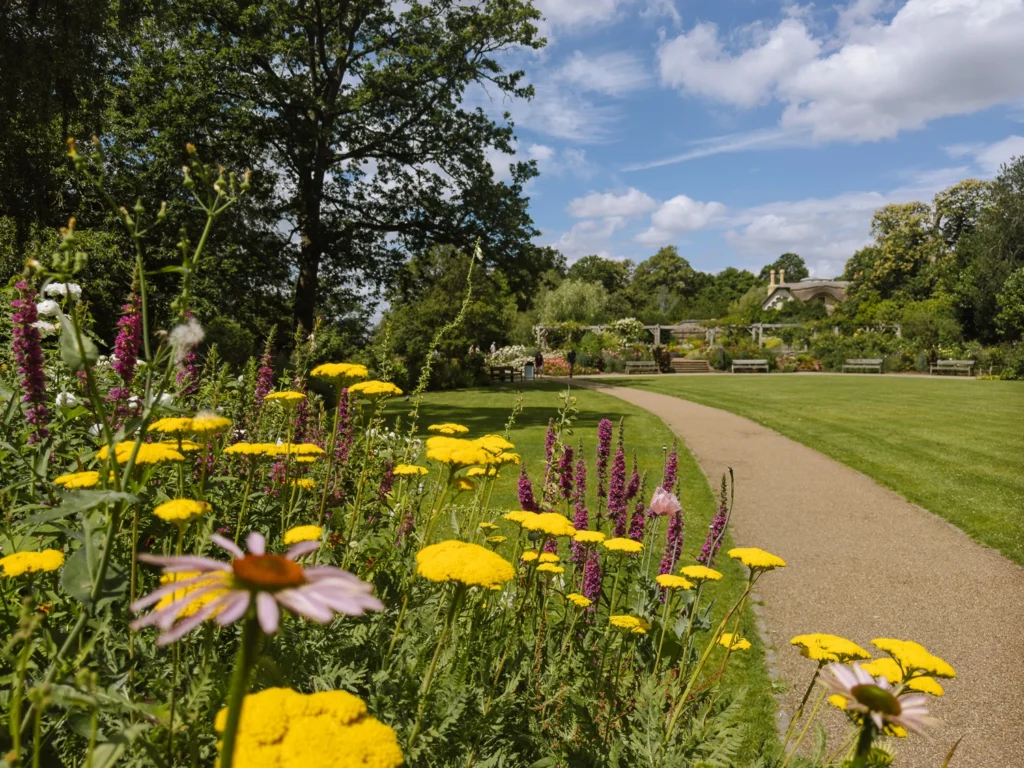
In spring and summer, the landscaped lawn is surrounded by a profusion of flowers. A winding path connects it to sweeping terraces and finally to King Henry’s Mound.
King Henry’s Mound is a small, ancient hill thought to be a Bronze Age burial mound and later, according to tradition, the spot from where Henry VIII watched for the signal confirming Anne Boleyn’s execution in 1536.
The mound has a legally safeguarded view that runs ten miles from west to east, and frames St. Paul’s Cathedral between a topiary of plants. There’s a telescope on the mound. Line it up using the finder before focusing the main scope.
From the mound, there are also fine views across the Thames Valley. Windsor Castle can be made out in the distance, as can (the slightly less attractive) Heathrow Airport.
You can also see the path you need to take down to Petersham. Exit the gardens through a metal gate and follow the path signed to Petersham Playground. At the bottom of the hill, exit Richmond Park at Petersham Gate (toilets).
Petersham Nurseries
Exiting the gate, cross straight over the road and down a narrow footpath between two houses. Turn left (past a graveyard), then right (with fields on your right), then left again to find yourself walking through Petersham Nurseries car park.
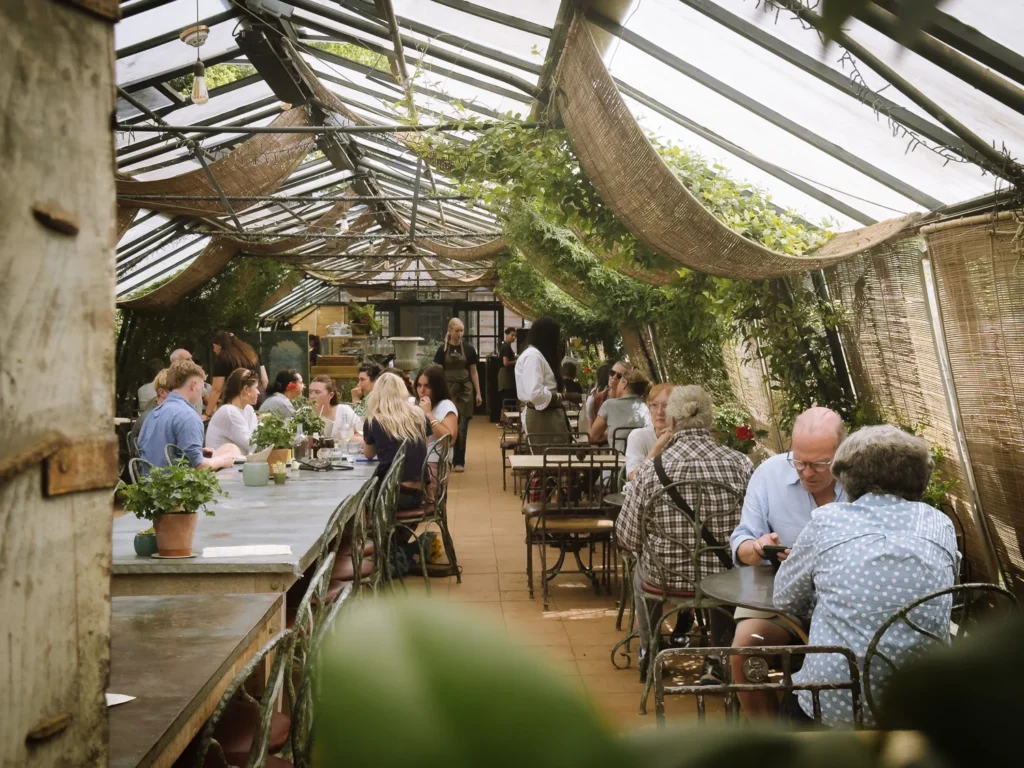
Petersham Nurseries is a beautifully ramshackle garden centre and restaurant founded by Gael and Francesco Boglione in the early 2000s. It has built a reputation among London’s food crowd for elegant, produce-driven Italian-inspired cooking in a secret garden setting. There are two options to grab lunch.
The smarter Restaurant or The Teahouse. We don’t often feel like a top-end meal while on a walk, but The Teahouse is a great choice. Light lunches are served in a stunning glasshouse with dirt floors, mismatched furniture, and dappled light filtering through the vines.
Even if you don’t eat here, it’s worth pottering around the outdoor beds full of plants, pots, and cut flowers for sale, plus a scattering of homeware and gift shops.
Exit the Nursery, turn left and continue along a very narrow pathway, crossing over River Lane. The path ends at a T-junction; turn left, then right along Ham Avenue (a path with trees lining either side and Ham Polo Club on your right).
At The Avenues (the junction of Ham Avenue and Ham House), turn right and follow the trail along the edge of Ham House and Garden to reach its imposing facade, perched on the River Thames.
Ham House & Garden
Ham House is a magnificent 17th-century mansion sitting on the banks of the Thames. It is widely regarded as one of the most complete surviving examples of Stuart architecture and interiors anywhere in Britain.
Built in 1610, it retains much of its original furniture, textiles, and artwork, offering an unusually vivid sense of how a grand household actually lived.
The gardens are a faithfully restored example of a 17th-century formal garden, with clipped hedges, a kitchen garden, an orangery, and the atmospheric Cherry Garden laid out in geometric parterres.
It is run by the National Trust and is well worth popping into. The house is open from 11.30 am to 3.30 pm, and the gardens are open from 10 am to 5pm. It costs £19.80 for adults (members are free). If you plan to enter, you may want to start the walk a bit earlier.
Returning to the walk, turn left and follow the south bank of the Thames Footpath into Richmond.

Thames Footpath
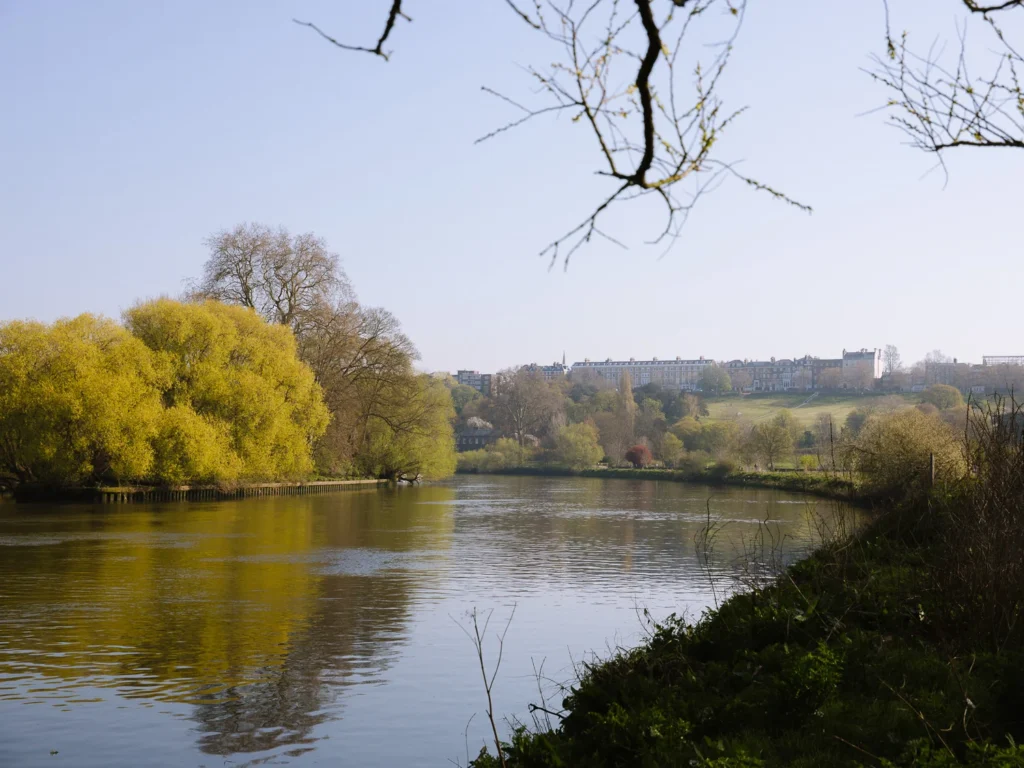
The walk now follows the Thames. It skirts Petersham Meadows with views back up to the Gothic Petersham Hotel, cuts through the Buccleuch Gardens and passes Gaucho Richmond restaurant (another good spot for a late lunch)
If you fancy a row on the river, boats can be hired from under Richmond Bridge. If a pint is more what you are after, then there are three great options along the final stretch of the walk.
First up, the White Cross is a Richmond institution. So close to the river that it often floods, this is where we head on a warm summer’s day.
Second up is the White Swan. Continue along the Thames footpath, turn right (just before Twickenham Bridge) onto Old Palace Lane, and the pub is on your left. Small, cosy and full of character, it’s a great place to head here on wet or cold days.
Ted Lasso Film Locations
Finally, turn right on The Green, and you’ll find The Prince’s Head. Known as the ‘Crown and Anchor’, it features in the Ted Lasso TV series, which is one of our favourite shows of all time.
Head inside and you’ll immediately recognise the bar where Mae Green served AFC Richmond fans in the show. Outside tables have an enviable spot on the edge of Richmond Green.
Ted Lasso fans should also make sure to explore the Paved Court, which regularly appeared on the show, and the Ted Lasso shop, which sells branded hats, cups, and clothes.
All that’s left is to head along the eastern side of The Green, then along Little Green Road before cutting right through a passageway signed to the Orange Tree Theatre. The passageway ends at Richmond Station and your train home.
We have curated lots of walks like this. To explore the others, read our best Walks in London.
More London Self-Guided Walking Guides
- Our favourite 15 walks in London with maps.
- See the best Shoreditch Street Art on our self-guided walking route.
- Enjoy the picturesque stroll along the Regent’s Canal Walk.
- Explore one of London’s best green spaces on our Hampstead Heath Walk.
- Take the iconic walk through Regent’s Park and Camden Town.
- See the grandeur of London on our Royal Parks & Palaces Walk.
- See the best Instagram spots on our Notting Hill Walk.
- Explore the heart of historic London on our City of London Walking Tour.
- Take a historic stroll along the Queen’s Walk in London.
- Our Southbank London Walk covers several iconic landmarks.
- See the best of the lights on our Christmas Lights Walking Route.
- Explore old and new London in our Greenwich to Tower of London Walk.

reader-supported
When you buy through links on our site, we may earn a small affiliate commission at no extra cost to you.
Thanks for your support // Paul & Mark