

By: Paul Healy // Last Updated:
At the junction of the Mekong and Tonlé Sap Rivers lies a city with a tortured past that is emerging as one of Asia’s coolest destinations. Here’s our guide to the best things to do in Phnom Penh.
We’ve been to Phnom Penh a few times now, and it remains an understated classic, in our opinion.
Dusty but leafy streets give it a lovely, village-like feel, while grand palaces and world-class museums position Phnom Penh as a modern international city.
But it also has a long and painful history. Cambodia’s harrowing past is brought to life in meaningful memorials that, while confronting, are important in understanding the compelling resistance of the Cambodian people.
Phnom Penh has all the intensity of Asian culture in a town that can be both quiet and hectic, chilled yet buzzing with atmosphere.
Here are all our favourite things to do in Phnom Penh.


Map: Phnom Penh Attractions
All our highlights from Phnom Penh are on the map below. To help you put your trip together, our Cambodia itinerary includes suggestions for getting around Phnom Penh.
Click on the top right corner to open our map in your Google Maps app. Click the star next to the title to save it to your Google account.
What to Do in Phnom Penh
1. Sosoro Museum
The Cambodian Museum of Economy and Money, the Sosoro Museum, provides a unique perspective of the important links between money, politics and power.
We thought it was a fascinating, well-organised museum and one of the cultural highlights of our last trip to Phnom Penh.
The story begins with an early 7th-century coin discovered at the Russian Market in 2012, providing evidence that ancient Angkor societies used money. From here, the exhibition traces Cambodia’s story through finance, trade, economics, and politics.
The best section is the history of the last 150 years, which shows just how far Cambodia has come over the last few decades.
If you only visit one museum in Phnom Penh, this is definitely the one.


2. Tuol Sleng Genocide Museum (S-21)
The Tuol Sleng Genocide Museum was the largest torture centre of the Khmer Rouge, where 12,000 people were tortured and murdered.
The former high school was the height of the Khmer Rouge atrocities. When liberated by Vietnam, there were only 7 people left alive at Tuol Sleng. Photographs of those tortured and killed as Vietnam advanced on the city remain on the walls to this day.
As with many genocidal regimes, the Khmer Rouge documented its insanity in great detail. Thousands of B&W photos of each prisoner are often displayed before and after torture, along with harrowing descriptions of what they did to them.
We’ve been to Tuol Sleng twice now, once in 2010 and again in 2024. On our first visit, we were guided by people who had family members killed at Tuol Sleng, which made the whole experience much more emotional.
As time has passed and there is now only one living survivor, most tours take place with the help of an audioguide. It’s important to get this to fully understand this harrowing museum.
Allow around 2 hours to visit.


3. Choeung Ek Killing Fields
The Killing Fields are several sites across Cambodia where more than 1 million people were executed by the Khmer Rouge in state-sponsored genocide.
The Choeung Ek Genocidal Centre is one of these killing fields where around 17,000 prisoners from Tuol Sleng were detained, tortured and executed. There are 129 mass graves, spread across 6 acres.
Visiting is a humbling but important experience in understanding the atrocities Cambodia has experienced.
An audio guide provides detailed information about the site, as well as personal accounts from survivors.
After the tour, you can visit the Memorial Stupa, which contains 9,000 skulls exhumed from the site and arranged by sex and age.
To get to the Killing Fields, organise a Tuk-Tuk driver who will charge around $US15-20 to take you out, wait and bring you back. Allow about 90 minutes to visit.


4. National Museum of Cambodia
On a lighter note, the National Museum of Cambodia houses the world’s largest collection of Khmer sculpture. It contains sculptures and statues discovered at the Angkor Temples near Siem Reap, as well as ceramics and textiles, some of which date to pre-Angkor times.
One of the highlights at the museum is the building itself. Constructed in 1920, it’s a traditional Khmer building with a lovely central courtyard with lotus pools.
Enter the building and turn left to see the collection in chronological order.
If you have been to Angkor Wat or are planning to go after Phnom Penh, the context you get from the museum and seeing some of the artefacts well preserved helps put it all in perspective. Our Siem Reap itinerary includes helpful info for visiting the temples.


5. Night Market (Psar Reatrey)
The Phnom Penh Night Market is a riverside open-air market selling clothing, handbags, fake designer goods and souvenirs.
It’s firmly geared towards tourists, but there’s also a fantastic Cambodian street food market, which we really loved.
We paid around $US1 to $US2 for a bowl of noodle soup, which was delicious. We also tried the fried rice, pork skewers, steamed buns and a few other things we couldn’t identify again.
You order food from one of the stalls, then either sit on mats in the central space or at the table and chairs around the edge. It’s one of the best local eating experiences in Phnom Penh.
The entrance is on Sisowath Quay, between streets 106 and 108. The night market is open every night from around 5 pm.


6. Royal Palace & Silver Pagoda
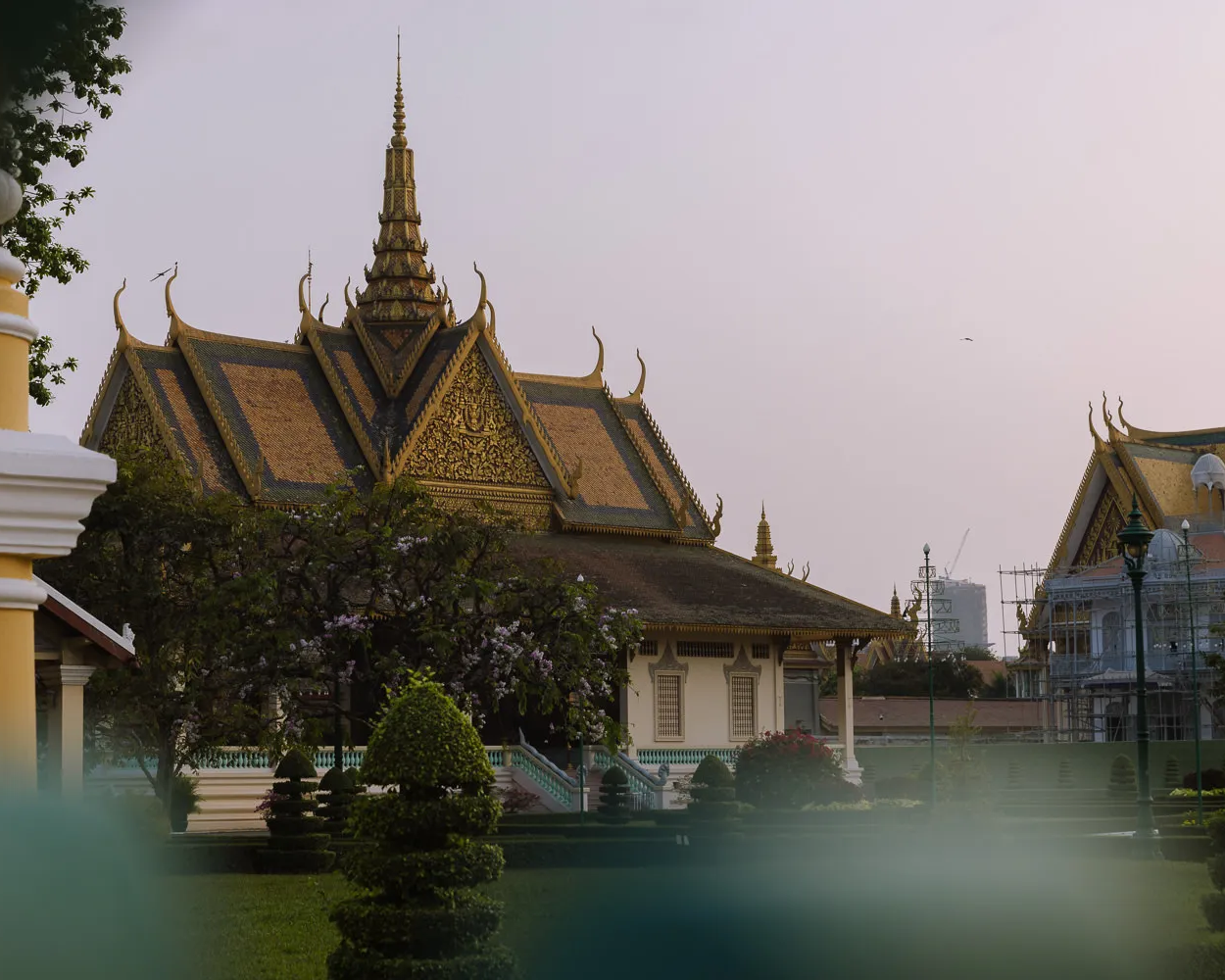
The Royal Palace is the official residence of the king. It’s a remarkable example of traditional Khmer architecture, and it’s probably the main tourist attraction in Phnom Penh.
As a royal residence, many areas are closed to the public, but you can visit the Throne Hall, used for official ceremonies. It has a 59-metre tower inspired by Bayon at Angkor Wat.
The other main highlight in the complex is the Silver Pagoda, named after the silver tiles covering the floor. Don’t miss the murals around the pagoda on the northwest side.
You need to adhere to the dress code to visit the palace: shorts that reach the knees and shirts that cover the elbows.


7. Wat Phnom & Wat Ounalom
Phnom Penh has several interesting temples that are worth visiting as you explore the city.
The main one you need to visit is Wat Phnom, which is located on the top of a grassy hill (Phnom means hill). It’s reached via a staircase adorned with lions and nāga (semi-divine, half-human, half-serpent creatures).
There’s often a great atmosphere at the bottom of the stairs with locals purchasing offerings to take to the temple.
It’s $1 to visit and, as with all temples in Cambodia, you need to take your shoes off to enter.
The second wat worth visiting is Wat Ounalom. This is the oldest Buddhist temple in Phnom Penh and the headquarters of Cambodian Buddhism. You’ll find lots of monks who live in the complex wandering around.


8. Koh Dach (Silk Island)
Koh Dach is a small island in the middle of the Mekong River, famous for its silk production.
You can visit on your own, but Silk Island is one of the few attractions we recommend seeing on an organised tour.
We took a boat tour that started with a relaxing ride down the river before dropping us off at Silk Island, where we learned about the tradition of silk-making.
You’ll be taken on a quick tour of the school before meeting the women who weave the silk. It was fascinating to watch them create intricate patterns on traditional looms and follow the silk process from worm to finished scarf.
There are toilets and a small hut selling drinks and snacks. Beer or soft drinks are included for free on the boat.
Book your Koh Dach tour online to avoid the hassle of the touts as you walk down the shorefront. The whole tour takes around 3 hours.


9. Phnom Penh’s Best Markets
Life in Phnom Penh happens in the markets. No visit would be complete without soaking up the atmosphere of the city’s vibrant markets. They are all a little different, but here are the ones we think you should visit.
Russian Market (Tuol Tom Poung)
The Russian Market is laid out under a patchwork of tin roofs with hundreds of stalls vying for space underneath. It got its nickname in the 1980s when Russian expats were among the most regular customers, and the name has stuck ever since.
There is a dense maze of stalls selling everything from silverware and jewellery to Buddha statues and vintage coins. Plus fresh food and vegetables, pig’s trotters and spices, car parts and wicker baskets.
The Russian market is a more local experience than the Central Market, which is more tourist-focused.
Russian Market Itinerary Suggestion // Visit Tuol Sleng in the morning, walk up to the Russian Market for lunch, then organise a tuk-tuk to the Killing Fields.


Orussey Market (Psar O’russey)
Orussey Market is the true local market in Phnom Penh, and there were almost no tourists when we were there. It’s the largest in the city – a sprawling three-storey concrete building near Monivong Boulevard in the heart of downtown.
The ground floor is fresh produce, meat, seafood, and street food. If you can arrive early in the morning, you’ll find restaurateurs and food stall owners stocking up for the day. It was a sensory overload, but we loved it.
The upper floors are clothing, fabrics, jewellery, tailoring supplies, soft furnishings, and electronics.

Central Market (Psar Thmei)
The Central Market, often referred to as the New Market, is an Art Deco landmark in Phnom Penh, shaped like a giant beehive. The huge domed hall is one of the largest in the world and acts to keep the market as cool as possible. The bright yellow colour means you can spot it from miles away.
There are 4 wings under the central dome, each of which specialises in different goods. Jewellery and gold are under the dome. Clothing, souvenirs, electronics, fresh produce, meat, and street food radiate out from there.
The Central Market is the most tourist-friendly, with higher prices, well-rehearsed bartering and more souvenirs.


10. Monuments of Phnom Penh
Phnom Penh is a proud city with several monuments to Cambodia’s independence from various occupiers. You don’t need long to see them, but they are worth picking up as you stroll around the city.
Independence Monument: Modelled on the central tower of Angkor Wat, the Independence Monument celebrates Cambodia’s independence from France. The design is beautiful, and it’s surrounded by a park, which is a nice place to relax.
Norodom Sihanouk: The 4.5-metre-tall statue of King Norodom Sihanouk is housed under a 27-metre stupa east of the Independence Monument.
Cambodia-Vietnam Friendship Monument: The Cambodia-Vietnam Friendship Monument was built in 1979 by the communist regime that took over after the country was liberated by the Vietnamese.


11. Bassac Lane & Langka Lane
Phnom Penh has a neighbourhood vibe with tree-lined streets and cafes housed in ramshackle buildings. Although it maintains the intensity of Asian culture for the most part, there are a few areas specifically aimed at tourists, which we loved.
Bassac Lane is the first of these. Also known as Street 308, it was a quiet residential lane that has been transformed into a hub for trendy dining and cocktails.
Try White Rabbit for a relaxed speakeasy, Mama Wong for excellent homemade noodles, Yacht Club for stylish cocktails, and Elia Greek Kitchen for some tasty Mediterranean food.
Just around the corner, Langka Lane is a tiny street with a smart collection of stylish Western bars. We loved the GroovyRoom lounge bar, TicTic for stylish cocktails and BattBong, a speakeasy hidden behind a Coca-Cola fridge.


12. Sunset River Cruise
A sunset cruise on the Mekong is a very cost-effective way to experience Phnom Penh from the river. See the lights of Phnom Penh fade and get a glimpse of local life from the other side of the Mekong.
All tours include unlimited beer and soft drinks, plus a seasonal fruit platter. Most will pick you up from your hotel, but you need to find your own way back.
Book your sunset river cruise here.
After the cruise, walk down to the Night market for dinner – a lovely way to cap off the evening in Phnom Penh.


13. Sora Sky Bar
Since our last visit a decade ago, rooftop bars have sprung up across the Phnom Penh skyline, the swishest of which is Sora Sky Bar. It’s set across a cantilevered terrace on the 37th floor of the Rosewood Hotel, and the views are spectacular, especially around sunset.
There are a few different spaces you can enjoy. Sip cocktails outside on the terrace, or cosy down in the library and try a sample from the largest collection of single malts in Cambodia.
Prices are expensive by local standards, but good value compared to what you’d pay in the West for a similar location. The dress code is smart casual.

Planning & Logistics
Getting to Phnom Penh
By Air
Phnom Penh International Airport (PNH) is Cambodia’s main international gateway, located around 10km northwest of the city centre — roughly a 20–40 minute drive depending on traffic.
There are no direct flights from the UK or Europe, so you’ll need a connecting flight through a major Asian hub.
The most common and convenient routes are via Bangkok, Singapore, Kuala Lumpur, or Ho Chi Minh City, with total journey times from the UK typically around 14–18 hours, including connections.
From the Airport to the City
- Grab or PassApp — the easiest option: book a fixed-price car or tuk-tuk in-app before you leave the terminal, with no fare negotiation needed.
- Official airport taxis — metered taxis line up outside Arrivals with set fares; expect around $9–12 to the city centre.
- City bus (Route 3) — the cheapest option at around $0.40, running from the airport along Russian Boulevard to the Night Market on Sisowath Quay. Slow but perfectly functional for independent travellers with light luggage.
From Siem Reap
We arrived in Phnom Penh from Siem Reap on the bus, and it was a very smooth and effortless journey. The bus takes around 6–7 hours and costs $10–12. It’s comfortable and air-conditioned, and you get meal service along the way.
You can also fly, but the flight time is just under an hour; by the time you factor in the time to get to and from the airport, it’s not really worth it.
From Ho Chi Minh City
The overland bus route from Ho Chi Minh City (Vietnam) to Phnom Penh is a popular backpacker connection, crossing at the Moc Bai/Bavet border and taking around 6–7 hours in total. Several operators run this route daily, with tickets typically costing $10–15.

Visas
Most nationalities — including UK and EU citizens — can obtain a Cambodian e-visa in advance online for $30, or a visa on arrival at the airport for $35. The e-visa is a single-entry 30-day stay and is valid for 3 months from the date of issue.
You need at least 6 months left on your passport and 2 full blank pages.
You also need to fill out an electronic arrival card 7 days before arrival via the Cambodia e-arrival website.
Where to Stay in Phnom Penh
Phnom Penh is made up of several distinct neighbourhoods, each offering something different.
For most visitors, we’d recommend Riverside. This is where all the main attractions are, including the palace, museums, and ornate temples.
The other area we like is Sangkat Voat Phnum – a small neighbourhood just north of Riverside. It is dominated by Wat Phnom, and it’s just around the corner from the Night Market.
We cover all the best areas with hotel recommendations in: Where To Stay in Phnom Penh.

How Long Do You Need?
We think two to three days is the sweet spot for most first-time visitors.
Two full days give you enough time to cover the major historical sites (Tuol Sleng and the Killing Fields deserve a full day between them), the Royal Palace and National Museum, and still have time to explore the riverfront and markets.
A third day opens up the city’s food scene, bar lanes, and the quieter neighbourhood temples at a more relaxed pace.
If you are planning a trip, you might find our Cambodia Itinerary useful.

When to Go
Phnom Penh is a year-round destination, but the dry season from November to April is the most comfortable time to visit, with clear skies and temperatures between 25°C and 35°C.
December and January are the peak months — pleasant weather but busier and slightly pricier.
If you want to avoid crowds, October and November offer a good balance: the rains are easing, the city is lush and green, and tourist numbers are lower.
Avoid August and September if possible — these are the wettest months, with rain on most days.

How to Get Around?
PassApp and Grab are the go-to ride-hailing apps in Phnom Penh — prices are fixed in-app, there’s no fare negotiation, and they work seamlessly for both tuk-tuks and cars. We can’t stress how useful these are in Cambodia.
Tuk-tuks are the classic Phnom Penh experience and ideal for shorter journeys. If you hail one on the street, always agree on a fare before you get in — a short trip should cost around $1–2
Walking works well for the main riverfront area and between Sisowath Quay, the Royal Palace, and the National Museum, which are all within easy reach of each other
For the Killing Fields, you’ll need a tuk-tuk or taxi — it’s around 15km from the city centre and costs approximately $15–20 return
Currency and Payments
US dollars are widely accepted and effectively the standard currency in Phnom Penh — most prices for tourists are quoted in USD. Cambodian riel is used for small change (4,000 riel ≈ $1). ATMs are widely available but typically charge a withdrawal fee.


More Guides to Plan Your Cambodia Trip
- Plan your trip using our Cambodia itinerary.
- See the best temples on the Angkor Small Circuit self-guided tour.
- How to spend 3 days in Siem Reap.
- Take a tour of the Tonlé Sap floating villages.
- See the best temples near Siem Reap.
- Find the best areas with our guide on where to stay in Phnom Penh.
- Enjoy a beach getaway on Koh Rong Samloem.

reader-supported
When you buy through links on our site, we may earn a small affiliate commission at no extra cost to you.
Thanks for your support // Paul & Mark