

By: Mark Barnes // Last Updated:
Rye is one of England’s finest medieval towns — cobbled lanes, ancient inns and a food scene that punches well above its weight. Here’s everything worth doing, eating and seeing.
Rye is unlike anywhere else in the southeast of England. A medieval hilltop town that time forgot.
It used to be a thriving harbour, but the river silted up years ago, leaving behind an untouched town two miles from the sea.
While the rest of the region changed around it, Rye stayed almost exactly as it was.
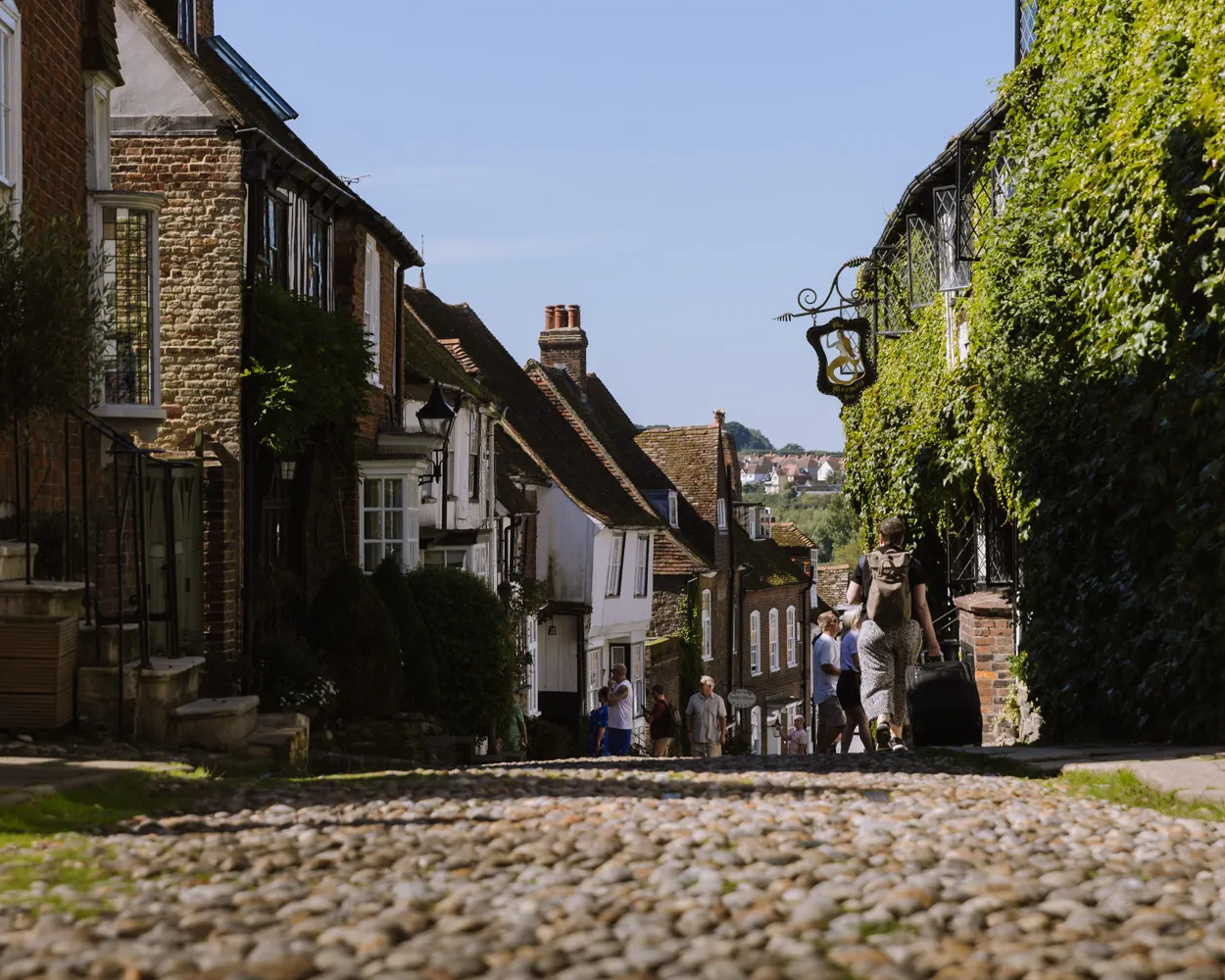
Cobbled lanes wind between half-timbered houses that have barely moved since the 15th century. Ancient inns serve real ales beneath oak beams.
Independent bookshops, record stores, and art galleries occupy buildings that would have been old when Shakespeare was alive.
We’ve been coming to Rye for years and it’s one of those places that gets better every time. The food scene has quietly become one of the best in the southeast, and the arts community is thriving.
This guide covers everything worth doing in Rye — from the medieval sights in the old town to the beaches, castles and nature reserves nearby — plus our honest recommendations on where to eat, drink and stay.


Why Visit Rye?
It’s one of the best-preserved medieval towns in England. York and Chester get more attention, but Rye is smaller, less touristy, and in some ways more authentic.
The food scene punches well above its weight. Locally caught fish, Romney Marsh lamb, and produce from the surrounding farms all feature heavily.
The independent shopping is genuinely special. Rye has resisted the chains almost entirely. The high street is a run of record shops, antique dealers, chocolatiers, art galleries and curiosity shops that you won’t find replicated anywhere else.
It has real character in every season. Summer brings festivals, beach days at Camber Sands, and long evenings in pub gardens. Winter transforms the town — log fires in the Mermaid Inn, fewer crowds, and a moody stillness to the cobbled lanes.
It works brilliantly as both a day trip and a weekend. Rye is just over 1 hour from St. Pancras Station in London. The medieval centre is compact enough to explore thoroughly in a single day. But the surrounding area — Bodiam Castle, Camber Sands, Rye Harbour Nature Reserve, Battle Abbey — makes a weekend great, too.
A Brief History of Rye
In the Middle Ages, Rye was one of the most important towns in England.
Before the country had a standing navy, the Crown relied on a confederation of five southeast harbours — the Cinque Ports — to supply ships and men in times of war.
In return, these towns were granted extraordinary privileges: exemption from taxes, their own courts, and the right to collect tolls. Rye joined the confederation in 1189 and grew wealthy and powerful as a result.
For two centuries, Rye was fortified, expanded, and fiercely defended. The walls, towers, and gates you can still see today were built during this golden age.
The town was also repeatedly attacked — most dramatically in 1377, when French raiders burned much of Rye to the ground and made off with the church bells from St Mary’s. The men of Rye sailed to France the following year and brought them back.
Then the harbour began to silt up.
By the late 16th century, larger ships needed deeper water and trade moved elsewhere. The Cinque Ports were called upon for the last time in 1596 to help repel the Spanish Armada, and then largely forgotten. Rye shrank, quietened, and stopped developing.
The result — entirely accidentally — is one of the finest medieval townscapes in England. Seven hundred years of history preserved not by grand design, but simply because nothing came along to replace it.

Map: Things to Do in Rye
Use our map to help navigate around Rye.
The best things to do are marked in red. Our favourite eating, drinking, and shopping spots are in purple, and our recommendations of where to stay are in brown.
Click on the top right corner to open our map in your Google Maps app. Click the star next to the title to save it to your Google account.
Best Things to Do in Rye
1.Landgate
Originally, four massive gates allowed access to the walled town of Rye.
Today only the Landgate remains. Constructed in 1329 it stands guard over the northern part of the old town.
The gate has two cylindrical towers connected by a chamber from where a portcullis used to drop to stop access over the drawbridge.
It’s easy to see how imposing the town walls must have been.

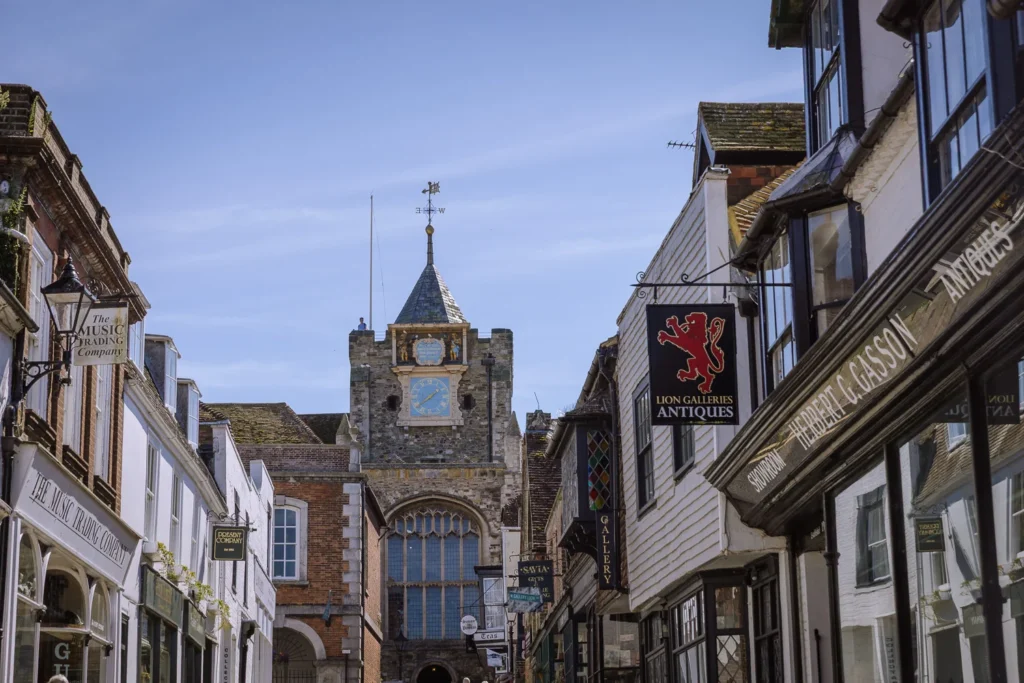
2.St Mary’s Church & Tower
St. Mary’s Church has been standing proudly on top of a hill in Rye for almost 900 years.
Built in the early 12th century, the church was severely damaged by fire and looted by the French in 1377. The following year, the men of Rye and Winchelsea sailed to France and recovered much of the loot including the church bells.
Today the church is a mish-mash of architecture from across the ages.
The highlight is the tower which contains the oldest church turret clock still functioning in the UK. The clock is second-hand and is thought to have originally been in Hampton Court Palace.
Climb the very narrow and steep staircase up the tower to get excellent views over Rye old town, Rye Harbour, and the Rother River.
On a clear day you can see all the way across the channel to France.
Details – The church is open from 9 am to 5:30 pm every in summer (until 4:30 pm in winter). It’s free to enter but £4 to climb the tower.


3. Church Square
Most visitors to Rye walk through Church Square without really stopping — which is a shame, because it’s one of the most quietly beautiful spaces in the town.
The square sits at the heart of the old town, framed on one side by St Mary’s Church and on the other by a run of characterful medieval and Georgian houses that have barely changed in centuries.
On a clear day with the light hitting the church tower and the old gravestones casting long shadows across the cobbles, it’s one of the most photogenic spots in England.
Sit down, take in the surroundings, and appreciate just how remarkably intact Rye’s medieval centre really is.

4.Ypres Tower
Ypres Tower (also known as Rye Castle) was originally built in the 13th or 14th centuries to defend the town and harbour.
As Rye’s influence waned, it became a prison and courthouse and then the town’s morgue.
Today it holds the Rye Castle Museum covering the history of Rye and the town’s maritime heritage. Exhibits include an old smuggler lamp, jackets of the Cinque Ports Volunteers, and medieval floor tiles.
There are also panoramic views from the tower.
Details – The museum is open from 10.30 am to 5 pm every day in summer (untill 3.30 pm in winter.) Entry is £5 but children under 16 are free.

5. Ypres Castle Inn Garden
Tucked below the walls of Ypres Tower and easy to miss if you don’t know it’s there, the castle inn garden is one of Rye’s best-kept secrets.
Step through the gate and you’ll find a terraced pub garden with uninterrupted views out over the Gun Garden, where cannons once defended the harbour.
On a clear day, the view across the flat expanse of the levels towards the coast stretches for miles.
The Ypres Castle Inn itself is one of Rye’s most characterful locals — unpretentious, properly pubby, and without the weekend crowds.
This is the spot we often end up at on a sunny afternoon in Rye. Pull up a bench, order a pint, and watch the light change over the marshes.
6.Mermaid Street
Narrow Mermaid Street highlights the timeless quality of the town and it’s one of the best things to do in Rye.
The charming, cobbled street is full of half-timbered houses and historic signs.
Don’t miss the Mermaid Inn, the House with Two Front Doors, and the Old Grammar School.
Mermaid Street is an Instagram favourite and one of the most photographed streets in the UK.


7.Lamb House on West Street
Another lovely lane in Rye is West Street.
The highlight is the National Trust-owned 18th-century Lamb House.
Built in 1723 by a wealthy wine merchant it has a rich history. King George I stayed here after his ship was washed ashore at nearby Camber Sands. It has also been the home of the mayor of Rye as well as famous writers such as Henry James & E.F. Benson.
Today Lamb House is a literary museum with exhibits to the writers who lived here.
Restored to its 1920’s appearance the house and walled gardens are both nice to stroll around.
Details – Lamb House is open from 11 am to 4.30 pm Friday to Tuesday. Entry is £9.40 for adults and £4.70 for children. National Trust members enter for free.

8.Rye Heritage Centre
To uncover 750 years of Rye’s history, head to the Rye Heritage Centre.
The “Story of Rye” is a 15-minute sound and light show that uses a model of the town to guide you through the cobbled streets as it tells stories of Rye’s past.
The centre also includes Vintage Penny Arcade machines in a space that has been made to look like a Victorian seaside pier. Games include Bellringers, What The Butler Saw and The Laughing Sailor.
£1 will buy you 7 old pennies to play on the machines.
Details – The Rye Heritage Centre is open from 10.30 am to 4.30 pm (Tue – Sat) and 1 pm to 4 pm (Sun). Entry is £4.50 per adult (£3 for children).

9.The Strand
Just near the heritage centre, there’s a small collection of shops in The Strand Car Park located in a historic building.
Halcyon Days has a large selection of vintage fabrics, haberdashery, furniture and much more.
At Mr Tods you’ll find weird and wacky homewares. This is a great place to pick up a quirky gift.
There’s also an art gallery, a few cafes and places to grab a cake or ice cream.


10.The Apothecary
To take a break from sightseeing in Rye, stop for a coffee at The Apothecary.
The cafe is in a 16th-century house where medicines were originally prepared and sold. It has been restored to its former glory but remains dilapidated in all the right places.
Bright red walls, torn leather sofas and mismatched chairs all add to the nostalgia.
Sink into a cozy nook and have a coffee among the old pharmacy shelves.
It’s not the place we’d recommend for lunch in Rye (see further down in this article for our food tips) but it’s a great place to sit and have a coffee.

11. Shop onRye High Street
One of the things that makes Rye unique is the excellent selection of independent shops in the compact old centre. Here are a few of our favourites.
Grammar School Records – Housed in an imposing red brick building, Gramma School Records has over 20,000 LPs in stock. They also have the largest selection of 8-track cartridges in the country.
Ashbees 100 – Showcasing contemporary artists, Ashbees 100 has quirky modern art using a wide range of materials.
Purdie Gallery – The Purdie Gallery is a great way to see the beauty of the area around Rye. David Purdie’s wonderful photographs can be bought on canvas or as posters.
Puckhaber Decorative Antiques – This mother-and-son business with over 30 years’ experience in decorative antiques, specialise in original painted furniture, period mirrors, and paintings.
Rye Chocolates – Rye Chocolates has the most innovative selection of chocolate flavours we’ve come across in a long time.


12.Kino Boutique Cinema
If you plan on staying the evening in Rye, check out what’s on at the Kino Cinema.
This boutique movie house has vintage vibes with state-of-the-art digital projection and sound.
There are 3 very cosy screens. The Red screening room has 96 seats, the Blue screening room 48 seats, and the Silver screening room has just 26 seats.
Weekly film programs start on Friday and are published at 4 pm the Tuesday before.
Given the intimate nature of the cinema, it’s a good idea to book ahead on the Kino Rye website.

13. Rye Harbour Nature Reserve
Rye Nature Reserve consists of 475 hectares of land on the East Sussex coast between Rye town and the English Channel.
Formed by the wind and sea pushing up great ridges of shingles, it’s a mosaic of different habitats. Saline lagoons and salt marsh sit side by side gravel pits and reedbeds.
This flat and wild landscape is home to more than 4,500 species of plants and animals. Three hundred of them are rare or endangered.
Over 100 different species of birds nest here. Try your luck photographing them from the ‘Little Red’ hut.
The Rye Nature Reserve Discovery Centre has information about the reserve and the wildlife. The modern building has toilets, a café, a helpful information desk, and expansive windows.
A series of walking trails head through the reserve. Our pick is the circular 3-kilometre route that goes past the birdwatching hides as it winds around the salt marsh. Pick up a map from the Discovery Centre. The walk takes about 1 hour.


14.Camber Castle
Camber Castle was built in the 16th century by King Henry VIII to protect the Sussex coast from a French attack.
Designed as a large artillery fort, a small central keep is surrounded by four circular bastions and a circular entrance bastion.
The castle is an intriguing shape but difficult to get to. Situated in the Rye Nature Reserve the nearest car park is over a mile away. It takes thirty minutes to walk to the castle, then thirty minutes to walk back again.
Our tip – If you don’t want to walk all the way, you can head out to a small wooden platform about 5 minutes’ walk from the parking location on the map above. There’s a view of the castle from over the reeds.

Where to Eat in Rye?
For a town of just 4,000 people, Rye has a food scene that would embarrass many cities. Local ingredients do a lot of the heavy lifting — Romney Marsh lamb, Rye Bay scallops, freshly caught fish from the harbour, and produce from the surrounding farms all feature heavily.
Coffee & Breakfast
The Apothecary – The most atmospheric café in Rye, housed in a 16th-century apothecary with bright red walls, torn leather sofas and shelves still lined with old pharmacy jars.
The Fig – The café attached to The Fig hotel is one of the best spots in Rye for breakfast or lunch. Excellent coffee, seasonal ingredients, and a room that manages to be both buzzy and relaxed.
Whitehouse Rye Bakery – The bakery attached to Whitehouse Rye hotel on the high street turns out excellent pastries. We often stop here, pick up something decadent and go sit on a bench in Church Square.
Lunch & Dinner
If you are coming in the summer or on long weekends, it would be wise to book in advance.
Fletcher’s House – A wonderfully old-school dining room on Lion Street serving modern British food at very reasonable prices. The building itself — low beamed ceilings, uneven floors — is part of the experience.
Mermaid Inn – A 13th-century historic inn packed with old-world charm. Choose between a casual lunch in the bar with a real fire under old oak beams, or a white tablecloth affair in the dining room. Even if you don’t eat, it’s a great place for a pint.
Globe Inn Marsh A short walk out of the old town but worth the detour, particularly on a fine day when the terrace comes into its own. The menu is small but interesting, with a strong focus on local ingredients.experience.
Landgate Bistro – Ranked as the best restaurant in Rye for six years in a row, Landgate Bistro serves British food with a classic or modern slant. Their ingredients come from local fields, woodlands, and waters.


How Long to Spend in Rye
All the main attractions in Rye’s medieval town centre can easily be seen on a day trip. However, there are many sights nearby, which make Rye an excellent weekend break. It is particularly easy to visit from London.
London to Rye by train – Rye is a 1-hour 10-minute train ride from London St Pancras Station. The train leaves hourly and requires a change at Ashford International train station. Rye Station is a 5-minute walk from the town centre.
London to Rye by car – It takes roughly 2 hours to drive from central London to Rye. Times can vary substantially as traffic in and around London can be very slow. There are many car parks around the medieval centre and a large car park by the train station.
Day Trip Itinerary
Morning – Start at the Landgate — it’s a five-minute walk from the train station and a fitting introduction to the town’s medieval past. Grab a morning coffee at Apothecary then head straight to St Mary’s Church. Climb the tower for views over the rooftops.
Make your way to Ypres Tower for a look around the castle and its small museum, and then take a seat in Church Square and admire the surrounding buildings.
Lunch – For an excellent light lunch, head to The Fig on the High Street. For the full pub experience, try the Mermaid Inn.
Afternoon – After lunch, explore West Street and Lamb House — the National Trust property is at its best in the afternoon light. Then head down cobbled Mermaid Street to the Strand to explore the local stalls and Rye Heritage Centre for the Story of Rye.
End the day perusing in the independent stores on the High Street and surrounding area, before grabbing a pint in the Mermaid or Castle Inn.


Weekend Itinerary
Day One — the Medieval Town
Follow the day trip itinerary above for your first day. With a full day rather than a train to catch, you can move at a more relaxed pace. We recommend the Landgate Bistro for dinner – but be sure to reserve in advance.
Day Two – Choose Your Adventure
For history: Battle Abbey & Bodiam Drive the 30 minutes to Battle for one of the most significant historical sites in England. The audio guide around the 1066 battlefield is genuinely atmospheric, and the ruins of Battle Abbey make a striking backdrop.
Then drive the 15 minutes to Bodiam Castle. One of our favourite castles in England. The moat, the drawbridge, and the portcullis look exactly as a medieval castle should. The National Trust tearoom does a good lunch.
For the outdoors: Rye Harbour Nature Reserve & Camber Sands Walk the circular route through Rye Harbour Nature Reserve in the morning — allow around an hour — then either walk to Camber Castle or drive the 10 minutes to Camber Sands for a lazy afternoon on one of the finest sandy beaches in the southeast
Practical note — A car makes the second day significantly easier. If you’re relying on public transport, the Rye Harbour Nature Reserve and Camber Sands are both reachable by bus from Rye town centre, making that the best car-free option for day two.


Best Time to Visit Rye
Rye is a genuine year-round destination worth visiting any time. But there are a couple of festivals you may want to time your trip for.
September brings the Rye Arts Festival, the town’s flagship cultural event, which fills the churches, galleries and historic buildings of Rye with theatre, music, visual art and literature over two weeks.
In August, the Rye Jazz & Blues Festival fills the streets, courtyards and venues of the old town with live music across a long weekend.

Where to Stay in Rye
The timeless architecture provides some unique places to stay in Rye. Here are our favourites.
WHITEHOUSE RYE – A boutique hotel in a grand house on Rye High Street. Whitewashed walls and exposed beams are complimented with modern furniture. Breakfast is a treat from their award-winning bakery.
THE FIG – This lively café with rooms is a trendy stay right on the high street. An excellent breakfast is served in the cafe before it opens to the public.
MERMAID INN – This historic inn dates to the 13th century. Wonky walls, sloping wooden beamed ceilings, four-poster beds, and buckets of old-world charm. Set on Mermaid Street, it couldn’t be in a prettier location.
THE GALLIVANT – Set behind the dunes of Camber Sands Beach, this stylish beach hotel is a glorious retreat from everyday life. Super chilled yet luxurious, it’s a great place to hang out and take strolls along the beach.


More Day Trips
- Pick from one of our 20 curated day trips from London.
- See the achievable highlights on our 1-day Cambridge itinerary.
- Enjoy a medieval weekend break with our Rye day trip.
- Hit the beach on a relaxing day out in Brighton.
- Explore the rich history on our Canterbury day trip from London.
- Scoff the freshest oysters with our Whitstable day trip.
- Enjoy the regal side of life with our Bath day trip itinerary.
- Pick from one of our 10 Cotswolds day trip ideas.
- Hike the white cliffs on our Seven Sisters day trip.

reader-supported
When you buy through links on our site, we may earn a small affiliate commission at no extra cost to you.
Thanks for your support // Paul & Mark