

By: Paul Healy // Last Updated:
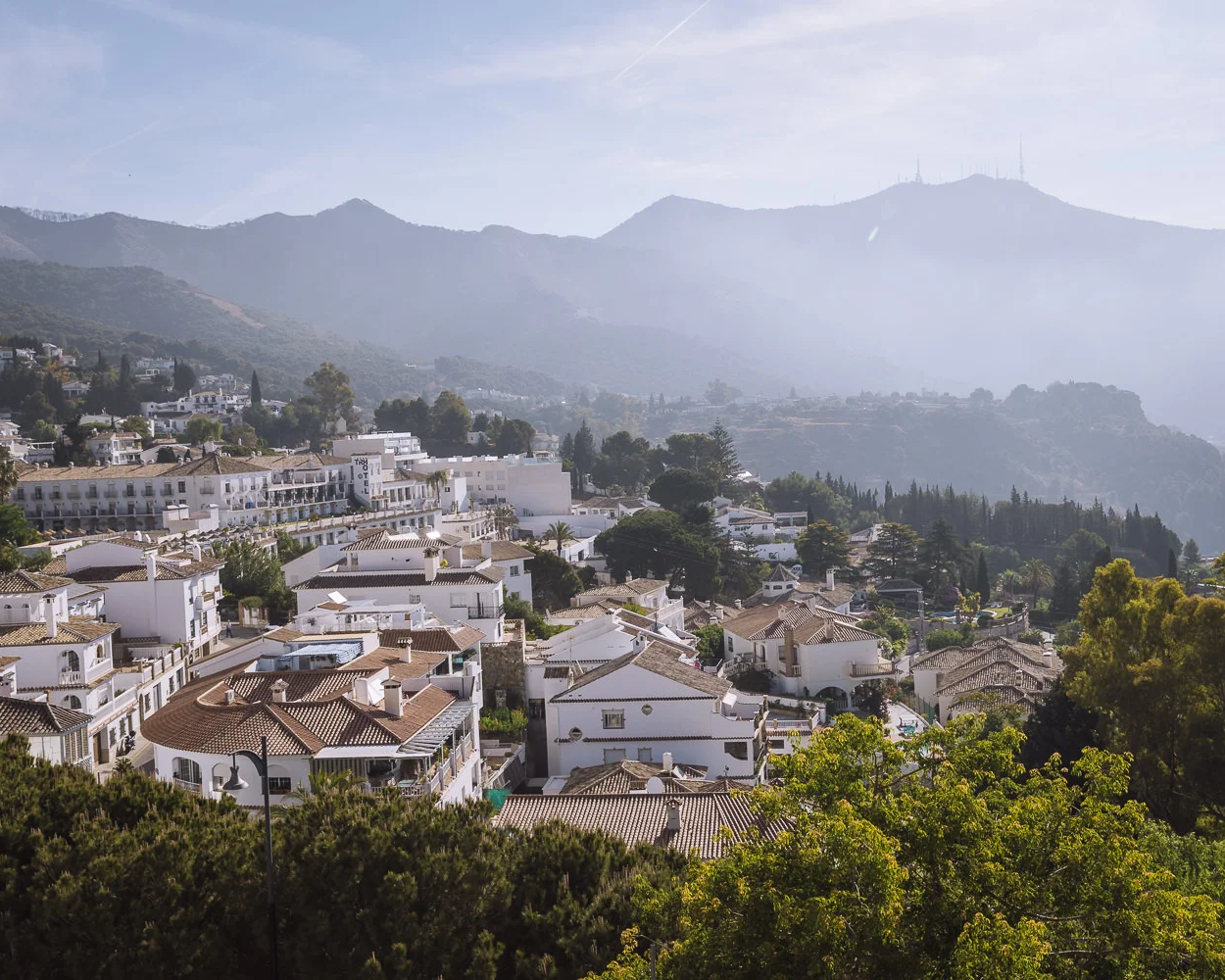
Due to its close proximity to Málaga, Mijas is one of the region’s most-visited white villages. Collect the best viewpoints and enjoy a slice of village life with our guide to the best things to do in Mijas on a day trip.
Mijas is a white village high above the Costa del Sol in southern Spain.
Like many villages in the area, Mijas has a long history.
A Moorish Castle occupied the village from the 8th to the 15th century. In a prime location high above the coast, the remains of the castle today provide one of the best viewpoints along the Costa del Sol.
Before this, the Romans used Mijas as an important trading link on the road between Málaga and Cadiz.
Today, a day trip to Mijas from Málaga is one of the most popular excursions on the Costa del Sol.
It’s the easiest way to see one of the white villages if you are based around Málaga or Marbella. This makes it very popular with tour groups and can get busy, but it’s a beautiful village with many interesting things to do.
If you have more time, read our driving route of the White Villages, which includes a few less-visited, but no less charming, villages in the hills of Andalucía.


Practical Information
Where Is Mijas?
Mijas Pueblo is 428 metres above sea level on the Costa del Sol, around 8 kilometres from Fuengirola. The main airport, Málaga Costa del Sol, is 25 minutes away by car.
How to Get to Mijas
Mijas is a 30-minute drive from Málaga, making it a perfect day trip. Driving yourself to Mijas via the AP 7 toll road is very easy. Select Mijas Pueblo on Google Maps or in your car SatNav to ensure you end up in the right village.
Unfortunately, getting to Mijas via public transport is difficult, but there is a regular bus service from Fuengirola if you are based there.
If you don’t have your own car and you’re not based in Fuengirola, a private tour is the best way to see it. We have some tour options below.
Where to Park
As you drive into Mijas, you’ll notice there is a lot of off-street parking. If you arrive early in the day, this is a good option.
However, it fill up quickly and we normally head straight to the multi-story car park. It’s easy to find and get into, and it’s located right near the Tourist Information office. We have marked it on the map below and you’ll find it the perfect place to start exploring Mijas if you’re doing it as a 1-day itinerary.
The car park has toilets.

Tours to Mijas
As mentioned above, the easiest way to get to Mijas is on a private tour. Most likely you’ll be coming from Málaga, where tours will pick you up, drive you to Mijas and drop you back.
Here are a few we recommend.
Mijas, Puerto Banús & Marbella (Viator) – This tour departs from Málaga, Torremolinos, Fuengirola, or Marbella and includes stops at Mijas, Puerto Banús, and Marbella, the area’s three best day trip destinations.
Mijas, Puerto Banús & Marbella (Get Your Guide) – This tour only departs from Málaga, but it includes a bit more time in Mijas before going on to Marbella and Puerto Banús.
Hotel pick-up from Málaga or Marbella (Viator) – This tour will pick up from any hotel in Málaga or Marbella and includes transport in a comfortable, air-conditioned minivan, and a guided walking tour of Mijas.
Private Group Tour (Get Your Guide) – If you are with a group, this private tour for up to 8 people includes hotel pick-up in Málaga and a guided tour with a certified historian in Mijas.


Tours in Mijas
If you are happy to make your own way to Mijas but would still like to enjoy the experience of an expert guide, here are some tours in the village we recommend.
Chocolate Factory (Viator) – This very well-rated tour visits the Mayan Monkey chocolate factory and includes a hands-on chocolate-making experience and plenty of tastings.
Panoramic Tuk-Tuk Tour (Viator) – This comprehensive tour on an eco-friendly electric Tuk-Tuk is a great way to see the best of Mijas and take in the panoramic views.

Best Things to Do in Mijas – Day Trip Itinerary
We’ve listed the attractions below in the order you should see them in, so this guide works as a 1-day walking route.
The route starts at the top of the village near the car park, then you’ll work your way through the village finishing near the best viewpoints.
1. Ermita de la Virgen (Chapel of the Virgin of the Rocks)
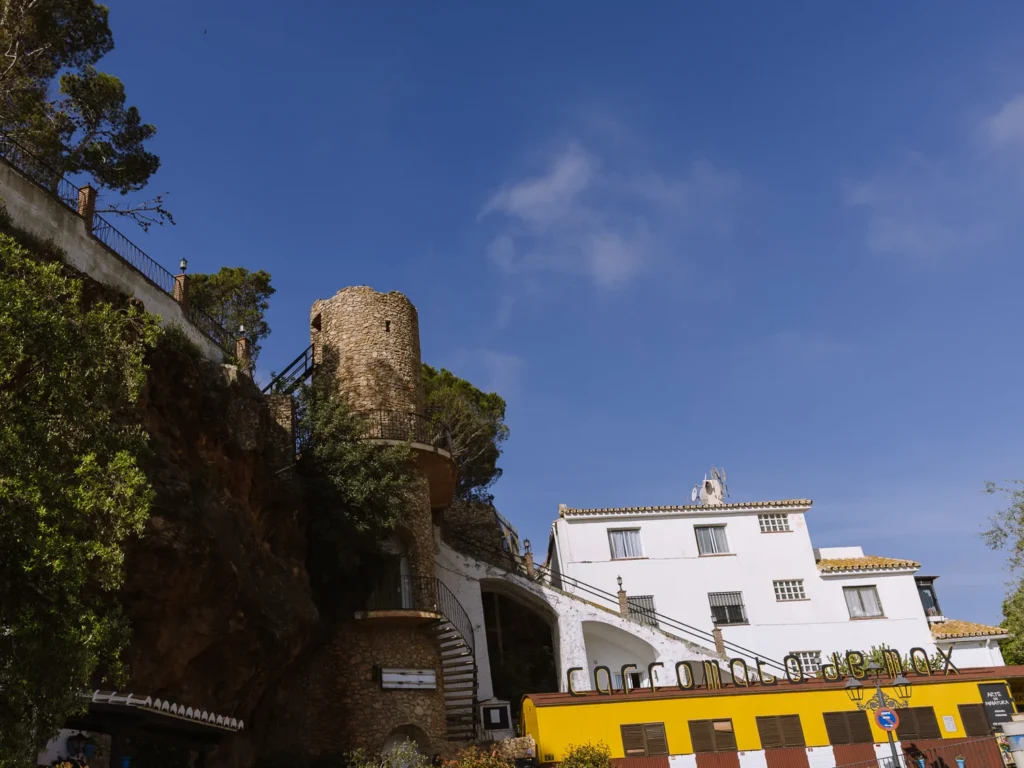
From the tourist office, head over to the Chapel of the Virgin of the Rocks — it’s right next to El Compás, one of the best viewpoints in the village and a great place to get your bearings before you start exploring.
The chapel itself was carved directly into the rockface in the 17th century. It’s small inside, but beautifully preserved, with religious artefacts and the much-venerated image of the Virgin of the Rock — the patron saint of Mijas.
It’s free to enter and only takes about 10–15 minutes to look around.


2. Flour MILL & Miniature Museum
From the Ermita, follow the path along the viewpoint terrace — the views from here are genuinely spectacular, with Fuengirola and the Costa del Sol coastline stretching out below you. It’s one of the best photo spots in Mijas, so don’t rush past it.
At the end of the terrace you’ll find two of the village’s more quirky attractions sitting side by side: the Flour Mill and the Miniature Museum.
The Miniature Museum is housed in a bright yellow caravan, includes Leonardo da Vinci’s Last Supper painted on a grain of rice, fleas dressed in tiny costumes, and a handful of other curiosities that are hard to explain but genuinely worth a look.
The Flour Mill next door is a recreation of a traditional Andalusian mill, with authentic old machinery that gives you a sense of how the village used to operate. It’s mildly interesting if you have the time, but on a tight day trip schedule it’s probably the one stop we’d say is skippable.
3. Plaza de la Constitución
From the Miniature Museum, follow Avenida del Compás down to Plaza de la Constitución — the main square of Mijas Pueblo.
Fair warning: this is where the tour groups tend to congregate, so if you’ve timed your arrival well and beaten the morning rush, make the most of it. By mid-morning it can get busy, and the square is small enough that a couple of coach parties make it feel crowded quickly.
It’s still worth lingering for a few minutes though. Check out the central fountain, which is made from rocks recovered after a devastating landslide in 1884 that killed a number of local residents.
There’s a great lookout point just behind the plaza. It’s easy to miss but it gives you a completely different angle over the rooftops and down towards the coast.

5. Mijas Fortress
From Plaza de la Constitución, it’s just a short walk up to the Mijas Fortress.
Built during the Middle Ages, the original fortification was largely destroyed over the centuries, but what’s been preserved and landscaped in its place is a lovely spot to explore.
Today it’s a walled garden, with a paved path that winds past ornamental water features and fountains, framed by the old fortress walls. The views from the fortress are about as good as it gets in Mijas.
You don’t need more than 15–20 minutes to walk through, but the combination of the old stone walls, the greenery, and that coastal backdrop makes it one of the best photo spots in the village.

5. The Bullring
From the fortress, it’s a short walk down to one of Mijas’ most unusual landmarks, the Bullring.
Built in 1900 and whitewashed to blend in with the houses around it, the Plaza de Toros de Mijas is oval rather than the traditional circle, purely because that was the only way it could fit into the tightly packed hillside.
It’s an interesting piece of architecture, and getting a shot of the whitewashed walls and the rocky hillside backdrop is very Mijas.
If you want to go inside, entry is €4 and it’s open daily from 10:30am to 7pm. Inside you’ll find a small museum with bullfighting memorabilia and costumes.

6. La Muralla (Fortress Walls & Botanical Gardens)
Continuing from the bullring, the old fortress walls stretch along the clifftop and form the boundary of the Botanical Gardens.
The gardens have been designed to make use of the natural contour of the walls, with planting chosen to keep colour in the beds year-round.
The walls pass along the edge of deep gorges cut into the cliff face, and the drop on one side gives you a real sense of just how high up in the hills you are.
We’ll be honest: when we visited, the gardens were looking a little tired after a dry spell, and they didn’t quite live up to the photos.
But the views over the Costa del Sol are hard to argue with.
It’s free to enter, takes around 15–20 minutes to stroll through at a relaxed pace.

7. Calle San Sebastián
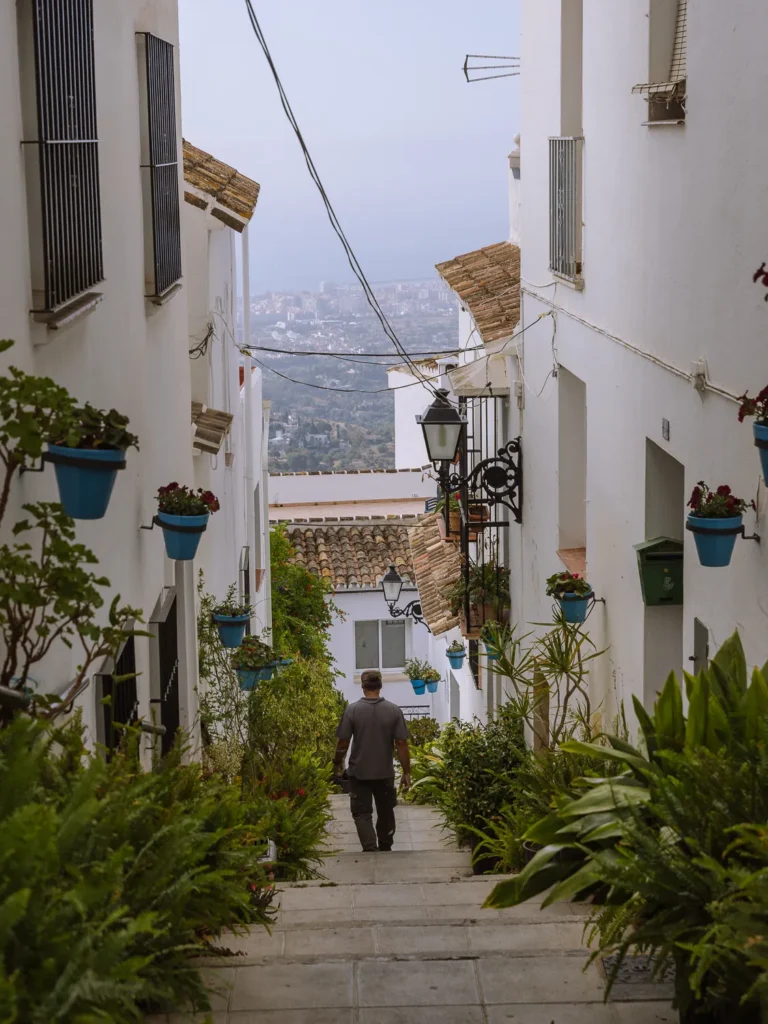
From the Botanical Gardens, make your way towards Calle San Sebastián, taking a slight detour via Calle del Pilar. This is a narrow staircase street that climbs steeply up the hillside, with potted plants stacked on the incline. It’s a classic Andalusian scene.
Calle San Sebastián itself is the most photographed street in Mija. The lane is narrow, with each window ledge and doorway is decorated with terracotta pots.
If you want a clean shot without other tourists in it, early morning is your best chance — by late morning it’s one of the busiest spots in the village.
There are a handful of small cafés along the street where you can grab a coffee and sit in the sun, which makes it a natural place to take a break mid-way through the day.
On the corner, the San Sebastián Chapel is worth a look as well.


8. Calle Málaga
After Calle San Sebastián, Calle Málaga feels like a different side of the village entirely.
It’s the main commercial street in the village, lined with boutiques, craft shops, and souvenir stores. If you’re looking for a gift idea that’s a step above the usual tourist tat, this is a good place to find it.
One stop we’d specifically recommend is Sabor a España, a family-owned shop dedicated to nuts, dried fruits, and traditional Spanish treats.
A bag of their roasted almonds or a jar of local honey is a much better souvenir than a ceramic donkey.
It’s a short street and you won’t need long here — 20 to 30 minutes is plenty unless you’re a serious shopper. But it’s a natural transition between the sightseeing part of your day and the eating and drinking that follows.


9. Contemporary Art Centre
Tucked a little further along Calle Málaga, we almost walked past the Contemporary Art Centre but we’re glad we didn’t.
For a small village gallery, the collection punches well above its weight. There’s a dedicated room housing 15 works by Picasso who was born just up the coast in Málaga.
There’s also a room of Dalí pieces that we really loved.
A third room rotates temporary exhibitions, so there’s a reasonable chance you’ll see something different from us depending on when you visit.
At €3 entry it’s one of the easiest decisions of the day. It’s quiet, it’s cool inside (a welcome break if you’re visiting in summer), and it takes around 20–30 minutes without feeling rushed.


10. Town Hall & Plaza Virgen de la Peña
From the Contemporary Art Centre, follow the road around to the Town Hall. The classic Andalusian facade is worth a quick shot.
The Plaza Virgen de la Peña is just beyond the Town Hall.
This is where locals actually gathef for markets, festivals, and cultural events. We happened to arrive during a Cheese and Wine festival, which came with a free flamenco performance in the square.
If you’re visiting in early September, the Fiestas Patronales in honour of the Virgen de la Peña take place here.
Even on a normal day with nothing on, it’s a lovely square to finish your sightseeing at.
There are several cafés with outdoor seating around the perimeter, and after a full morning on your feet, sitting down with a coffee or a cold beer and watching village life go by is a pretty good way to spend half an hour.
It’s also right next to the best restaurant options in the village. (More about those below)


Where to Eat in Mijas
As a tourist favourite, there are plenty of places to eat in Mijas.
You could head to the restaurants below Plaza de la Constitución, which have wonderful views over the coastline. You’ll get tourist-targeted food, but the views might be worth it.
The other option is to plant yourself in any of the squares around town and people while you have lunch.
But after several visits, we recommend Restaurant Pampa Tablas y Tapas for the best food we’ve had in Mijas. They have excellent sharing boards, some tapas options, and delicious Thai-inspired specials.


Where to Stay in Mijas
Mijas is best explored as a day trip, so you’ll probabaly find yourself based in nearby Málaga, Marbella, or Fuengirola — all within easy driving distance. If you are still looking for somewhere, read our guide on where to stay in Málaga.
That said, if you want to wake up in the village itself and beat the day-trip crowds, there are some excellent options right in Mijas Pueblo.
€ | TRH Mijas – Set on the hillside just a short walk from the village centre, TRH Mijas is a well-reviewed 4-star hotel that regularly comes in at surprisingly affordable rates, especially outside of peak summer.
€€ | ILUNION Hacienda de Mija – Sitting on a quiet hillside between Mijas and Fuengirola, the ILUNION Hacienda de Mijas has outdoor pools, a sauna, and a fitness centre.
€€€ | Opuntia Boutique Hotel – If you want the ultimate Mijas experience, look no further than the Opuntia Boutique Hotel, housed in a restored 18th-century building right on Plaza de la Constitución in the heart of the village.

Best Time to Visit Mijas
Spring (March–May) is the best time to visit Mijas. Temperatures are warm and comfortable (typically 18–24°C), the wildflowers on the hillside are in full bloom, and the village hasn’t yet been hit by the full wave of summer tour groups.
Summer (June–August) is the busiest time with most intense heat. Mijas sits at altitude which helps, but midday temperatures can still push well above 30°C.
Autumn (September–October) is another excellent window. The summer crowds thin out, the light is golden and beautiful for photography, and it’s when most of the festivals take place.
Winter (November–February) is quiet, cool, and more relaxed. Many of the cafés and restaurants remain open year-round, and on a clear winter’s day the views from the mirador are exceptional.
But, We Didn’t Mention the Donkey Taxis
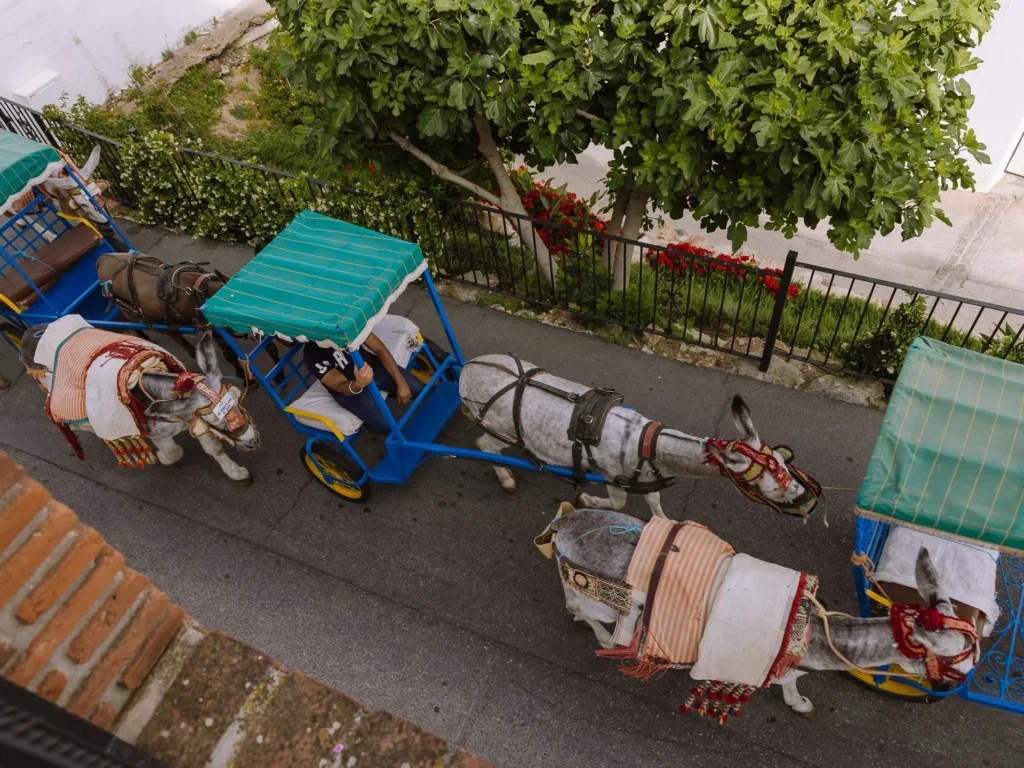
You can’t visit Mijas without noticing the donkeys. They’ve been a fixture of the village since the 1960s, when the service was created to ferry tourists around. They remain one of the most photographed sights in Mijas Pueblo today.
However, we’d encourage you not to take a ride.
The donkey taxi service has been at the centre of a sustained and well-documented animal welfare controversy for several years.
Animal rights organisations have repeatedly raised concerns about the conditions these animals work in, including long working hours, restricted movement due to short tethering ropes, overcrowded stables, inadequate shade.
In July 2025, donkeys were filmed working during an officially declared heat alert, in breach of newly introduced municipal rules. As recently as May 2026, fresh protests were held in the village calling for the service to be permanently ended.
More Andalucía Guides
- Spend a glorious 3 days in Seville, the capital of Andalucia.
- How to plan a day trip from Seville to Córdoba.
- Our guide to Málaga includes the best things to do, top beaches and great day trips.
- See the Alhambra with our guide to visiting Granada.
- Take a road trip through these beautiful white villages in Andalucía.
- How to visit Ronda on a day trip from Seville or Málaga.
- Read up on the best things to do in Cádiz.
- See the incredible history of the region in our 2-day itinerary for Córdoba.
- Hike the stunning Garganta Verde.
- Find secluded beaches near Tarifa ideal for kite-surfing or bum-sitting.
- Visit more interesting places in Andalucía.
- Read about all the best things to do on the Costa del Sol.

reader-supported
When you buy through links on our site, we may earn a small affiliate commission at no extra cost to you.
Thanks for your support // Paul & Mark